Category:
Book ReviewsProfiles in Cowardice Review: Democracy's Reckoning
Prices can sometimes be lower on bigger marketplaces, but this link helps independent bookstores and local reading communities.
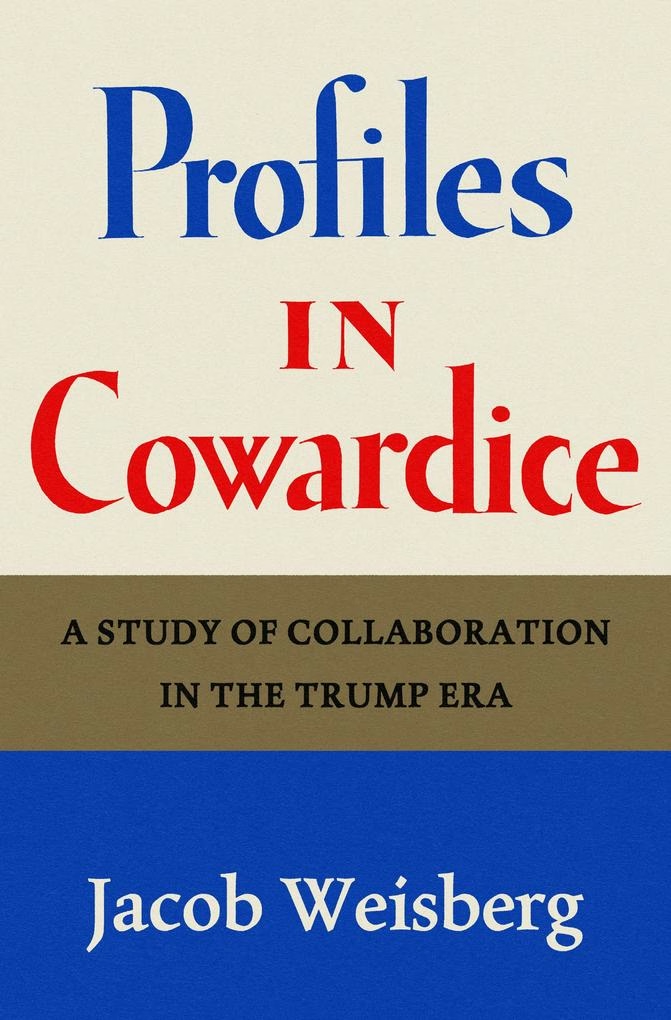
Jacob Weisberg's Profiles in Cowardice: A Study of Collaboration in the Trump Era arrives as one of the most unflinching examinations of institutional failure in contemporary American politics. This is not a book that pulls punches or offers comfortable narratives about resistance. Instead, Weisberg methodically dissects how eight powerful individuals—titans of finance, law, journalism, and government—abandoned their principles when authoritarianism demanded a choice. The verdict is brutal and necessary: this is essential reading for anyone seeking to understand how democracies erode from within, not through violent revolution, but through the calculated cowardice of those who know better.
What This Book Actually Does
Unlike many political screeds that rely on outrage, Weisberg's approach is forensic. He profiles eight individuals across distinct power centers: Jeff Bezos (Big Tech), Stephen Schwarzman (Wall Street), Brad Karp (Big Law), Mitch McConnell (Senate), John Roberts (Supreme Court), Megyn Kelly (Journalism), George W. Bush (Republican establishment), and others representing higher education and the executive branch. Each profile operates as a case study in rationalization—how intelligent, successful people construct justifications for abandoning their stated values.
The genius of Profiles in Cowardice lies in its structural clarity. Rather than offering a sprawling narrative that demands 500 pages of context, Weisberg delivers eight equally-weighted chapters, each examining one sector of American institutional life. This architecture makes the book digestible without sacrificing depth. Readers can absorb the specific dynamics of why a federal judge capitulates differently than a tech billionaire, yet recognize the common psychological mechanisms at work.
The Framework That Cuts Through Noise
Weisberg identifies five principal factors driving institutional collapse: peer pressure, fear of ostracization, fear of violence, financial incentives, and institutional self-preservation. This taxonomy is genuinely useful—it moves beyond simplistic "good vs. evil" framing into the actual mechanics of moral failure. He pairs this analysis with five countervailing strategies for resistance: pre-thinking your principles, building resistance habits, demonstrating everyday decency, providing institutional leadership, and strategic public shaming.
This dual framework transforms the book from memoir into something closer to a field manual. Readers aren't just observing failure; they're receiving a blueprint for recognizing and resisting similar pressures in their own contexts.
Where the Book Excels
The chapters on Mitch McConnell and John Roberts stand out as masterclasses in political biography. Weisberg traces McConnell's decades-long transformation from someone who occasionally resisted Republican orthodoxy into a man who essentially abdicated his constitutional responsibilities. The Roberts chapter similarly exposes how judicial philosophy became a convenient mask for political capitulation. These profiles work because Weisberg doesn't simply condemn; he traces the incremental decisions and rationalization patterns that led these figures to their breaking points.
Megyn Kelly's profile also resonates powerfully, illustrating how even those positioned to speak truth to power—journalists with massive platforms—succumbed to self-preservation instincts. The chapter demonstrates that cowardice isn't confined to backroom dealing; it plays out in real-time, on screens, normalized through repetition.
The book's opening acknowledgment deserves mention: Weisberg concedes that none of us truly knows how we'd respond under extreme pressure until we face it. This grace note prevents the book from becoming self-righteous, which is crucial for its credibility.
What Doesn't Quite Land
The Jeff Bezos chapter feels more biographical than incisive. Weisberg chronicles Bezos's empire-building and his relationship with Trump, but the profile lacks the contextual punch of the McConnell or Roberts chapters. It reads as though Weisberg struggled to connect Bezos's specific capitulations to broader technological power dynamics in ways that illuminate systemic failure.
The George W. Bush profile similarly veers toward personal narrative rather than structural analysis. While Bush's complicated relationship with Trump is worth examining, the chapter sometimes prioritizes biographical detail over the kind of institutional critique that makes other sections sing.
Some readers may also find the book's scope limiting. With only eight profiles across dozens of potential subjects, Profiles in Cowardice necessarily omits significant actors. The selection, while defensible, invites questions about who else might have warranted inclusion and why these eight represent the most consequential failures.
How It Compares
If you've read Profiles in Courage—Kennedy's 1956 meditation on senators who risked their careers for principle—Weisberg's title is deliberately ironic. Where Kennedy celebrated moral courage, Weisberg catalogs its absence. The structural homage works, though readers should understand this isn't a direct sequel or counterargument. Instead, it's a companion piece examining what happens when institutions lack the kind of courageous leadership Kennedy celebrated.
Compared to other Trump-era political analysis, Profiles in Cowardice differs significantly from books like Frankly, We Did Win This Election or I Alone Can Fix It, which focus more on electoral mechanics or White House intrigue. Weisberg's work is more philosophical and systemic—it's asking fundamental questions about how power operates rather than chronicling specific events.
Who Should Read This
Perfect for: Readers seeking serious political analysis without partisan cheerleading. Anyone interested in institutional failure, the psychology of moral compromise, or how democracies actually deteriorate. Educators looking for case studies in ethical decision-making. Anyone who's asked themselves, "Why didn't they just refuse?" about powerful figures during recent political crises.
Will frustrate: Readers seeking partisan validation or Trump-bashing for its own sake. Those wanting a comprehensive historical narrative rather than focused case studies. Anyone uncomfortable with books that implicate institutional systems rather than offering simple villain-identification. Readers who prefer their politics delivered with more rhetorical fire and less analytical precision.
The Enduring Value
What makes Profiles in Cowardice particularly important is its refusal to treat these failures as historical artifacts. Weisberg frames his profiles as mirrors, asking readers to examine their own silences and thresholds for action. This transforms the book from political critique into something more personal and unsettling—a challenge to recognize similar pressures and rationalizations in our own lives.
The book arrives at a moment when democratic backsliding remains a genuine threat globally. Whether readers are American or international, the mechanisms Weisberg identifies—how institutions bend under pressure, how fear operates, how rationalization functions—carry universal relevance.
Final Verdict
Profiles in Cowardice is a necessary, well-constructed examination of institutional failure during America's most destabilizing recent period. While not every chapter achieves equal impact, the overall framework and analysis justify the book's existence and its demands on the reader's attention. Weisberg has created something rarer than partisan critique: a serious work of political analysis that respects reader intelligence while refusing moral compromise.
Is Profiles in Cowardice worth reading? Absolutely—particularly if you're interested in understanding not just what happened during the Trump era, but why so few resisted, and what that reveals about power, fear, and institutional integrity. This is the kind of book you'll return to when confronting difficult questions about your own complicity and courage.