Category:
Book Reviews¿Por qué son tan lindos los caballos? Review
Quick Verdict
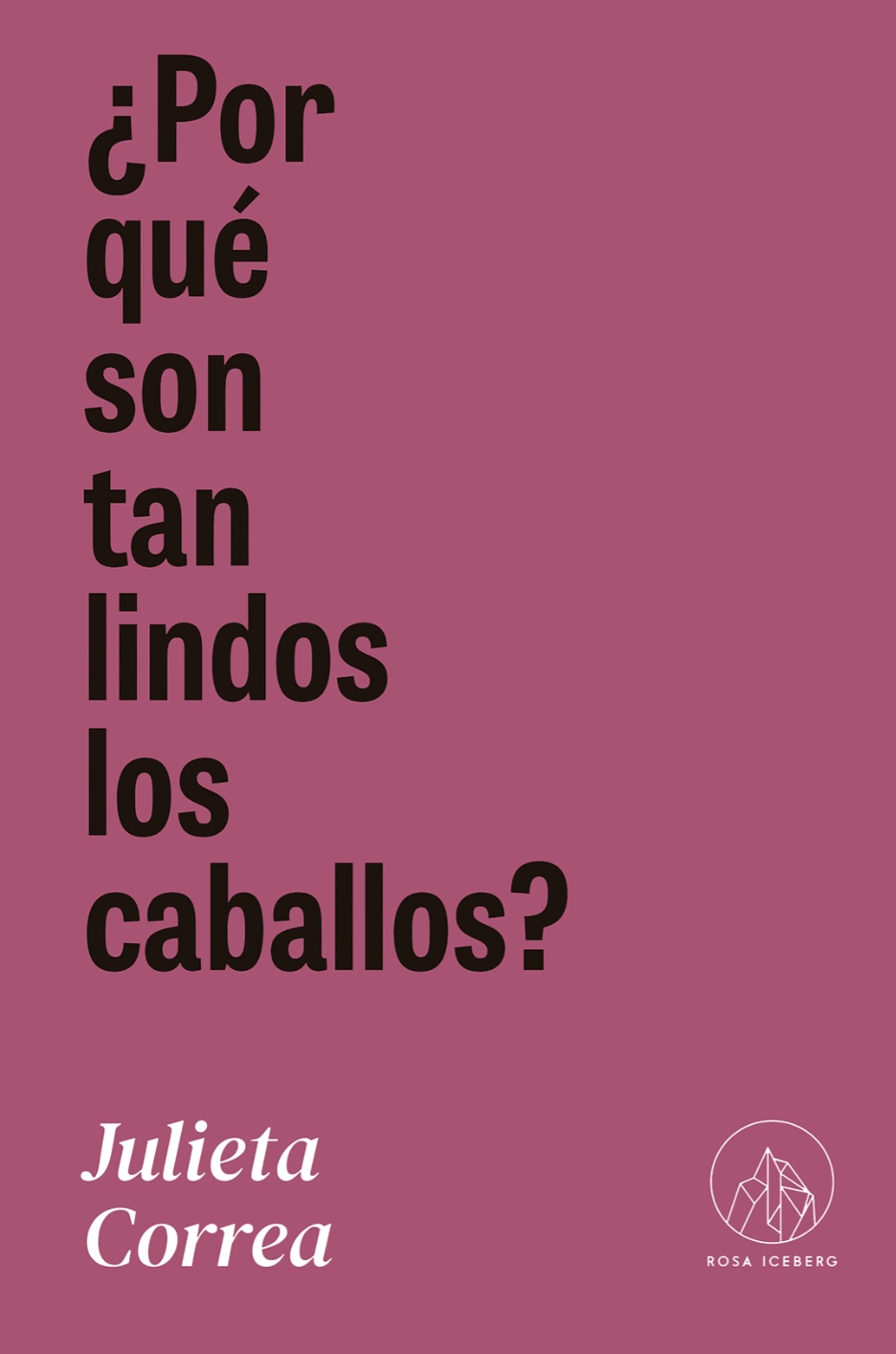
¿Por qué son tan lindos los caballos? by Julieta Correa is a devastating yet vital portrait of maternal dementia that transcends grief literature by insisting on life. This is not a book about dying—it's about the excruciating beauty of losing someone who's still breathing. At 4.3/5 stars across thousands of readers, it's polarizing precisely because it refuses easy emotional catharsis, instead offering something rarer: honest documentation of a daughter watching her mother dissolve into a stranger who still laughs.
What This Book Actually Is
Correa's debut operates as something between a fragmented diary, a collage of overheard conversations, and a love letter written in real time. The premise is deceptively simple: as her mother Sari descends into dementia, the narrator records everything—the funny non-sequiturs, the repeated questions, the moments of sudden clarity, the gaps where language used to live. But the execution is anything but simple.
This isn't memoir in the traditional sense. There's no three-act structure, no redemptive arc where the daughter learns to accept her loss. Instead, Correa builds the book like she describes her mother becoming: fragmented, non-linear, held together by desperate attention rather than narrative convention. Short chapters—some barely a paragraph—accumulate like evidence at a crime scene. The crime? Time.
The Writing: Precision in Collapse
What distinguishes Julieta Correa's approach from other dementia narratives is her refusal to sentimentalize. The prose is sharp, almost clinical in places, then suddenly tender. She captures Sari mid-sentence, mid-thought, the way dementia actually works—not as a graceful fade but as linguistic chaos. Words interrupt themselves. Sentences loop back. The narration mirrors the subject.
Readers consistently report stopping every few pages to cry, which speaks to the emotional precision of the writing. This isn't manipulation; it's accuracy. Correa has found the exact language for watching someone you love become unreachable. One reader described it as "writing with urgency," as if racing to capture Sari's words before they vanish entirely. That urgency lives in every sentence.
The book's title itself—a question Sari asks repeatedly—becomes a meditation on beauty, loss, and the arbitrary details that survive when everything else collapses. It's absurd and profound simultaneously, which is exactly how dementia functions for families living through it.
What Works: The Collage Method
Correa's structural choice to avoid linear narrative actually becomes her greatest strength. By assembling fragments—diary entries, overheard dialogue, neighborhood scenes, repeated phrases—she creates something that feels more true to experience than any chronological account could. This is how memory actually works when you're in crisis: in flashes, contradictions, loops.
The book refuses self-pity, which is its ethical core. There's pain here, yes—genuine, physical pain. But the narrator doesn't ask for sympathy. Instead, she documents. She witnesses. She honors Sari not by smoothing out the difficult parts but by preserving them exactly as they occur. One reader noted the book contains "moments of laughter amid the devastation," and this tonal range feels earned rather than forced.
Correa also succeeds in something technically difficult: making the reader care about Sari as a person, not just as a symbol of loss. We learn about her life in Spain, her love for her dog, her television habits, her humor. The dementia doesn't erase these details; it scrambles them, preserves them in strange combinations. Sari remains vivid even as she becomes unreachable.
The Comparison: How It Stands Against Similar Works
If you've read works like Reliquia (which one reader mentioned reading immediately before this book with devastating results), you know the territory. But where some dementia narratives lean toward philosophical acceptance or spiritual resolution, ¿Por qué son tan lindos los caballos? refuses both. It's closer in spirit to Nora Rabinowicz's Madre Robot—both are about daughters documenting mothers in states of disintegration—but Correa's approach is more fragmented, less explanatory.
This book doesn't provide the comfort of understanding. It provides the comfort of being witnessed.
What Doesn't Work (For Some Readers)
The fragmented structure, while powerful, isn't for everyone. Readers seeking narrative momentum or clear emotional progression will find this book frustrating. There's no climax, no resolution where the daughter accepts her mother's condition or finds peace. The book simply stops, like Sari's words simply stop.
The short chapters can feel gimmicky if you're not attuned to what they're doing. Some readers might interpret the form as stylistic affectation rather than necessary expression. Additionally, the book's emotional weight is relentless. There's no breathing room, no subplot to lighten the mood. It's 200 pages of concentrated grief and love, which some readers will find exhausting rather than cathartic.
For those expecting a traditional narrative arc or a clear "lesson" about dementia, this book will disappoint. Correa isn't interested in explaining dementia or making sense of it. She's interested in documenting what it feels like to live inside it.
Who Should Read This
Perfect for:
- Anyone who has experienced dementia in their family and needs to see their experience reflected without sentimentality
- Readers interested in experimental or fragmented narrative forms
- People seeking literature about grief that refuses easy answers
- Those who appreciate formally innovative work that serves emotional truth
- Readers of contemporary Spanish literature looking for fresh voices
Skip if:
- You need narrative comfort or clear resolution
- Dementia narratives feel too close to home right now
- You prefer linear storytelling with clear character arcs
- You're looking for practical advice about caregiving
- You want literature that ends with acceptance or spiritual growth
The Real Question: Is It Worth Reading?
Yes, absolutely—but with the caveat that "worth" here means something different than entertainment or escapism. ¿Por qué son tan lindos los caballos? review discussions consistently highlight that this is a book that changes how you think about memory, language, and what we owe to people we love. It's worth reading because it does something most literature doesn't: it honors the irreducible strangeness of human experience.
The book's 4.3-star rating across thousands of readers reflects genuine consensus, not just polite appreciation. Readers are moved, shaken, transformed. Some report being unable to write about it for days after finishing. That's not hype; that's evidence of real impact.
Julieta Correa has written something necessary. Not comforting, but necessary. In an era where grief narratives often perform resolution, ¿Por qué son tan lindos los caballos? insists on the permanence of loss, the ongoing nature of mourning, and the stubborn refusal to stop paying attention to people even when they stop being able to meet us halfway.
Final Verdict
8.5/10 — A formally brilliant, emotionally devastating portrait of dementia that refuses sentimentality and insists on the strange beauty of what remains when language fails.