Category:
Book ReviewsPeck & Peck Review: Witty But Frustratingly Unfocused
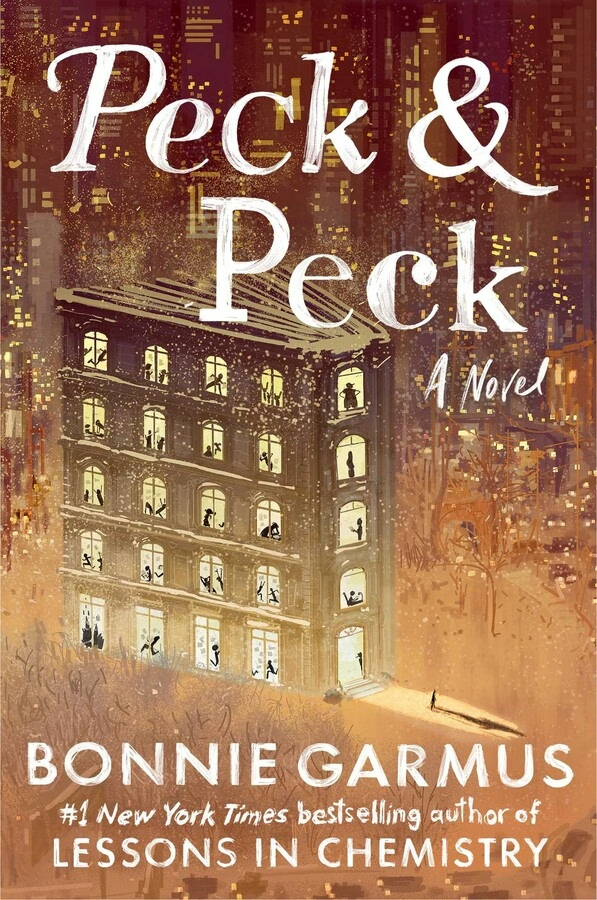
Prices can sometimes be lower on bigger marketplaces, but this link helps independent bookstores and local reading communities.
Bonnie Garmus's second novel, Peck & Peck, arrives with considerable expectations trailing behind it. The author who delivered the runaway success of Lessons in Chemistry returns with a story about poetry, ambition, and the messy internal politics of a prestigious literary institution. Yet this Peck & Peck review reveals a book that sparkles with clever writing but stumbles under the weight of its own indecision about what story it actually wants to tell.
Let's establish the core tension immediately: Peck & Peck by Bonnie Garmus is a novel about the power of words that somehow underutilizes poetry itself. It's a coming-of-age story featuring a protagonist who doesn't particularly grow. It's a workplace drama that moves glacially for two-thirds of its length before suddenly accelerating. These contradictions aren't accidental—they're fundamental to understanding whether this book deserves your time.
What You're Actually Getting Into
Batter Gray, named after his mother's heroic dog and an identical twin who died at birth, is a young man adrift in New York City. He loves poetry with an almost religious devotion, yet he can't write it himself. This distinction matters enormously, and it's where Garmus plants the seeds of her protagonist's central conflict: passion without talent, enthusiasm without capability.
When Batter lands a job in the copy room at Peck & Peck—a secretive, prestigious quarterly poetry journal run by the notoriously abusive Salton Peck—he enters a world of institutional dysfunction. The firm is populated by editors battling between artistic integrity and commercial viability, between preserving poetry's sanctity and acknowledging its limited market appeal. Batter becomes entangled in office politics, workplace hierarchies, and the slow-burn mystery of what actually happens at this strange company.
The novel functions as both workplace satire and literary coming-of-age story, though not always smoothly.
Where Garmus's Wit Shines Brightest
No honest Peck & Peck review can ignore what Garmus does exceptionally well: her prose voice is consistently engaging and frequently hilarious. The author understands that a novel about the importance of words must itself weaponize language with precision and purpose. She delivers punchlines that land because they're grounded in genuine observation about human nature, ambition, and the absurdity of institutional life.
The humor works best in dialogue between Batter and his mother, a typesetting designer whose conversations about letterforms, kerning, and the visual architecture of language provide unexpected charm. These scenes sparkle with warmth and specificity. The office dynamics occasionally crackle with tension and dark comedy as well—the contrast between poetry-loving editors and those who view the journal as a business obligation creates genuine dramatic friction.
Garmus's thematic exploration of duality—right versus wrong, truth versus lies, acceptance versus rejection—resonates throughout. The dead twin serves as a constant metaphor for the multiple perspectives embedded in every situation. This structural choice gives the narrative an intellectual backbone that elevates it beyond simple workplace fiction.
The Substantial Problems Beneath the Surface
Yet this is where a critical Peck & Peck review must acknowledge what readers have consistently noted: the book's pacing is genuinely problematic. Nothing substantial happens for the first 70% of the narrative. Batter drifts through his job, observing very little, understanding even less, and passively accepting whatever situation presents itself. He's pushed around by stronger personalities and only realizes what's actually happening around him when other characters explicitly explain it to him.
This wouldn't be fatal if the protagonist demonstrated growth or self-awareness, but he largely doesn't. Batter remains fundamentally clueless throughout most of the novel. He's not thoughtfully naive or charmingly oblivious—he's simply a vessel through which events happen rather than a character who drives them. The reader experiences his bewilderment rather than his agency, which creates emotional distance precisely when the narrative needs intimacy.
The novel's central promise—that poetry matters, that words hold the key to human survival—gets lost in the institutional drama. There's surprisingly little actual poetry in the book. References abound, discussions about poetic forms proliferate, but the reader hungry for the transformative power of verse itself will feel shortchanged. Garmus tells us poetry is important rather than showing us why through the poems themselves.
Salton Peck, the antagonistic editor-in-chief, also strains credibility. That talented editors and writers would tolerate his constant verbal abuse, his screaming, his admitted hatred of poetry itself, requires suspension of disbelief that the narrative doesn't earn. Even within the logic of the novel, his continued employment seems inexplicable.
The Ending Arrives Too Late
When the plot finally accelerates in the final 20% of the book, resolution comes swiftly and tidily. The pacing whiplash—glacial for hundreds of pages, then suddenly resolved—feels like a different novel entirely. Readers report feeling relief that "things will turn out o.k.," but this relief stems from the book finally ending rather than from genuine emotional satisfaction.
Compare this to Garmus's debut: Lessons in Chemistry maintained momentum throughout while juggling multiple timelines and complex character development. That novel made its protagonist's journey feel inevitable and earned. Peck & Peck feels more like a first draft that needed another revision pass to either accelerate the middle sections or deepen Batter's character arc substantially.
Who Should Actually Read This
This book is perfect for readers who value clever, witty prose above all else and who don't require tight plotting or consistent pacing. If you loved Lessons in Chemistry and want more of Garmus's voice regardless of structural concerns, you'll find enough to enjoy here. Readers interested in literary industry satire and workplace dysfunction will appreciate the institutional critique.
Skip Peck & Peck if you want a protagonist who actively shapes events, if you expect consistent pacing, or if you're reading specifically for poetry content. This isn't a novel that will frustrate you if you approach it as a slow character study with occasional humor rather than as a propulsive narrative. But if you're expecting the same narrative momentum and character development that made Lessons in Chemistry a phenomenon, you'll find yourself disappointed.
The Verdict
Is Peck & Peck worth reading? It depends entirely on your tolerance for witty writing that isn't matched by equally strong plotting. Garmus remains a writer of considerable talent—her prose is never less than engaging, and her thematic concerns about art, commerce, and human connection matter. But this novel is her most uneven work, a book that knows how to make readers smile but struggles to make them care deeply about its protagonist's journey.
The novel works best as a meditation on institutional absurdity and the tension between artistic purity and commercial reality. It works least well as a coming-of-age story or as a celebration of poetry's transformative power. Readers who can compartmentalize these elements and appreciate what works while forgiving what doesn't will find an entertaining, if ultimately slight, reading experience.