Category:
Book ReviewsOperation Bounce House Review: Ambitious but Uneven
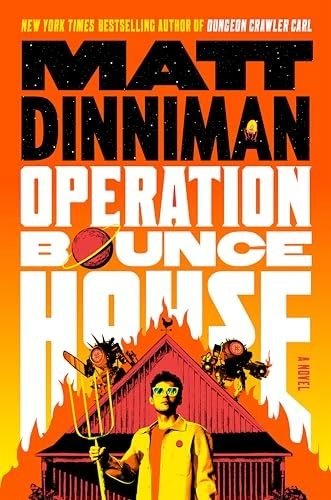
Prices can sometimes be lower on bigger marketplaces, but this link helps independent bookstores and local reading communities.
Matt Dinniman's Operation Bounce House is a science fiction novel that swings for the fences—and sometimes connects, sometimes whiffs entirely. The premise alone is audacious: Earth's government hires a corporation to evict colonists from another planet, but instead of deploying traditional military forces, they monetize the invasion by turning it into a video game. Bored gamers pay premium rates to pilot war machines remotely and annihilate an alien settlement for entertainment. It's a concept that crackles with satirical potential and genuine menace.
Yet this Operation Bounce House review reveals a book that doesn't quite deliver on its provocative setup. With a 3.89/5 rating across 40,000+ readers, the novel has polarized audiences in ways that tell us something important: Dinniman's ambition occasionally outpaces his execution.
What It's About
The story follows Oliver Lewis, a rancher on the colonial world of New Sonora who just wants to tend his family's land, play music with his band, and keep aging agricultural robots functional. When Earth finally reopens the transfer gate after decades of isolation, Oliver expects reconnection and prosperity. Instead, the Apex Corporation arrives with a sinister agenda: clear the colonists through a profitable game that turns real warfare into interactive entertainment for paying customers.
Oliver becomes an unlikely resistance leader, armed with his grandfather's old book and salvaged technology, defending his home against machine-piloting gamers who view the conflict as a premium gaming experience. The collision between colonial survival and Earth's gamification of violence forms the novel's thematic core.
The Concept: Where It Shines
Dinniman's central idea deserves credit—it's genuinely unsettling and timely. The novel weaponizes our understanding of video game detachment and corporate profit motive, asking uncomfortable questions about how we dehumanize distant conflicts when they're framed as entertainment. This mirrors contemporary anxieties about drone warfare, remote violence, and the psychological distance technology creates between actions and consequences.
The worldbuilding around New Sonora feels lived-in and immersive. Dinniman constructs a believable colonial society with its own culture, technology, and social dynamics. The details matter here—the aging bot infrastructure, the family ranch economy, the band subplot—these ground the story in specificity rather than generic sci-fi trappings.
Character chemistry among Oliver's core group generates genuine warmth. The relationships feel earned and the banter occasionally lands with real humor, balancing the darker thematic elements. Readers consistently praise the emotional depth beneath the action-adventure surface.
Where the Execution Falters
Here's where Operation Bounce House review scores become revealing: the book's pacing is erratic. Multiple readers describe stretches of exposition and dialogue that feel necessary but exhausting. The novel asks you to track complex details—technical specifications, political maneuvering, character backstories—and while this level of detail appeals to some readers, others found themselves grinding through sections that prioritized worldbuilding over momentum.
The action sequences, which should be the novel's centerpiece, arrive infrequently and lack the visceral intensity the premise promises. When combat does occur, it sometimes feels more like a tactical briefing than a gripping confrontation. For a book that positions itself as an epic sci-fi thriller, the stakes can feel surprisingly muted. The psychological distance Dinniman explores thematically—the detachment of gamers piloting machines—occasionally becomes the reader's experience too.
Character development is uneven. While some secondary characters shine, Oliver himself remains somewhat reactive, responding to events rather than driving them. His arc doesn't quite achieve the transformation the narrative seems to promise. This matters because Operation Bounce House asks readers to invest deeply in his journey, yet he sometimes feels like a vessel for the plot rather than its engine.
Writing Style: Readable but Dense
Dinniman's prose is competent and frequently engaging, but the novel suffers from information overload. Conversations often function as exposition delivery systems rather than organic character moments. The author trusts his readers to track numerous plot threads, technical details, and world-specific terminology—which is admirable but occasionally exhausting.
The humor works better than expected. Dinniman intersperses genuine comedy throughout, particularly in how the gamers approach the conflict with gaming logic applied to real warfare. This tonal balance between comedy and existential threat is one of the book's strengths, even if it doesn't always land perfectly.
Comparisons to Similar Works
If you've read Ready Player One by Ernest Cline, you'll recognize Dinniman's interest in gaming culture meeting reality. However, where Cline leans into adventure-fantasy escapism, Dinniman attempts something darker—a critique of gamification rather than a celebration of it. The comparison isn't entirely fair, though, because Operation Bounce House is more serious-minded about its satirical elements.
The novel also echoes Ender's Game by Orson Scott Card in its exploration of remote warfare and the moral implications of treating conflict as a game. However, Card's novel maintains tighter focus and clearer thematic payoff. Dinniman's ambition sometimes exceeds his structural control.
Who Should Read This
Perfect for: Readers who loved Dungeon Crawler Carl and want to explore Dinniman's range. Science fiction fans interested in near-future satire and corporate villainy. Readers who appreciate character-driven narratives and don't mind slower pacing if the worldbuilding is rich. Anyone interested in thoughtful exploration of how technology distances us from violence.
Will likely disappoint: Readers seeking constant action and high stakes. Those fatigued by dense exposition and technical detail. Fans of fast-paced space opera who want plot to dominate character moments. Anyone expecting the book to match the energy of Dinniman's previous work.
The Verdict
Operation Bounce House is worth reading if you approach it with calibrated expectations. It's not a failure—it's an ambitious novel that occasionally stumbles under its own ambition. The core concept is genuinely compelling, the worldbuilding is solid, and the thematic exploration of gamified violence feels urgent. But the execution doesn't always match the promise.
Is Operation Bounce House worth reading? Yes, particularly if you appreciate character work and thematic depth over relentless pacing. Just understand that this is a slower-burn narrative that asks patience. Dinniman proves he can write compelling science fiction beyond his established success, even if this particular entry doesn't quite reach the heights it aims for.
The novel's polarized reception isn't a mystery—it reflects genuine differences in reader priorities. Some will find the depth rewarding; others will wish for more velocity. That's not a flaw; that's just how ambitious, uneven books work.