Category:
Book ReviewsOne Man In Review: A Gripping Firsthand Account
Prices can sometimes be lower on bigger marketplaces, but this link helps independent bookstores and local reading communities.
Quick Verdict
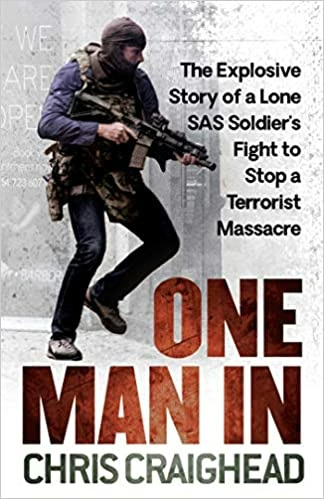
One Man In by Chris Craighead is a visceral, minute-by-minute account of a British SAS soldier's solo intervention during a terrorist attack on a Nairobi hotel complex. This book delivers exactly what its subtitle promises: an explosive firsthand narrative that reads like a real-world Die Hard scenario. The critical question isn't whether Craighead's story is compelling—it undeniably is—but whether you're prepared for the polarizing cultural conversation that surrounds it.
What It's About
On a seemingly ordinary morning in Nairobi, Kenya, off-duty special forces operative Chris Craighead receives a phone call that changes everything. Armed terrorists have launched an assault on the DusitD2 hotel and office complex in the city's Westgate neighborhood. Within minutes, Craighead is racing toward the gunfire with his weapons case in tow, beginning a 22-hour ordeal that would test every ounce of his nearly three decades of elite military training.
What unfolds is a taut, real-time chronicle of tactical decision-making under extreme pressure. Craighead navigates an active combat zone, repeatedly entering the building under fire, systematically neutralizing threats, and orchestrating the evacuation of hostages. The narrative alternates between the immediate crisis and carefully woven flashbacks to his military development, creating context for how a single trained operative could influence such a catastrophic situation.
The Writing & Storytelling
Craighead's prose is direct and unadorned—exactly what you want from a tactical memoir. He doesn't waste time on literary flourishes; instead, he builds tension through concrete detail and chronological precision. The pacing is relentless, mirroring the psychological experience of operating in a hostile environment where every decision carries lethal consequences.
The structural choice to intercut battlefield narrative with biographical material works well. Rather than front-loading his entire military history, Craighead reveals relevant training and experience precisely when it illuminates his tactical choices. This approach keeps the narrative momentum while grounding his actions in genuine expertise.
The book reads quickly—most readers report finishing it in one or two sittings. This isn't a sprawling military epic; it's a tightly constructed crisis narrative that respects the reader's time while delivering substantial content.
What Works Exceptionally Well
Tactical authenticity is the book's greatest strength. Craighead doesn't oversimplify the complexity of operating in an unfamiliar building against multiple armed opponents. He describes the genuine uncertainty, the tactical trade-offs, and the moments where luck intersects with training. This specificity is what separates the book from generic action narratives.
Verifiable facts anchor the narrative. Unlike some military memoirs that blur reality for dramatic effect, Craighead's account is corroborated by extensive video footage, news documentation, and testimonies from Kenyan authorities and survivors. This transparency is crucial for a book making such extraordinary claims.
The human dimension prevents the book from becoming a sterile tactical breakdown. Craighead captures the psychological weight of making life-and-death decisions for strangers, the moral clarity of facing an unambiguous threat, and the aftermath of violence. He doesn't shy away from the emotional reality of combat.
Comparative context matters here. Unlike Chris Kyle's American Sniper, which operates at a remove through a scope, or Mark Owen's No Easy Day, which focuses on large-scale military operations, One Man In presents a singular, localized crisis resolved through individual agency. This makes it more immediately gripping than books structured around broader military campaigns.
What Falls Short
Some readers will find the biographical sections feel slightly disconnected from the main narrative. While Craighead's military background is relevant, the book occasionally pauses its momentum to explore childhood experiences or pre-SAS training that, while competently written, doesn't quite achieve the narrative urgency of the Nairobi siege itself.
The book also leaves certain questions unanswered. Readers interested in the legal complications surrounding publication, the geopolitical implications of a foreign operative's intervention, or deeper analysis of the counterterrorism response would find these areas underdeveloped. The focus remains deliberately narrow—on Craighead's personal experience rather than systemic analysis.
For readers seeking extensive detail about the terrorist organization or the broader security failures that enabled the attack, this book won't satisfy that curiosity. Craighead maintains focus on actionable intelligence and immediate tactical response rather than investigative journalism.
The Polarization Problem
This One Man In review must address the elephant in the room: the book has become unexpectedly controversial, not for its narrative quality but for its cultural optics. Some readers celebrate Craighead as an unambiguous hero who risked his life to save strangers. Others dismiss the narrative as a "white savior" story packaged for Western audiences.
This tension is worth understanding. The facts are documented: Craighead did intervene, he did neutralize attackers, and he did facilitate evacuations. Video evidence corroborates the core narrative. Whether one celebrates this as heroism or examines it through a critical lens about Western intervention in African contexts is genuinely a matter of interpretive framework, not factual dispute.
What's important for potential readers: this book doesn't exist in a political vacuum. Your reaction to it will likely depend on your existing perspectives about military intervention, race, and heroism narratives. Neither celebration nor criticism is inherently invalid; they're simply different interpretive lenses applied to documented events.
Who Should Read This Book
Perfect for: Military memoir enthusiasts, readers who loved American Sniper or Lone Survivor, anyone interested in real-world crisis response, tactical decision-making under pressure, and firsthand accounts of extraordinary circumstances. If you appreciate precise, action-driven narratives over philosophical reflection, this is your book.
Also works for: Readers who don't typically engage with military non-fiction but appreciate tightly plotted thrillers. The narrative momentum carries you forward regardless of your usual genre preferences.
Probably not for: Readers seeking extensive geopolitical analysis, those uncomfortable with military narratives generally, or anyone looking for a book that interrogates rather than chronicles events. If you prefer reflective, morally ambiguous narratives, this straightforward account may feel too uncomplicated.
Comparison to Similar Works
If you've read American Sniper by Chris Kyle, One Man In operates in similar territory but with crucial differences. Kyle's memoir unfolds across years and multiple deployments; Craighead's compresses extraordinary intensity into 22 hours. Kyle's narrative is about sustained combat operations; Craighead's is about singular crisis response. Both are page-turners, but they satisfy different narrative appetites.
Compared to No Easy Day by Mark Owen (the Navy SEAL account of the Osama bin Laden raid), One Man In is more intimate and localized. Owen's book operates at the scale of military operations; Craighead's is personal and immediate. Both offer tactical authenticity, but One Man In achieves greater immediacy through its narrow focus.
The Verdict
Is One Man In worth reading? Yes, unequivocally, if you appreciate well-executed military narratives grounded in verifiable events. Craighead's account is tense, competently written, and genuinely gripping. It delivers on its promise of a firsthand crisis narrative without sensationalizing or fabricating details.
The book's value isn't diminished by the cultural conversation surrounding it. Rather, that conversation makes it more interesting—a text where narrative quality and interpretive framework don't necessarily align. You can acknowledge Craighead's tactical competence and heroic intervention while simultaneously questioning what it means when Western military expertise becomes the narrative focus in an African context.
What you won't get is a book that resolves these tensions. One Man In is deliberately focused, almost narrow, in its scope. It tells Craighead's story with precision and momentum. Whether you celebrate that story, interrogate it, or do both simultaneously is entirely up to you.
Final Score
8/10 — A gripping, well-executed crisis narrative that delivers tactical authenticity and genuine tension, though it remains deliberately narrow in scope and doesn't attempt to address the broader implications of its own story.