Category:
Book ReviewsOn the Equality of All Things Review: Brilliant But Bewildering
Prices can sometimes be lower on bigger marketplaces, but this link helps independent bookstores and local reading communities.
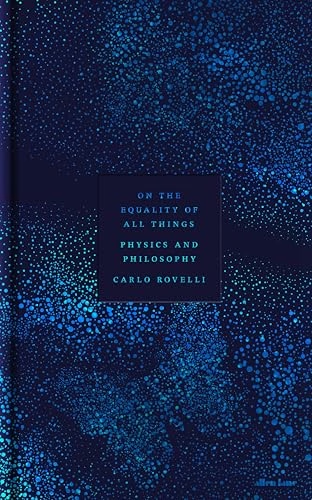
Carlo Rovelli's On the Equality of All Things: Physics and Philosophy is a provocative meditation on the nature of reality that reads like a physicist trying to write philosophy while a philosopher whispers corrections in his ear. The book's central claim—that electrons and minds, stones and laws, judgments and galaxies are fundamentally equal in nature—is audacious enough to make you pause. Yet the execution oscillates between moments of genuine insight and passages that feel like they're trying too hard to sound profound.
Quick Verdict
This is a book that rewards intellectual effort but punishes casual reading. Rovelli's prose sparkles with clarity when discussing physics, but becomes frustratingly abstract when he ventures into philosophical territory. It's worth reading if you're prepared for a challenging, occasionally maddening experience—but don't expect straightforward answers.
What This Book Actually Tries to Do
Rovelli positions On the Equality of All Things as a bridge between scientific and philosophical worldviews. He argues that modern physics has fundamentally undermined our ability to distinguish between observer and observed, subject and object. Drawing on relational interpretations of quantum mechanics and relativity, he suggests that reality isn't composed of fundamental "things" but rather of relationships and interactions.
The book's intellectual lineage is fascinating: Rovelli explicitly invokes Zhuangzi's butterfly paradox, suggesting that our certainty about reality is illusory. We are not detached observers of the world but entangled participants in it. This isn't new territory for physics, but Rovelli's attempt to ground philosophy in this insight feels fresher than the usual pop-science fare.
Where Rovelli's Physics Shines
When On the Equality of All Things review focuses on the physics, it becomes genuinely excellent. Rovelli's explanation of relational quantum mechanics—the idea that physical properties only exist relative to other systems—is more detailed and accessible than his previous popular works. He doesn't oversimplify; he trusts readers to follow genuine complexity.
His discussion of time's flow is particularly compelling. Unlike the block universe view that treats time as an illusion, Rovelli argues that time emerges from interactions between systems. This section demonstrates why Rovelli has earned his reputation as one of the finest science communicators working today. The physics is rigorous without being impenetrable, and the implications are genuinely mind-expanding.
The relativity sections also benefit from his clarity. He connects quantum mechanics and general relativity in ways that illuminate rather than obscure, making the reader understand why these theories matter beyond abstract mathematical elegance.
Where the Philosophy Stumbles
Here's where this review must be honest: when Rovelli dons his philosopher's hat, the results are mixed at best. His opening gambit—that electrons and minds are essentially equivalent—lands with the subtlety of a sledgehammer. The prose becomes ornate in ways that obscure rather than illuminate. Phrases like "ideas that illuminate each other" feel borrowed from a philosophy undergraduate's first essay, not from a working theoretical physicist.
Moreover, Rovelli's dismissal of contemporary philosophy as trapped in conceptual mistakes comes across as the very naïveté that professional philosophers might attribute to physicists. He tells us that philosophers are wrong to believe concepts adequate for understanding reality, but then proceeds to build his entire thesis on concepts drawn from physics. The circular reasoning here is hard to ignore.
The book also suffers from what might be called "cosmic poetry syndrome"—the tendency to inflate modest scientific insights into grand metaphysical claims. Yes, quantum mechanics shows that properties are relational. Yes, this has philosophical implications. But does it really tell us that all things are fundamentally equal? The logical leap feels unearned.
The Writing Problem That Isn't Always a Problem
Rovelli's prose style is simultaneously his greatest asset and most significant liability. Readers consistently report that this book is difficult—not because the ideas are incomprehensible, but because the presentation is so densely layered. Short sentences pile on top of each other. Abstract concepts cascade without sufficient scaffolding. You'll read a paragraph, finish it, and realize you need to read it again.
This density works brilliantly when discussing quantum mechanics. It forces you to slow down and engage seriously with the material. But when discussing philosophy, the same technique makes the writing feel pretentious. The prose seems to be compensating for conceptual weakness with stylistic complexity.
That said, Rovelli's occasional humor and self-aware hedging prevent the book from becoming entirely impenetrable. He clearly knows he's skating on thin ice philosophically, and his frequent expressions of uncertainty feel honest rather than evasive.
What Actually Works in This Book
Beyond the physics exposition, Rovelli makes several genuinely valuable points. His discussion of embodied knowledge—that we are not pure reason but "fragile and confused pieces of this world"—resonates deeply. This recognition that our knowledge is both powerful and radically incomplete feels both scientifically grounded and humanly true.
The book's central insight about interconnectedness, while not original, is presented with enough rigor and nuance to feel fresh. Rovelli isn't simply saying we're all connected (a cliché of pop spirituality). He's arguing that quantum mechanics and relativity demonstrate this connection at the most fundamental level of physical reality. That's a more substantial claim.
The brief sections on morality are also intriguing. Rovelli argues that morality isn't external to us but emerges from our nature as embodied, relational beings. It's underdeveloped, but it points toward a richer understanding of ethics grounded in physics rather than abstract principle.
Who Should Actually Read This
This book is perfect for readers who have worked through Rovelli's previous popular physics books and want something more philosophically ambitious. If you enjoyed Seven Brief Lessons on Physics but found it too introductory, this is your next step. You'll also appreciate this if you're interested in quantum mechanics beyond the usual interpretations—Rovelli's relational approach is genuinely less discussed in popular science than many alternatives.
You should also read this if you're willing to sit with confusion. This isn't beach reading. It's the kind of book you'll want to discuss with someone, or at least pause frequently to process. Readers who find that intellectually stimulating rather than frustrating will get the most from it.
Who Will Absolutely Hate This
If you want definitive answers about reality, look elsewhere. Rovelli is comfortable with uncertainty and circularity in ways that will frustrate those seeking solid ground. If you dislike philosophical speculation, the book's later sections will feel like a betrayal of the earlier physics material.
Avoid this if you're new to physics or philosophy. The book assumes significant familiarity with both fields, despite its accessible prose. Starting with something like Jim Al-Khalili's On Time or a standard quantum mechanics introduction would be wiser.
Also skip it if you value clear argumentation over evocative prose. Rovelli prioritizes beauty and suggestion over logical rigor. Some readers find this liberating; others find it infuriating.
The Comparison Question: How Does This Stack Up?
Compared to Stephen Hawking's The Grand Design, which Rovelli implicitly critiques, On the Equality of All Things is far more intellectually honest about the limits of science. Hawking and Mlodinow claimed philosophy was dead; Rovelli argues it's misguided but necessary. That's a more sophisticated position.
Against Sean Carroll's Something Deeply Hidden, which also explores quantum mechanics interpretation, Rovelli's book is more philosophical but less rigorous mathematically. Carroll gives you a clearer picture of competing interpretations; Rovelli gives you a deeper sense of what one interpretation might mean for our understanding of reality.
The Verdict
7/10 — A fascinating failure that's worth the struggle, but only for readers prepared to do the intellectual heavy lifting.
Rovelli's On the Equality of All Things review ultimately reveals a book at war with itself. The physics sections deserve a 9; the philosophy sections deserve a 5. The result is something genuinely interesting but frustratingly uneven. Is On the Equality of All Things worth reading? Yes—but only if you accept that you'll finish it confused, challenged, and probably wanting to argue with the author. That's not a flaw; it's the entire point.