Category:
Book ReviewsNuclear War: A Scenario Review—Terrifyingly Essential
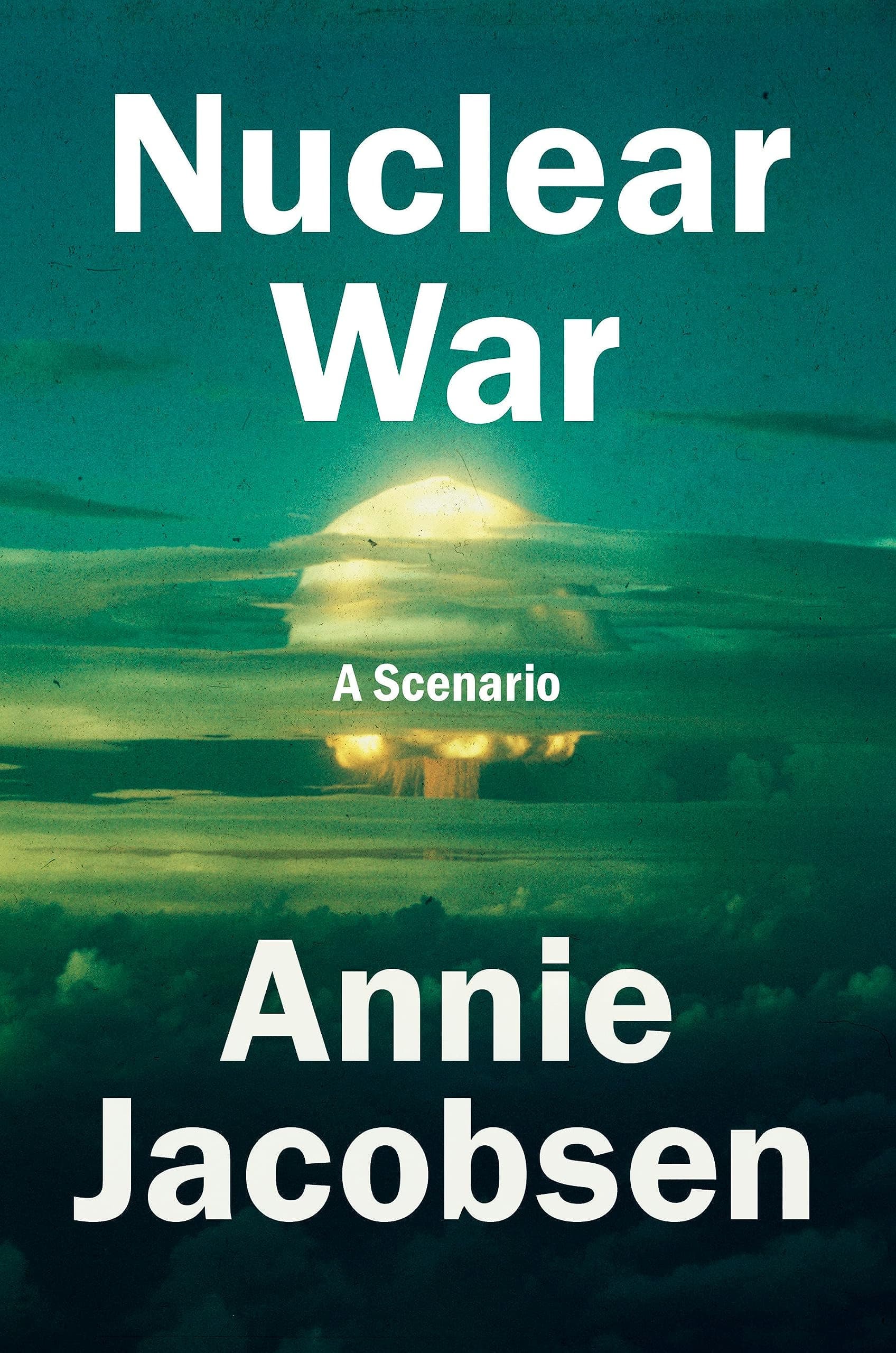
Prices can sometimes be lower on bigger marketplaces, but this link helps independent bookstores and local reading communities.
Annie Jacobsen's Nuclear War: A Scenario is the most genuinely unsettling non-fiction book published in recent years, and it's also the most important. This isn't hyperbole—it's a carefully researched, meticulously reported exploration of what happens in the 60 minutes following a nuclear missile launch toward the United States. Jacobsen, a Pulitzer Prize finalist known for her investigative journalism on military and intelligence programs, has created something that transcends typical nuclear war literature: a minute-by-minute, technically precise walkthrough of apocalypse that reads with the urgency of a thriller but carries the weight of documented fact.
The central premise is deceptively simple: what if deterrence failed? In an era where Vladimir Putin has openly threatened nuclear weapons, where North Korea continues accelerating its arsenal, and where miscalculation remains humanity's most underestimated threat, this question feels less theoretical and more like a ticking clock.
What This Book Actually Does
Unlike armchair speculation or Cold War nostalgia, Jacobsen's Nuclear War review material reveals something far more troubling: the author conducted dozens of exclusive interviews with military commanders, weapons designers, intelligence officials, and civilian decision-makers who have actually grappled with these scenarios. These aren't anonymous sources or declassified documents alone—they're firsthand accounts from people who have held the weight of nuclear response protocols in their hands.
The book walks through a hypothetical North Korean nuclear strike on the continental United States with visceral technical detail. Jacobsen describes how a 1-megaton thermonuclear detonation begins—the flash of light and heat so intense that concrete surfaces explode, metal objects evaporate, and humans instantaneously convert into combusting carbon. Within seconds, a fireball expands to over a mile in diameter. Within minutes, the response machinery of the U.S. military springs into action.
But here's what separates this from disaster fiction: the author then explores what actually happens in the Pentagon's war room, the decision-making protocols, the communication systems, the fail-safes, and the terrifying margins for error. One nuclear missile provokes two dozen in return. The entire conflict—from launch to nuclear winter—unfolds in roughly one hour.
The Writing: Precision Meets Dread
Jacobsen's prose style is deliberately clinical, which makes it more disturbing, not less. She presents technical specifications alongside human consequences. The effect is like reading a physics textbook written by someone who understands that every equation represents the annihilation of millions of people.
The structure moves chronologically through those critical 60 minutes, building momentum without sensationalism. This is investigative journalism at its finest—the author trusts her material to speak for itself. She doesn't need to editorialize about how terrifying nuclear war would be; the documented facts accomplish that work.
The audiobook version, which many readers have praised, becomes almost unbearably tense when narrated aloud. There's something about hearing these scenarios read in real time that makes them feel less abstract, more immediate.
What Works Brilliantly
First, the sourcing is genuinely impressive. Jacobsen didn't recycle Cold War-era interviews or rely on publicly available information. She secured access to people who have spent careers thinking about nuclear scenarios—the architects of deterrence policy itself. This gives the book authority that speculative works simply cannot match.
Second, the book refuses easy answers or comforting narratives. There is no superhero, no last-minute diplomatic breakthrough, no technological save. What emerges instead is a portrait of systems designed to prevent catastrophe that are nonetheless vulnerable to miscalculation, miscommunication, and human error. The UN Secretary-General's warning that "humanity is just one misunderstanding away from nuclear annihilation" frames the entire project.
Third, Jacobsen contextualizes the technical details with historical perspective. She explains how nuclear arsenals evolved, why deterrence theory developed as it did, and how the current geopolitical moment differs from previous eras of nuclear tension. This prevents the book from feeling like a one-off scenario exercise and instead positions it as a logical outcome of decades of weapons proliferation.
Fourth, the book is genuinely page-turning despite—or perhaps because of—its terrifying subject matter. Readers consistently report thinking about this book every night for weeks after finishing it. That's not accidental. Jacobsen has crafted something that combines journalistic rigor with narrative momentum.
Where It Might Disappoint
If you're looking for solutions, you won't find them here. The book doesn't propose policy changes, nuclear disarmament strategies, or diplomatic frameworks. Some readers seeking actionable takeaways may find this frustrating. However, this restraint is arguably a strength—Jacobsen resists the temptation to wrap up an unsolvable problem with false hope.
The technical detail, while compelling, occasionally demands sustained attention. Readers unfamiliar with military terminology or nuclear physics might need to slow down during certain passages. This isn't a flaw so much as a recognition that the book takes its subject seriously enough not to oversimplify.
Some may also argue that focusing on a single scenario—a North Korean strike—doesn't address other potential triggers: Russian miscalculation, Chinese escalation, or accidental launch. The book's narrow focus is intentional, but it does mean readers seeking broader geopolitical analysis might look elsewhere.
Who Should Read This
This book is essential for anyone interested in national security, military strategy, or contemporary geopolitics. If you read books about foreign policy, defense budgets, or international relations, this belongs on your shelf.
It's also vital for people who feel disconnected from nuclear threats—those who grew up after the Cold War ended and assume nuclear weapons are historical artifacts rather than active existential risks. Jacobsen's reporting demonstrates that nuclear war remains disturbingly plausible.
Critically, this book is for people who can tolerate genuine discomfort in service of understanding. If you need your non-fiction to be ultimately reassuring, this isn't the right choice. Jacobsen's Nuclear War review reveals a world where the safeguards exist but the margins are terrifyingly thin.
Who Might Struggle With It
If you have anxiety around existential threats, this book could amplify those concerns significantly. Readers have reported experiencing genuine psychological distress—not because the writing is sensationalized, but precisely because it's credible. This is a feature, not a bug, but it's worth acknowledging.
Those seeking quick reads or light non-fiction will find this demanding. The book requires intellectual engagement and emotional fortitude.
Comparison to Related Works
Unlike Jonathan Schell's The Fate of the Earth (1982), which offered philosophical meditation on nuclear annihilation, Jacobsen grounds her work in contemporary technical and political reality. Where Schell was essayistic, Jacobsen is reportorial.
Compared to Daniel Ellsberg's The Doomsday Machine (2017), which also examined nuclear policy failures, Jacobsen's book is more scenario-focused and less autobiographical. Ellsberg's work is essential context; Jacobsen's is a specific, urgent exploration of what happens when deterrence fails.
The Verdict
Is Nuclear War: A Scenario worth reading? Absolutely, though "worth" isn't quite the right word. It's necessary. In a moment when nuclear weapons remain active arsenals controlled by leaders of varying temperament and judgment, understanding what nuclear war would actually entail—not as speculation but as documented possibility—feels like a civic responsibility.
Jacobsen has written a book that accomplishes something rare: it's simultaneously a work of rigorous journalism, a gripping narrative, and a profound warning. The 4.35-star rating across tens of thousands of readers reflects genuine consensus that this book matters, even if—or especially if—it disturbs you profoundly.
The fundamental insight driving Annie Jacobsen's project is correct: we need to understand the machinery of our potential extinction. This book delivers that understanding with precision, clarity, and appropriate terror.