Category:
Book ReviewsNot Today, Fascists Review: Urgent, Funny, Imperfectly Honest
Prices can sometimes be lower on bigger marketplaces, but this link helps independent bookstores and local reading communities.
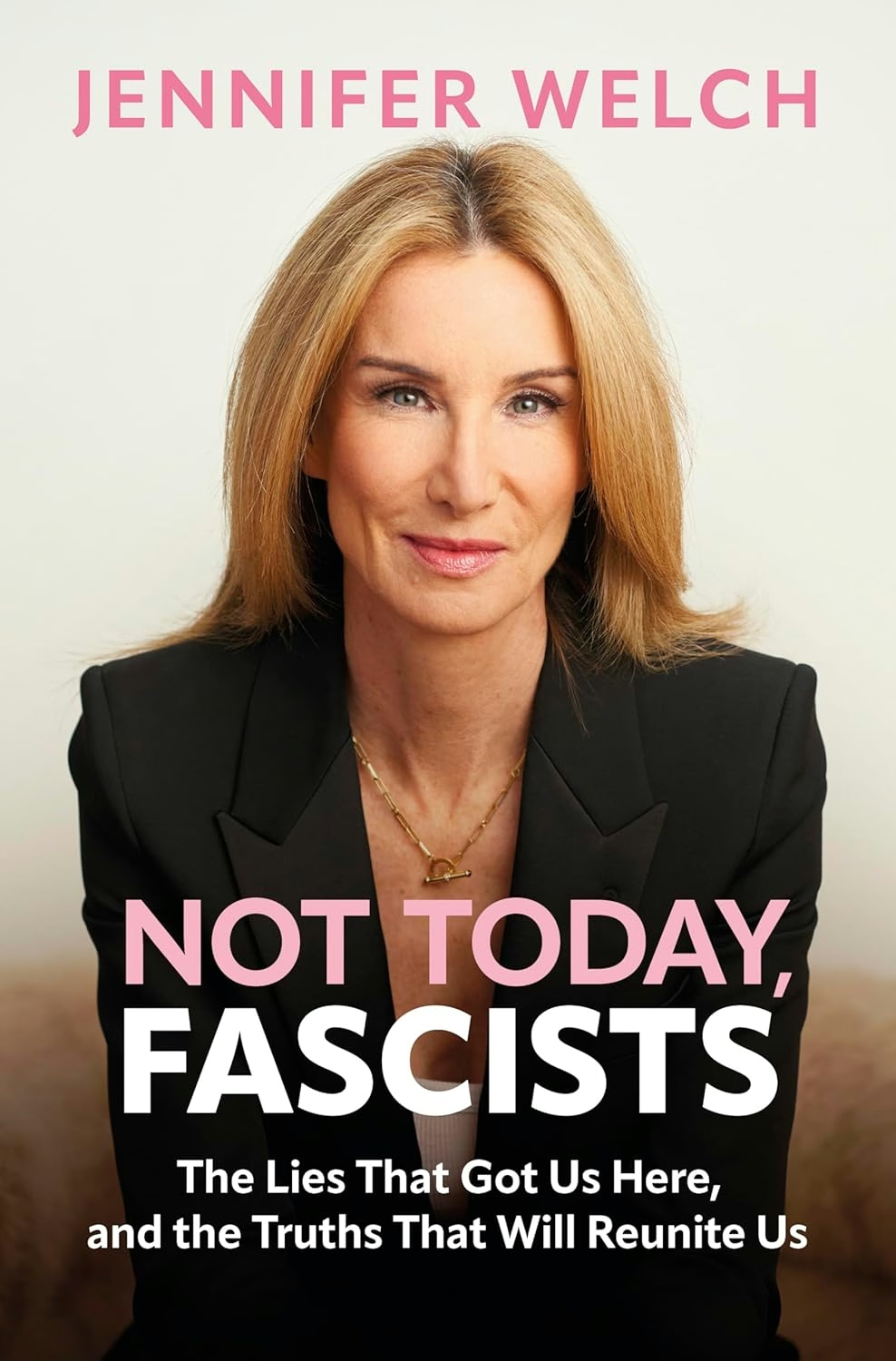
Jennifer Welch's Not Today, Fascists: The Lies That Got Us Here, and the Truths That Will Reunite Us arrives as a rallying cry wrapped in dark humor—a book that refuses the polite distance most political commentary maintains. This is not a measured treatise on American democracy. It's a former atheist from Oklahoma turning her podcast's unfiltered energy into 300 pages of unapologetic argument about theocracy, fascism, and the specific machinery that's dismantling the separation of church and state.
The central claim is provocative: America isn't just drifting toward authoritarianism—it's being actively engineered toward religious governance by a coalition of Christian nationalists, prosperity gospel preachers, and politicians willing to weaponize faith for votes. Welch doesn't whisper this thesis. She shouts it, backs it with research, then punctures the tension with jokes about "Canks and Smoky Eyes" (her podcast nicknames for certain political figures). Whether you find this approach brilliant or exhausting will determine whether Not Today, Fascists becomes your manifesto or your skip pile.
What This Book Actually Does
Welch's real contribution isn't breaking new ground on American fascism—scholars like Jason Stanley and Timothy Snyder have mapped that territory thoroughly. Instead, she translates abstract political theory into the lived experience of someone who watched her Bible Belt community weaponize religion against her family's atheism, then watched that same machinery scale nationally.
The book interrogates how the prosperity gospel—the doctrine that financial success signals divine favor—creates both theological justification for inequality and a psychological mechanism for the working class to blame themselves rather than systems for their poverty. This connection between religious messaging and economic control is where Welch's analysis sharpens. She's not arguing that Christianity caused fascism; she's showing how specific interpretations of Christianity were deliberately amplified to serve political ends.
She also addresses the infrastructure: how evangelical megachurches operate as tax-exempt political machines, how the Supreme Court's recent religious liberty decisions aren't neutral law but theological victories, and how the current administration's policies actively harm vulnerable Americans while being framed as moral crusades.
The Writing: Podcast Energy on Paper
If you've listened to Jennifer Welch's "I've Had It" podcast, you know exactly what you're getting: conversational urgency, sharp observations, and the comedic timing of someone who understands that gallows humor is how we process crisis. She writes the way she talks—in short, punchy sentences that build momentum. Paragraphs rarely exceed four sentences. Arguments don't meander; they accelerate.
This works brilliantly for engagement. You won't get lost in dense prose or feel like you're reading an academic paper. The book moves. But this same quality creates a vulnerability: there's minimal space for nuance or complexity. Welch presents arguments in bold strokes, which makes them memorable but sometimes flattens the actual texture of the problems she's describing.
Where This Review Gets Complicated
Here's the tension: Not Today, Fascists is simultaneously more honest and less rigorous than it could be. Welch explicitly calls out failures of both major parties—particularly the Democratic Party's inability to craft compelling messaging around human dignity and populist economics. She doesn't let the left off the hook. This refusal to offer simple partisan comfort actually makes the book more credible to readers who've felt abandoned by establishment politics.
But the book's strength becomes its limitation in the final sections. When Welch pivots toward solutions—how Democrats can rebuild messaging, how citizens can resist—the energy deflates slightly. She's more powerful diagnosing disease than prescribing treatment. The book promises "truths that will reunite us," but the reunification strategy amounts to "vote better and demand accountability," which feels thinner than the 200 pages of evidence preceding it.
There's also the question of audience reach. This book preaches effectively to the convinced. If you already believe that Christian nationalism is a genuine threat, that the prosperity gospel corrupts both theology and economics, and that the current political moment is genuinely dangerous, Welch will make you feel less alone and more articulate about your concerns. If you don't share those starting assumptions, her rapid-fire arguments and dismissive tone toward opposing views might feel more like provocation than persuasion.
Who Should Actually Read This
Perfect for: Progressive readers who feel politically gaslit and need someone to name what they're seeing without apology. People with religious upbringings who've rejected those traditions and want to understand how their communities got weaponized. Podcast listeners who appreciate Welch's voice and want her extended argument. Anyone trying to understand the specific machinery connecting evangelical Christianity to modern authoritarianism.
Will struggle with this: Readers seeking balanced presentation of opposing viewpoints. People who need careful distinction between Christian faith and Christian nationalism (Welch makes this distinction but doesn't dwell on it). Conservatives or religious readers looking for good-faith engagement rather than critique. Anyone wanting a comprehensive policy roadmap rather than a diagnostic and a call to action.
The Verdict Question: Is This Worth Reading?
Yes, with context. Not Today, Fascists doesn't break entirely new intellectual ground—the connections between religious nationalism and fascism have been documented by political scientists and historians. But Welch does something different: she makes those arguments personal, urgent, and funny in ways that academic analysis cannot. She also brings specific attention to the economic dimensions of religious messaging in ways that deserve more mainstream discussion.
The book is strongest as a validation for people already alarmed by these trends and a conversation-starter for those beginning to notice them. It's weakest as a persuasion device for skeptics or as a detailed policy document. Think of it as a manifesto rather than a treatise—it's meant to mobilize, not to comprehensively prove.
Compare this to similar recent works: Jason Stanley's How Fascism Works is more academically rigorous but less emotionally resonant. Michelle Goldberg's Kingdom Come covers similar theological ground but with more journalistic distance. Welch's contribution is her willingness to be unambiguously angry and funny simultaneously, treating the subject as both urgent crisis and cultural phenomenon worthy of dark comedy.
Final Assessment
Not Today, Fascists by Jennifer Welch succeeds as a polemic and fails as a comprehensive solution manual, which is probably fine—that's not what polemics are designed to do. The book's real value lies in its refusal to separate the personal from the political, its interrogation of how specific religious messaging creates economic control, and its insistence that citizens can still push back against these trends if they organize with conviction.
The Not Today, Fascists review landscape tends to split between readers who found it validating and readers who found it one-dimensional. Both responses are defensible. What's undeniable is that Welch writes with purpose, research, and the kind of clarity that makes complex political dynamics suddenly legible.
Final Score: 7.5/10 — Sharp, urgent, and genuinely funny, but more effective as diagnosis than as cure, and more persuasive to the already-convinced than to those still forming opinions.