Category:
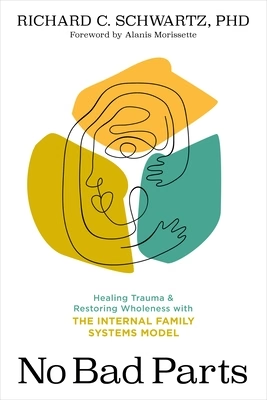
Self-HelpNo Bad Parts Review: Revolutionary or Spiritual Overreach?
Prices can sometimes be lower on bigger marketplaces, but this link helps independent bookstores and local reading communities.
Quick Verdict
Richard C. Schwartz's No Bad Parts presents a genuinely transformative psychological framework wrapped in language that oscillates between scientific rigor and spiritual mysticism. The Internal Family Systems (IFS) model itself deserves the attention it's received from therapists and mental health professionals—but this particular book's execution divides readers sharply. If you're willing to engage experientially with the material rather than demand academic proof on every page, you'll likely find it revelatory. If you prefer your psychology stripped of metaphysical language, this won't be your book.
What This Book Actually Offers
At its core, No Bad Parts challenges the foundational assumption of Western psychology: that humans possess a unified, singular mind. Schwartz argues instead that we're born with multiple "parts"—distinct sub-personalities with their own perspectives, needs, and protective strategies. This isn't dissociative disorder or pathology. It's the normal human experience of inner conflict made visible.
When you've felt torn between wanting to stay in bed and needing to go to work, or between wanting to eat cake and wanting to be healthy, you've experienced what Schwartz calls intrapsychic conflict. Most therapeutic traditions treat these competing impulses as problems to eliminate. IFS treats them as family members trying to help, however clumsily. The difference is profound.
The book explores how trauma and cultural conditioning "burden" our parts, distorting them from their original protective purpose into something rigid and destructive. An exiled part might carry childhood shame. A protector part might develop perfectionism or self-sabotage to prevent that shame from surfacing. Another part might police both of them obsessively. The system becomes a prison.
The Revolutionary Part (That Actually Works)
What makes this No Bad Parts review worth reading is acknowledging what clinical data supports: IFS genuinely works. The model has demonstrated efficacy in trauma recovery, addiction treatment, and depression management in peer-reviewed studies. The American Psychological Association recognizes it as an evidence-based practice.
Schwartz's core insight—that parts aren't enemies but protective allies operating on outdated information—is genuinely liberating. When you stop fighting your inner critic and instead ask it what it's trying to protect you from, something shifts. The critic doesn't disappear; it becomes useful. This reframing has helped thousands of people escape cycles of self-sabotage and shame.
The practical exercises scattered throughout the book are the real value. Mapping your parts, accessing what Schwartz calls "the Self" (your core, undistorted consciousness), and dialoguing with protectors—these are experiential practices that work whether or not you buy the entire philosophical framework.
Where This Book Stumbles
Here's the tension in this No Bad Parts review: the author's spiritual language will either feel like wisdom or like manipulation, depending on your tolerance for unfounded metaphysical claims.
Schwartz frequently makes sweeping statements about consciousness, human nature, and spiritual truth without providing the evidence he demands of conventional psychology. He uses phrases like "I've stumbled upon" and "it turns out" before making assertions that would require rigorous proof. For readers trained in scientific skepticism, this creates cognitive dissonance. The IFS model itself doesn't require these spiritual claims to work, yet Schwartz presents them as integral to the approach.
The interview transcripts included as examples are particularly problematic. They read less like therapy sessions and more like spiritual conversion experiences. One reviewer accurately noted they resemble "attempts at literal exorcism." Whether that's powerful or off-putting depends entirely on your worldview, but it's worth knowing what you're getting.
There's also a subtle but real conflict of interest. Schwartz founded the Center for Self Leadership and built an entire institute around IFS. While this doesn't invalidate the model, it does mean he has significant financial and reputational incentive to present IFS as the key to human flourishing rather than as one useful therapeutic tool among several.
The Polarization Problem
Few books inspire such divergent reader responses. Some readers describe No Bad Parts as genuinely life-changing, their favorite psychology book ever. Others find it off-putting and pseudo-scientific. This isn't a case where one group is wrong—it reflects real differences in how people process information.
Readers who engage experientially and are open to metaphorical language find the book illuminating. Readers who demand explicit evidence and prefer their psychology demystified find it frustrating. The book itself doesn't bridge this gap; it assumes readers will meet it halfway.
Who Should Actually Read This
Perfect for: Anyone currently in therapy who wants to understand their inner dynamics more deeply. People interested in trauma recovery who've hit plateaus with conventional approaches. Those already open to contemplative or spiritual frameworks. Readers who've experienced inner conflict and want language for it beyond "I'm just crazy" or "I'm being irrational."
Skip it if: You require peer-reviewed evidence before accepting psychological claims. You're skeptical of spiritual language in clinical contexts. You prefer straightforward, demystified psychology. You want a quick self-help fix rather than deep inner work.
The middle ground: If you're curious about IFS but skeptical of Schwartz's spiritual packaging, consider reading the academic literature on IFS first or finding a trained IFS therapist to experience it directly. The model works without requiring belief in Schwartz's metaphysical claims.
Comparison to Similar Books
Unlike Daniel Siegel's The Developing Mind, which grounds neuroscience in accessible language, No Bad Parts moves toward spiritual territory. Unlike Bessel van der Kolk's The Body Keeps the Score, which focuses on trauma's physiological impact, this book emphasizes consciousness and inner dialogue. No Bad Parts occupies a unique space between Jungian psychology and modern therapy—which is exactly where it confuses some readers and enlightens others.
Writing and Accessibility
Schwartz writes clearly and often engagingly. The book moves at a good pace and includes enough practical material to feel actionable rather than purely theoretical. The exercises are genuinely useful. However, the constant spiritual asides and philosophical tangents interrupt the practical flow. A more tightly edited version focused on the IFS methodology itself would likely be stronger.
Is No Bad Parts Worth Reading?
Yes, with caveats. The IFS model is legitimate and useful. Schwartz's presentation of it is thought-provoking even when you disagree with his conclusions. The practical exercises have real value. But go in knowing you're getting both rigorous psychology and spiritual philosophy mixed together, and decide if you're okay with that blend.
The book is most valuable if you approach it as an introduction to IFS rather than the definitive word on human consciousness. Use it as a starting point for deeper exploration, whether through therapy, additional reading, or personal practice.
Final Verdict
This is a genuinely important book about a genuinely important psychological model, hampered by the author's tendency to overreach beyond what evidence supports. Read it for the IFS framework and practical tools. Forgive it for the spiritual packaging. Judge for yourself whether that packaging is profound or problematic.
Rating: 7.5/10 — A valuable introduction to a transformative model undermined by its author's conflation of clinical psychology with spiritual truth claims.