Category:
Book ReviewsMoral Ambition Review: Inspiring but Frustratingly Selective
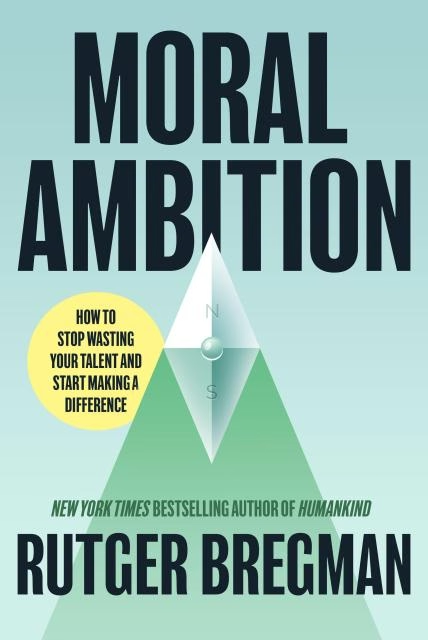
Prices can sometimes be lower on bigger marketplaces, but this link helps independent bookstores and local reading communities.
Quick Verdict
Rutger Bregman's Moral Ambition is a provocative manifesto that challenges how we define success and career fulfillment. The book's central premise—that the best use of your talent is solving humanity's biggest problems—resonates deeply with idealistic readers. However, this Moral Ambition review reveals a troubling pattern: Bregman cherry-picks inspiring examples while conveniently glossing over the psychological costs and darker implications of his philosophy.
What This Book Actually Argues
Bregman presents a deceptively simple framework: most people waste their careers in "bullshit jobs" or pursuing empty status symbols. His solution is moral ambition—the drive to excel, but measured by impact rather than salary or title. He categorizes people into four groups: those with neither ambition nor idealism (the burnt-out), the ambitious but cynical (consultants and bankers), the idealistic but lazy (armchair activists), and finally, the morally ambitious—the rare breed who combine drive with purpose.
The book draws on historical figures like Thomas Clarkson, who at 25 dedicated his entire life to abolishing slavery, and Benjamin Lay, an early abolitionist so obsessed he'd smash tea cups sourced from slave plantations. Bregman also profiles modern problem-solvers: Ralph Nader's "Radical Nerds" who tackled corporate malfeasance, Wendy Kopp's Teach for America model, and climate tech entrepreneurs in Silicon Valley.
The Seductive Parts (Where It Works)
Bregman's core insight is genuinely valuable: how you spend 2,000 workweeks—the typical career—matters enormously, and most people never seriously consider dedicating those hours to something meaningful. The framework of four ambition types is elegant and immediately useful for self-reflection. When he profiles Ralph Nader's successful lawsuit against General Motors—which led directly to the Highway Safety Act—you feel the tangible power of focused talent applied to systemic problems.
The book excels at demystifying how change happens. Rosa Parks didn't spontaneously desegregate buses; she was part of a coordinated movement. Nader didn't revolutionize consumer safety alone; he recruited brilliant law students and mobilized them strategically. These aren't stories of lone genius—they're stories of talented people choosing to work on hard problems together. That's genuinely empowering.
For readers in their late teens and twenties, this book can be transformative. It arrives at a critical juncture when career choices feel permanent, offering permission to pursue meaningful work instead of defaulting to prestige or money.
The Fatal Flaw: Selective Storytelling
Here's where this Moral Ambition review gets critical: Bregman's arguments are fundamentally anecdotal, and worse, they suffer from confirmation bias. He celebrates historical abolitionists and civil rights activists as paragons of moral ambition, but buries—literally in the final pages—the psychological devastation these figures endured. Many experienced severe burnout, social isolation, and personal dissolution from total dedication to singular causes. Bregman mentions this almost apologetically, as though it's an unfortunate side effect rather than a central feature of his philosophy.
This is intellectually dishonest. If you're going to advocate for life-consuming dedication to a cause, you can't simply acknowledge the personal costs in a footnote and move on. The book also oddly sidesteps the question: wouldn't Elon Musk have fit Bregman's definition of morally ambitious a few years ago? He's ambitious, driven, and pursuing what he frames as humanity's existential challenges. Yet Bregman doesn't grapple with how moral ambition can become obsession, how visionary zeal can curdle into authoritarianism.
There's also a troubling undercurrent when Bregman casually suggests people should "start cults." He frames this positively—pointing to climate tech communities as cult-like movements—but glosses over why actual cults are dangerous: they demand unquestioning loyalty, create enemy-other dynamics, and concentrate power around charismatic leaders. Bregman focuses exclusively on the mobilization aspects while ignoring the pathology.
Writing Style and Readability
Bregman writes with infectious enthusiasm. The book moves quickly—many readers report finishing it in a single sitting—and the prose is accessible without being simplistic. He uses vivid historical anecdotes effectively and structures arguments clearly. However, this readability masks the selectivity of his examples. You're swept along by compelling stories without pausing to ask what he's leaving out.
Who This Book Is Perfect For
Read this if: You're questioning your career trajectory and wondering whether you're wasting your potential. You're idealistic but unsure how to channel that into tangible impact. You're in your 20s or early 30s and haven't yet committed to a conventional path. You want permission to pursue meaningful work over prestigious work. You're interested in how social movements actually organize talent.
Skip this if: You're skeptical of grand moral frameworks and prefer nuance over manifestos. You've already experienced the burnout that comes from total dedication to a cause. You want a balanced exploration of trade-offs rather than cheerleading for sacrifice. You're looking for practical career guidance rather than philosophical inspiration.
The Uncomfortable Truth
Bergman's philosophy works best for people with sufficient privilege to absorb the costs of moral ambition: financial safety nets, supportive families, access to networks where meaningful work exists. A person working three jobs to pay rent doesn't have the luxury of choosing moral ambition. The book occasionally nods to inequality but doesn't seriously reckon with how its advice maps onto different life circumstances.
Moreover, there's a cult-like quality to the "School of Moral Ambition" community that Bregman has built around this book. The philosophy itself isn't cultish, but the way it's being packaged and promoted—with circles, initiatives, and a growing movement—mirrors the very dynamics Bregman fails to critically examine.
Compared to Similar Books
If you've read Humankind (Bregman's earlier bestseller), you'll recognize his optimistic humanism and love of surprising historical examples. Moral Ambition is more prescriptive—it doesn't just celebrate human goodness, it tells you how to live. Compared to Malcolm Gladwell's work (the Times called Bregman "a more politically radical Malcolm Gladwell"), this book is more ideologically committed but less intellectually rigorous. Gladwell entertains multiple perspectives; Bregman evangelizes for one vision of the good life.
It's also worth comparing this to books like Range by David Epstein or The Courage to Be Disliked (based on Adlerian psychology). Both explore unconventional paths and personal fulfillment, but they engage more honestly with complexity and contradiction.
Final Verdict
Moral Ambition is a book that inspires first and examines second—if it examines at all. Bregman's core insight about wasting talent on meaningless work is important, and his historical examples of coordinated impact are genuinely valuable. But the book commits the sin of selective storytelling: it cherry-picks the inspiring parts of moral dedication while minimizing the psychological, social, and political risks. It's a manifesto masquerading as analysis.
Is Moral Ambition worth reading? Yes, but with eyes open. Read it for the framework and the permission it grants to pursue meaningful work. Just don't read it as a complete guide to the life you're considering. Supplement it with more critical explorations of ambition, sacrifice, and the costs of total commitment to causes. Bregman has written a genuinely useful book for people at a crossroads—just not the complete book his confident tone suggests.
Final Score: 6.5/10
Justification: Inspiring framework and valuable perspective on career meaning, undermined by selective examples and failure to honestly reckon with the costs of the life it advocates.