Category:
Book ReviewsMestra Review: A Gut-Wrenching Masterclass
Prices can sometimes be lower on bigger marketplaces, but this link helps independent bookstores and local reading communities.
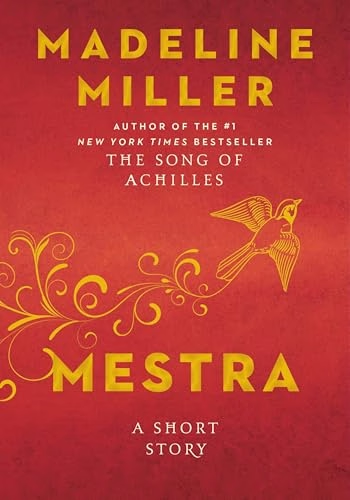
Madeline Miller's Mestra is a deceptively slim volume that packs the emotional wallop of a full-length novel. At just 80 pages, this short story proves that Miller remains the undisputed queen of mythology retellings—and that she doesn't need hundreds of pages to devastate her readers. The book is a visceral exploration of parental exploitation disguised as a fairy tale, and it's far more relevant to contemporary life than its ancient Greek bones might suggest.
What This Book Actually Is
Mestra draws from one of mythology's cruelest tales: King Erysichthon, cursed by Demeter with insatiable hunger as punishment for desecrating her sacred grove, eventually sells his own daughter to survive. But Miller's version centers Mestra herself—a young woman gifted by Poseidon with the ability to shapeshift into any form she imagines. What should be liberation becomes a trap. Her father, consumed by his curse, doesn't see his daughter's gift as her own miracle. He sees it as an endless resource to exploit.
This is the premise. The execution is where Miller transcends genre.
The Writing: Lush, Precise, Devastating
Miller's prose in Mestra maintains the lyrical, jewel-like quality that made Circe and The Song of Achilles modern classics. Every sentence carries weight. There's no filler, no tangential mythology lessons—just pure narrative momentum wrapped in gorgeous language. The audio version, clocking in at just over an hour, feels like a perfectly calibrated experience rather than a truncated novel.
What strikes most readers is Miller's ability to make you feel profound emotion in minimal space. She doesn't waste words on exposition or world-building flourishes. Instead, she builds tension through restraint, letting the horror of Mestra's situation accumulate quietly until it becomes unbearable.
What Works: The Uncomfortable Mirror
The genius of Mestra lies in its refusal to soften the story's core horror. This isn't a redemptive tale where love conquers all. It's a parable about the cost of devotion to someone incapable of reciprocating it—and about the particular vulnerability of daughters to paternal hunger, literal or metaphorical.
Readers repeatedly note that this book functions as a gut-wrenching exploration of toxic family dynamics, parental exploitation, and the slow erosion of self that happens when you're raised to believe your purpose is feeding someone else's needs. If you've lived through this, Mestra doesn't offer comfort. It offers recognition. And sometimes that's more valuable.
The mythology here serves the emotional truth rather than the reverse. Miller uses the curse and the shapeshifting as metaphors so precise they feel like they were always meant to describe modern family dysfunction. The result is a story that feels simultaneously ancient and urgently contemporary.
What Doesn't Land: The Brevity Question
If Mestra has a weakness, it's that some readers finish it hungry for more—and not in a good way. Coming off Miller's full-length novels, which have the space to develop complex emotional landscapes across hundreds of pages, Mestra can feel like an amuse-bouche when you're craving a full meal.
This isn't a flaw in the story itself. It's a structural reality. A short story simply cannot do what a novel does. Some readers will find this frustrating, particularly those who discovered Miller through Circe or The Song of Achilles and have been waiting years for her next full-length work. Mestra is a gift, but it's also a tease.
There's also a question of accessibility. The story's darkness—particularly around parental exploitation and the commodification of a young woman's body—means this isn't a light read. It's emotionally demanding in ways that some readers found rewarding and others found simply draining.
Who Should Read This
Read Mestra if:
- You've loved Miller's previous mythology retellings and want more of her voice
- You're interested in feminist retellings of ancient myths
- You appreciate short stories that pack emotional complexity into minimal space
- You've experienced or are processing toxic family dynamics (fair warning: it's triggering, but also validating)
- You want to understand why Miller is considered a master of her craft
Skip it if:
- You need plot-driven narratives with resolution and redemption
- You're looking for escapist mythology rather than psychological depth
- You're burnt out on Greek mythology retellings
- You find depictions of parental exploitation too difficult to engage with
- You want a substantial reading experience and resent paying $15 for 80 pages
How It Compares
If you loved Circe, you'll recognize Miller's voice immediately—the same lyrical prose, the same commitment to centering female agency within mythological constraints. But Mestra is darker, more claustrophobic. Where Circe eventually finds power through isolation and magic, Mestra explores what happens when power is demanded of you before you're ready to claim it.
Compared to other contemporary mythology retellings, Mestra stands apart because Miller never sacrifices emotional truth for narrative convenience. She's not interested in making her characters likable or their choices easy to understand. She's interested in making them real.
The Verdict
Mestra is absolutely worth reading, but with clear eyes about what you're getting. This is not a comfort read. It's not a beach book. It's a concentrated dose of Miller's particular genius: the ability to take ancient stories and make them feel like they were written specifically about your life.
The Mestra review consensus among serious readers is overwhelmingly positive, but not uniformly enthusiastic. The book divides on a single axis: those who believe Miller's lyrical precision and emotional depth justify the brevity, and those who wish she'd expanded the story into a full novel. Both positions are defensible.
What's indisputable is that Miller hasn't lost her touch. If anything, Mestra proves she's become even more economical with her power, able to break your heart and rebuild it in fewer than 10,000 words.
Final Thoughts
Madeline Miller's Mestra is a masterclass in how to tell a complete, emotionally devastating story in minimal space. It's a book that will haunt you long after you finish it—not because of what happens, but because of what it reveals about the cost of unconditional love directed toward someone who will never stop taking.
The question isn't whether Mestra is good. It clearly is. The question is whether you're ready for what it demands from you as a reader. If you are, it's essential.