Category:
Book ReviewsMaterial World Review: Why Raw Materials Matter
Prices can sometimes be lower on bigger marketplaces, but this link helps independent bookstores and local reading communities.
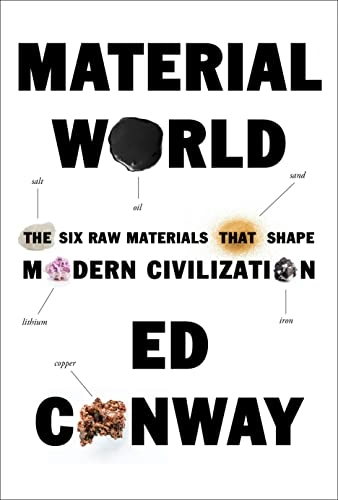
Ed Conway's Material World: The Six Raw Materials That Shape Modern Civilization arrives with a deceptively simple premise: sand, salt, iron, copper, oil, and lithium are the invisible scaffolding holding up everything we call modern life. What makes this book genuinely surprising isn't the premise itself—it's that Conway transforms what could have been a tedious materials science textbook into a page-turner that reads like geopolitical thriller meets industrial history epic.
This Material World review cuts to the heart of what makes the book work: it demolishes the popular myth that we've transcended the physical world. We live, Conway argues, in a carefully constructed illusion of weightlessness. Your smartphone, your internet connection, your electricity grid—all ethereal until you remember that we extracted more raw materials from Earth in 2017 than in all of human history before 1950. That's the book's central tension, and it's genuinely unsettling.
What Makes This Book Different
Unlike traditional economics or business books that treat materials as abstractions, Conway takes you into the mines, the factories, and the geopolitical battlegrounds where these six materials are fought over. He doesn't just tell you that copper is essential for electrical grids; he shows you why the transition to renewable energy means we'll need vastly more copper than we've ever extracted, and what that means for global power dynamics.
The book's structure is elegant. Each material gets its own deep dive, but Conway weaves them together into a larger narrative about resource dependency, technological progress, and the hidden fragility of global supply chains. It's the kind of book that makes you see your daily life differently—every time you use your phone, you're reminded of the silicon wafers, the rare earth elements, the mining operations on different continents.
The Six Materials Explained
Sand opens the narrative with a material so ubiquitous we barely notice it. Yet sand is extraordinarily specific—not all sand works for semiconductors or construction. Conway reveals the brutal reality: sand mafias in some countries control entire supply chains, and the competition for high-quality silica is already reshaping geopolitics. The US restrictions on chip-making materials to China aren't abstract policy—they're direct consequences of understanding sand's strategic importance.
Salt sounds mundane until Conway traces its history as a currency, a tool of state control, and a flashpoint for revolution. From ancient China to Revolutionary France, controlling salt meant controlling populations. Today, it's essential for water purification and pharmaceuticals, yet we've forgotten its historical weight.
Iron and copper form the backbone of industrial civilization. Iron's story is steel's story—the material that built empires and continues to build our infrastructure. Copper's narrative becomes increasingly urgent as renewable energy demands skyrocket. Conway makes a compelling case that the green energy transition will create unprecedented demand for copper, creating new geopolitical vulnerabilities.
Oil needs little introduction, but Conway's treatment of it is refreshingly non-ideological. He doesn't preach about climate change; he simply documents oil's total infiltration into every aspect of modern life and explores what happens when supply becomes contested.
Lithium closes the book by pointing toward our future. As battery technology becomes central to energy storage and transportation, lithium's importance will only grow. Conway's reporting from lithium extraction sites in South America provides visceral understanding of what the green energy transition actually looks like on the ground.
Writing Style and Accessibility
Conway writes with clarity and narrative momentum. This isn't academic prose; it's journalism married to historical research. He makes technical concepts accessible without dumbing them down. The book moves between personal anecdotes, historical narratives, and economic analysis in ways that keep you engaged rather than overwhelmed.
The pacing is deliberate. Conway takes time to develop each material's story, but he never gets lost in minutiae. He understands what matters: the human stakes, the geopolitical implications, and the surprising connections between seemingly unrelated industries.
Where the Book Excels
The Material World review must acknowledge what this book does brilliantly: it reframes how we think about civilization. Most books about progress focus on ideas, innovation, or leadership. Conway's argument that material abundance is the actual foundation of everything is both obvious and revelatory.
His reporting is thorough. He's visited mines, factories, and lithium extraction sites. He's interviewed industry experts, geopoliticians, and workers. This isn't armchair theorizing; it's grounded in actual investigation.
The book also succeeds in making you understand interdependence. You finish Material World understanding that global supply chains aren't abstract economic concepts—they're literal dependencies. When China controls rare earth elements or when political instability threatens copper supplies, these aren't distant problems. They're threats to your electricity, your technology, your way of life.
Potential Limitations
Some readers might find the geopolitical focus occasionally overshadows deeper technical exploration. If you're looking for a materials science textbook, this isn't it. Conway prioritizes narrative and geopolitical implications over technical depth, which works for most readers but might frustrate specialists seeking more granular technical detail.
The book's scope, while ambitious, means some materials get less attention than others. Readers particularly interested in specific materials might wish for more depth. Additionally, while Conway addresses climate and environmental concerns, he doesn't position environmental destruction as central to his argument—his focus remains on supply, demand, and geopolitics.
Who Should Read This Book
Perfect for: Anyone interested in understanding how the world actually works beneath the surface. Business leaders making supply chain decisions. Students of economics, history, or political science. Technology enthusiasts who want to understand what's actually inside their devices. People concerned about geopolitical stability and resource competition. Anyone who's ever wondered why certain countries wield disproportionate power.
Probably not for: Readers seeking pure environmental polemics or climate change activism. Those wanting deep technical materials science. People who prefer their non-fiction without geopolitical complexity. Anyone already deeply versed in resource economics who might find the introduction-level material slow.
Is Material World Worth Reading?
Yes, absolutely. This is one of the more important non-fiction books published recently. It doesn't offer easy answers or comforting conclusions, but it provides something more valuable: clarity about how the world actually functions. In an era of AI hype and digital transformation discourse, Conway reminds us that civilization still runs on sand, salt, and copper. That reframing alone makes the book worth your time.
The book succeeds because it treats material reality with the seriousness it deserves. We've built an economic and technological system so complex that we've forgotten its foundations. Material World is a necessary reminder that the ethereal digital world we inhabit is built on very physical, very finite, very contested resources.
Final Verdict
This is essential reading for anyone wanting to understand 21st-century geopolitics, resource competition, and the hidden infrastructure of modern life. Conway writes with clarity and narrative drive, turning what could have been a dry subject into genuinely compelling non-fiction. The book's central insight—that we've created an illusion of weightlessness while remaining utterly dependent on material abundance—is both unsettling and impossible to forget once you've encountered it. Whether you're a policy maker, business leader, student, or simply curious about how civilization actually works, Material World offers insights that will reshape how you see the world.