Category:
Book ReviewsMagnifica Humanitas Review: Pope Leo XIV's Urgent AI Ethics Manifesto
Prices can sometimes be lower on bigger marketplaces, but this link helps independent bookstores and local reading communities.
Quick Verdict
Pope Leo XIV's Magnifica Humanitas is a surprisingly urgent and intellectually rigorous encyclical that transcends religious boundaries to confront the most pressing ethical crisis of our time: how artificial intelligence threatens human dignity. This isn't preachy theology—it's a direct challenge to Silicon Valley's utilitarian worldview, grounded in centuries of Catholic social doctrine. Whether you're religious or secular, technologist or humanist, this encyclical demands your attention.
What You're Actually Reading
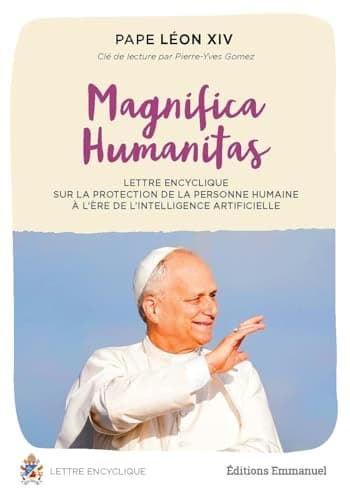
Magnifica Humanitas is Pope Leo XIV's first encyclical, a formal papal letter addressing the protection of human dignity in the age of artificial intelligence. Unlike typical papal documents that speak primarily to Catholics, this one addresses humanity itself. The encyclical positions AI not as an abstract technological question but as a profound moral challenge that strikes at the heart of what it means to be human.
The document arrives at a critical moment. Global AI adoption is accelerating faster than regulatory frameworks can manage. Meanwhile, public discourse remains trapped between techno-utopianism and Luddite panic. Leo XIV offers a third path: a coherent philosophical framework rooted in the intrinsic, non-negotiable dignity of every person.
The Central Argument That Changes Everything
Here's what makes this Magnifica Humanitas review essential reading: the encyclical identifies a dangerous philosophical shift in how AI systems treat human beings. When efficiency becomes the ultimate measure of value—when optimization replaces relationship—humans risk becoming projects to be perfected rather than persons to be respected.
Paragraph 112 crystallizes this: "When efficiency becomes the ultimate measure of value, human beings are tempted to see themselves as a project to be optimized rather than as persons called to relationship and communion." This isn't new Luddism. It's a sophisticated diagnosis of how technological systems reshape human self-perception.
More provocatively, Leo XIV argues that data colonialism represents a 21st-century form of exploitation. Paragraph 178 states: "Colonialism assumes new forms. It no longer dominates only bodies, but appropriates data, transforming personal lives into exploitable information. Entire regions, especially those marked by structural fragility and limited geopolitical relevance, are currently subjected to a new mindset of extraction: that of health data, epidemiological profiles, genetic maps and demographic information."
This isn't metaphorical. The encyclical draws direct parallels between historical imperialism and contemporary data extraction practices—a connection most AI ethics literature ignores.
Writing Style: Surprisingly Readable
Expect rigorous philosophy, not bureaucratic jargon. Pope Leo XIV writes with clarity and occasional fire. The encyclical grounds itself in Catholic social doctrine—principles developed over 140 years to address labor conflicts, economic inequality, and structural injustice—then applies those principles to AI with remarkable specificity.
The document doesn't shy away from complexity. It engages with technological realities while maintaining accessibility. Readers report that opening and closing passages hit particularly hard—they're worth rereading multiple times.
The writing avoids the preachy tone some might expect. Instead, Leo XIV constructs arguments methodically, building from shared human values toward concrete conclusions. This rhetorical approach makes the encyclical persuasive even to secular readers.
What Works Brilliantly
The Social Doctrine Framework: Rather than inventing new ethics from scratch, Leo XIV applies 140 years of Catholic social teaching to AI. This doctrine—birthed from the Church's response to industrial capitalism—offers principles that remain remarkably relevant: inalienable human dignity, the common good, subsidiarity, and solidarity. These aren't religious concepts; they're philosophical foundations that transcend faith traditions.
Specific Critiques of Utilitarian AI: The encyclical directly challenges the efficiency-maximization logic that dominates Silicon Valley. It argues that human flourishing cannot be reduced to optimization metrics. This is genuinely radical in tech industry discourse.
Recognition of Vulnerability as Human: A distinctive strength appears in how Leo XIV reframes human limitation. Rather than treating disease, aging, and vulnerability as defects to eliminate, the encyclical sees them as spaces where humans mature and open to relationship. This philosophical move cuts against the transhumanist grain without becoming anti-technology.
Structural Justice Focus: The document doesn't just warn about individual privacy violations. It analyzes how AI concentrates power in the hands of corporations and states, threatening democracy itself. This systemic analysis elevates the discussion beyond personal data concerns.
Where It Struggles
The Teleological View of History: Some readers note the encyclical carries a somewhat linear view of history—the sense that humanity progresses toward an endpoint. This philosophical framework, while traditional in papal documents, may frustrate readers who see history as more cyclical or contingent.
Just War Theory Critique Needs Expansion: The encyclical dismisses just war theory as outdated but doesn't fully develop alternatives for thinking about legitimate force or state authority. This feels underdeveloped given the encyclical's focus on power concentration.
Practical Implementation Remains Vague: While the philosophical framework is solid, the encyclical offers less guidance on how institutions should actually implement these principles. Readers seeking concrete policy recommendations may feel the document stops short.
The Paradox of Institutional Authority: An irony emerges when reading this as a secular reader: the encyclical critiques concentrated power while being issued by an institution that wields considerable authority itself. The document doesn't fully grapple with this tension.
The Reader Divide: Who Gets It, Who Doesn't
This Magnifica Humanitas review reveals a fascinating pattern in reader responses. Religious Catholics find validation and guidance. But perhaps more surprisingly, secular readers—even those hostile to organized religion—report finding the encyclical genuinely illuminating.
One reader, explicitly rejecting faith and organized religion, called the document "precious, current, and unmissable." Why? Because the philosophical arguments work independent of theological claims. The analysis of how human relationships break down under efficiency logic resonates across worldviews.
However, some readers struggle with the encyclical's framing. Those deeply invested in AI optimization or transhumanist frameworks will find it challenging rather than persuasive—which may be precisely the point.
Who Should Read This
Perfect for: Technology ethicists, policy makers, philosophers concerned with AI governance, anyone working in tech who feels moral unease about current trajectories, Catholics seeking papal guidance on contemporary issues, humanists interested in secular arguments for human dignity.
Will struggle with: Committed transhumanists, those seeking practical technical solutions rather than philosophical frameworks, readers allergic to any papal authority, people wanting data-heavy policy recommendations rather than ethical foundations.
How It Compares
Unlike Yuval Noah Harari's Homo Deus (which explores how AI might replace humans) or Nick Bostrom's Superintelligence (which focuses on technical AI safety), Magnifica Humanitas centers human dignity as non-negotiable. It's less about existential risk and more about existential meaning.
Compare it instead to Martha Nussbaum's capability approach to human development—both frameworks insist human flourishing cannot be reduced to metrics. But Leo XIV adds something Nussbaum doesn't: the claim that human value is intrinsic, not earned through achievement or productivity.
The Verdict
Is Magnifica Humanitas worth reading? Absolutely. This isn't a book you'll agree with entirely, but it's one that will sharpen your thinking about AI, human dignity, and power. Pope Leo XIV's encyclical offers what contemporary tech discourse desperately needs: a coherent philosophical alternative to utilitarian optimization.
The writing is clear, the arguments are rigorous, and the stakes are genuinely high. Whether you approach it as theology, philosophy, or urgent social commentary, Magnifica Humanitas earns serious attention.
The encyclical's central insight—that treating humans as projects to optimize rather than persons to relate to fundamentally corrupts our humanity—will haunt you after you finish reading. That's not a flaw. That's exactly what prophetic writing should do.
Final Score: 8.5/10
Justification: A philosophically serious, urgently necessary intervention in AI ethics that transcends its religious origins through rigorous argument, though it occasionally sacrifices practical specificity for principled clarity.