Category:
Book ReviewsLiar's Kingdom Review: Bold But Incomplete
Prices can sometimes be lower on bigger marketplaces, but this link helps independent bookstores and local reading communities.
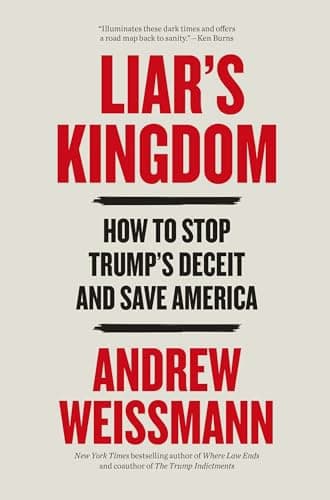
Andrew Weissmann's Liar's Kingdom: How to Stop Trump's Deceit and Save America tackles one of democracy's most urgent problems—the weaponization of political lies—but stumbles when it comes to delivering practical solutions. As a former Assistant U.S. Attorney and General Counsel for the FBI, Weissmann brings genuine credibility to this conversation. Yet his book oscillates between compelling diagnosis and frustratingly surface-level prescriptions, leaving readers with hope tempered by skepticism about whether any of his recommendations could actually survive judicial scrutiny.
The central premise is provocative: American law already restricts false speech in countless contexts—advertising, defamation, fraud—so why can politicians lie with near-total impunity about election results? This Liar's Kingdom review examines whether Weissmann adequately answers that question, and whether his proposed solutions are worth the intellectual investment required to understand them.
What This Book Actually Does
Weissmann structures his argument in three distinct movements. The first half rehashes the Trump administration's documented falsehoods and their consequences—the January 6th insurrection, election denial lawsuits, the erosion of public trust in democratic institutions. Readers already familiar with recent political history will find this section redundant. However, for those seeking a forensic compilation of how systematic lying destabilized American governance, Weissmann's prosecutorial lens provides useful documentation.
The middle section pivots to comparative law, examining how Germany, France, and Brazil have criminalized or restricted political falsehoods. This is where Liar's Kingdom becomes genuinely interesting. Weissmann doesn't simply transplant foreign legal frameworks; he acknowledges the constitutional, cultural, and institutional differences that make direct adoption impossible. His analysis of how other democracies balance free speech against democratic protection is thorough and thought-provoking.
The final quarter proposes three potential legal mechanisms for addressing political lies in America, complete with constitutional vulnerabilities and possible workarounds. This is simultaneously the book's most valuable and most underdeveloped section.
The Credibility Factor
Weissmann's credentials matter here. Unlike partisan commentators, he's a career prosecutor who worked on complex financial crimes and served in the FBI's upper echelons. When he argues that existing legal precedent already carves exceptions into First Amendment absolutism, he's not speculating—he's drawing from decades of courtroom experience. This authority gives Liar's Kingdom a gravity that purely political screeds lack.
Yet credentials alone don't solve the book's central problem: the gap between what should be legally possible and what will survive contemporary Supreme Court scrutiny. Weissmann acknowledges this tension but doesn't adequately wrestle with it.
Where the Book Excels
The comparative law section deserves praise. Weissmann's examination of how Germany prosecutes election misinformation without descending into authoritarianism is nuanced. His discussion of Brazil's experience with fact-checking legislation shows real research. These chapters demonstrate that democracies can indeed restrict political falsehoods without becoming tyrannies—a crucial counterargument to First Amendment maximalists.
Additionally, Weissmann's deconstruction of why existing false speech restrictions don't apply to elections is clarifying. The legal architecture he maps—defamation law's public figure exceptions, advertising regulation's limited scope—reveals genuine lacunae in American jurisprudence.
The writing itself is accessible. Weissmann avoids legal jargon where possible and explains necessary technical concepts clearly. This isn't a book that requires a law degree to follow.
The Critical Weaknesses
Here's where this Liar's Kingdom review must be honest: the book's proposed solutions lack teeth. Weissmann presents three options—legislative remedy, constitutional amendment, and judicial reinterpretation—but treats each with such caution that none emerges as genuinely viable. His acknowledgment that any solution requires Congressional and Supreme Court integrity simultaneously undermines his optimism. If we can't trust these institutions to act with integrity, why would they implement his proposals?
The first half's historical recap, while factually accurate, feels like padding. Readers drawn to this book already understand Trump's election lies and their consequences. Dedicating substantial pages to litigated falsehoods that already exist in public record dilutes the book's impact.
Most problematically, Weissmann's proposed solutions remain theoretical. He discusses how legislation might work, what constitutional challenges it would face, and potential defenses—but never demonstrates that any proposal could actually pass both chambers of Congress or survive appellate review. The book reads less like a playbook and more like a legal memo: thorough, but not actionable.
Some readers will find the legal sections tedious. Weissmann necessarily descends into constitutional doctrine to make his case, and this middle section requires sustained attention. Those seeking a quick polemic will find themselves bogged down in First Amendment jurisprudence.
Who Should Actually Read This
This book is essential for anyone genuinely interested in democratic reform and willing to engage with legal complexity. Civics teachers, policy professionals, and democracy advocates will find real value here. Readers concerned about election integrity and willing to think beyond partisan talking points should make this a priority.
Skip this if you're looking for a rousing call-to-arms or a simple roadmap for stopping Trump. Skip it if you've already read extensively about recent political history or have strong opinions about First Amendment limits. Skip it if you want concrete, immediately implementable solutions rather than theoretical frameworks.
Unlike comparable works such as Steven Levitsky and Daniel Ziblatt's How Democracies Die (which offers broader patterns of democratic erosion) or Barton Gellman's A Very Stable Genius (which focuses on Trump's specific incompetence), Weissmann's book is narrower and more technical. It's not a sweeping historical narrative; it's a focused legal argument.
The Real Tension
The polarized reader response reveals something important: this book inspires hope in some readers precisely because it takes the threat seriously, while disappointing others because it fails to deliver transformative solutions. Five-star reviewers praise Weissmann's courage and clarity; two-star reviewers find the proposals half-baked and the historical sections redundant. Both critiques contain truth.
Weissmann's fundamental problem is structural. He writes as a lawyer, not an activist. Lawyers present arguments and acknowledge counterarguments; activists present solutions and demand action. The book reads like the former because Weissmann is intellectually honest enough to admit that his own proposals face genuine constitutional obstacles.
The Verdict
Is Liar's Kingdom worth reading? Yes, if you care about democracy and can tolerate legal argumentation. Weissmann asks the right questions and brings genuine expertise to bear. His comparative law analysis is genuinely illuminating, and his documentation of how systematic lying destabilized American institutions is valuable.
But this isn't the comprehensive playbook its subtitle promises. It's a rigorous legal brief that proves the problem exists and that solutions are theoretically possible—without convincingly demonstrating that any solution could survive political and constitutional reality. Weissmann's book is necessary but incomplete, urgent but cautious, important but ultimately insufficient as a roadmap for saving democracy.
Read it for the analysis, not the answers. Use it as a starting point for deeper thinking about constitutional reform, not as a finished blueprint. Weissmann has identified the disease; he's less successful at prescribing the cure.