Category:
Book ReviewsL'Effondrement Review: A Raw Portrait of Class Collapse
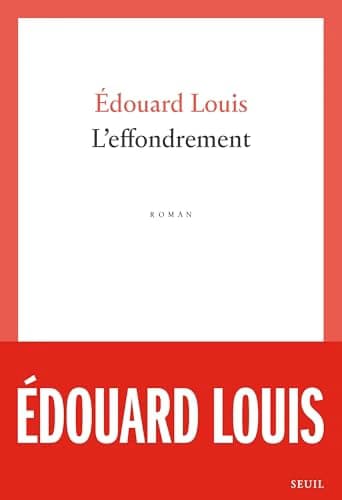
Prices can sometimes be lower on bigger marketplaces, but this link helps independent bookstores and local reading communities.
A Devastating Meditation on Class, Desire, and Broken Dreams
Édouard Louis's L'Effondrement is a profoundly unsettling examination of social collapse that masquerades as a memoir about his older brother's death. This isn't a conventional grief narrative—it's something far more provocative: a clinical autopsy of how poverty, parental rejection, and structural inequality can systematically destroy a human being. Louis refuses to sentimentalize his brother's suicide at thirty-eight, instead offering a portrait so unsparing it risks alienating readers who expect conventional emotional catharsis.
The central tension that makes this L'Effondrement review essential: Louis barely grieves. When he learned his brother was dead—after nine years of no contact—he felt nothing. Not sadness, not anger, not even the guilt one might expect. This emotional void becomes the book's most fascinating and controversial element, forcing readers to confront uncomfortable questions about familial obligation and the nature of loss itself.
What This Book Actually Explores
On the surface, L'Effondrement tells the story of a young man trapped between grandiose dreams and brutal reality. Louis's brother imagined becoming a world-renowned craftsman, traveling the globe, repairing cathedrals, winning his absent father's love. Instead, he remained anchored in the industrial north of France, in poverty, surrounded by violence that manifested not through physical brutality alone but through the systematic crushing of desire itself.
But this Édouard Louis work transcends simple biography. It's fundamentally about class as destiny—how being born poor doesn't just limit your opportunities, it colonizes your internal world. The brother's dreams were condemned before they began, not because he lacked talent or ambition, but because nobody in his environment possessed the cultural capital or social networks to help him escape. The book argues that working-class collapse isn't a moral failing; it's a structural inevitability.
Louis demonstrates how his brother became trapped in cycles of self-destruction: alcohol, gambling, violence toward women, homophobia directed at his queer brother. These weren't character flaws in isolation—they were symptoms of a man who had internalized society's message that he was worthless, unlovable, condemned.
The Writing: Deceptively Simple, Devastatingly Precise
Louis employs a deliberately restrained prose style that initially appears austere but reveals itself as extraordinarily controlled. His sentences are short, declarative, stripped of ornament. There's no melodrama here, no purple passages designed to wring tears from readers. Instead, the power emerges through accumulation—small details about failed job interviews, nights at the casino, his mother's silence in the face of paternal cruelty.
This stylistic choice mirrors Louis's emotional distance from his subject. He functions as a clinical observer rather than a grieving sibling, which some readers find refreshingly honest and others find uncomfortably cold. The writing refuses to manipulate; it simply presents the facts of a life and lets them speak.
Compared to similar works like Annie Ernaux's Shame or Deborah Levy's Living Autobiography, Louis maintains greater emotional restraint. Where Ernaux excavates the shame of class origin with lyrical intensity, Louis opts for documentary-like precision. This stylistic choice will appeal to readers who prize intellectual rigor over emotional catharsis.
What Works Brilliantly
The book's greatest strength is its unflinching examination of how class determines the shape of your interior life. Louis doesn't argue this abstractly—he traces it concretely through his brother's thwarted ambitions, his mother's learned helplessness, his father's systematic degradation of his stepson. The question posed implicitly throughout is devastating: how many brilliant potential lives are snuffed out before they begin, simply because of postal codes?
Louis also excels at capturing the specific texture of northern French working-class life: the industrial landscape, the limited economic horizons, the particular form of masculine violence that emerges when men have no legitimate outlet for their frustration. This regional specificity gives the book weight beyond memoir.
Perhaps most importantly, L'Effondrement refuses easy redemption narratives. Louis escaped through literature and intellectual work—but the book never suggests this was inevitable or available to his brother. The gap between their outcomes feels arbitrary, contingent, almost cruel in its randomness. This refusal to offer false comfort distinguishes it from much contemporary memoir.
Where It Stumbles
Some readers will find Louis's emotional distance from his subject deeply troubling. There's a risk that his clinical detachment reads as cold judgment rather than compassionate analysis. When he describes his brother's violence toward women or homophobic behavior, Louis doesn't excuse these acts—but neither does he fully explore the psychological mechanisms that produced them. A more generous reader might see this as appropriate restraint; a more critical one might see it as evasion.
The book's brevity, while often a strength, occasionally feels insufficient. Complex family dynamics get introduced and abandoned. The role of his mother—complicit through silence—deserves deeper examination. And while Louis positions himself as the brother who escaped, he doesn't fully interrogate his own complicity in the family's dysfunction or the guilt he perhaps should feel but doesn't.
Additionally, readers expecting L'Effondrement review material about how this fits into Louis's broader autobiographical project may find themselves disappointed. The book works as a standalone work, but those unfamiliar with his previous explorations of family trauma (Who Killed My Father, End of Eddie) might struggle with the assumed context.
Who Should Read This—And Who Shouldn't
Perfect for readers who:
- Value intellectual rigor over emotional manipulation in memoir
- Are interested in class analysis and social structures
- Appreciate formally experimental approaches to autobiography
- Want to understand how poverty functions as a system, not just a condition
- Read Annie Ernaux, Chris Kraus, or Rachel Cusk and want similar unflinching honesty
Will likely struggle with:
- Readers seeking conventional grief narratives or redemption arcs
- Those uncomfortable with the author's emotional distance from tragedy
- People looking for a "how to survive poverty" inspirational story
- Readers who prefer narrative momentum over philosophical reflection
- Anyone expecting warmth or familial reconciliation
The Verdict: A Necessary, Uncomfortable Book
8/10 — L'Effondrement is a masterwork of structural analysis disguised as intimate memoir, though its emotional coldness will alienate many readers.
Is L'Effondrement worth reading? Absolutely—but with the caveat that it will disturb you in ways you might not anticipate. This isn't a book designed to comfort or console. It's a book designed to make you understand, viscerally, how class operates as a death sentence for millions of people whose dreams are simply too expensive for their circumstances.
Louis has created something rare: a political book that never mentions politics, a devastating critique of capitalism that never lectures, a profound meditation on loss that refuses false sentiment. The question isn't whether this book is "good"—it's whether you're ready for what it has to say about the relationship between birth and destiny.