Category:
Book ReviewsLady of Uncanny Charms Review: Divisive Series Finale
Prices can sometimes be lower on bigger marketplaces, but this link helps independent bookstores and local reading communities.
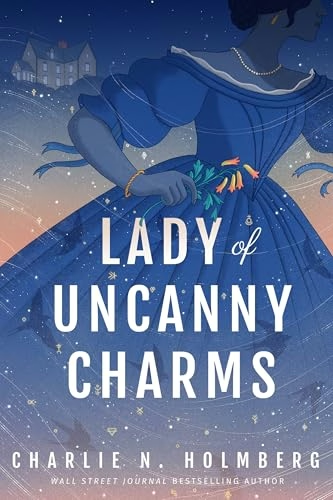
Charlie N. Holmberg's Lady of Uncanny Charms arrives as the fifth and final installment of the Whimbrel House series with considerable baggage—both narrative and thematic. This historical fantasy novel, set in 1851 England, follows Owein, a centuries-old wizard contracted to marry Lady Cora, only to find Queen Victoria has other plans for him and his magic. The book delivers on romance and intrigue but fundamentally struggles with the question every series finale must answer: does it honor what came before while providing satisfying closure?
Quick Verdict
Lady of Uncanny Charms is a competent but controversial conclusion that satisfies devoted fans of Owein's arc while disappointing those invested in the original cast. Holmberg's prose remains assured, but the narrative choices here—particularly the introduction of a major plot thread in the final book and the sidelining of beloved characters—will frustrate readers seeking a true series resolution rather than an extended epilogue. If you loved Keeper of Enchanted Rooms, this finale may feel like a step sideways rather than a triumphant landing.
What It's About
Owein travels to England prepared to marry his longtime epistolary friend Cora and claim the quiet life he's dreamed of. Instead, he's conscripted into Queen Victoria's League of Magicians, a shadowy organization obsessed with preserving and controlling magical power. Cora, heartbroken and resourceful, must investigate palace conspiracies while Owein navigates impossible choices between loyalty, love, and personal freedom. The setup promises intrigue and high stakes—and delivers both, though not always in the ways readers might expect.
The Romance That Saves It
Holmberg's greatest strength here is her treatment of Cora and Owein's relationship. Unlike the previous Owein-focused book (Wizard of Most Wicked Ways), this novel centers a romance that feels genuinely earned. The two characters have a foundation of trust and affection built through years of correspondence, and watching them navigate external pressures threatening to tear them apart creates genuine emotional tension. Cora emerges as a capable, intelligent protagonist—more compelling than her predecessor in the series—and her agency in unraveling palace secrets matters to the plot rather than serving as window dressing.
The love triangle that could have derailed everything instead resolves in a way that feels narratively honest rather than contrived. This is classic Holmberg at her best: character-driven fantasy where relationships carry weight.
Where the Series Stumbles
Here's where this Lady of Uncanny Charms review must address the elephant in the room: this book introduces a significant new story thread in the final installment of a five-book series. For readers who've invested in Merrit and Hulda's journey through the first three books, the shift toward a new generation of characters feels incomplete rather than evolutionary. The original cast receives minimal page time, relegated to the final pages in what reads more like an afterthought than a proper farewell.
The thematic problem runs deeper than nostalgia. The first three Whimbrel House books made magic central to their appeal—intricate systems, meaningful costs, genuine wonder. Here, magic feels diminished. The rules governing it seem less important, and the sense of discovery that characterized earlier entries is largely absent. For readers who valued the series' magical architecture, this represents a significant tonal shift that undermines what made those earlier books special.
The Controversial Elements
One reader identified a genuinely troubling thematic issue: the narrative appears to position readers as sympathetic to a faction initiating a eugenics program. This isn't a minor plot point but a core element of the political conflict. Whether Holmberg intended this or whether it emerges from the historical fantasy setting remains unclear, but the discomfort is valid. Fantasy novels set in historical periods must reckon with the ideologies those periods represent, and this book doesn't always do so clearly enough.
Additionally, the ending—while emotionally satisfying for some—fails to provide closure on several fronts. Major plot threads remain unresolved, and the conclusion reads more like a stopping point than a destination. For a series finale, this is a significant misstep.
Writing Quality & Pacing
Holmberg's prose remains polished and readable. She moves the narrative forward efficiently, and the book never drags. Character dialogue feels natural, and her ability to balance multiple plot strands simultaneously shows technical competence. If you're reading this after The Shattered King (which fans universally acknowledge as a low point in her career), you'll appreciate the return to form. The writing itself isn't the problem—the structural and thematic choices are.
Who Should Read This
Read Lady of Uncanny Charms if:
- You're committed to completing the Whimbrel House series and want to see Owein's story conclude
- You value romance over epic worldbuilding and are willing to accept a smaller-scale finale
- You haven't read the earlier books and are starting fresh (though you absolutely shouldn't—begin with Keeper of Enchanted Rooms)
- You love Holmberg's character work and can forgive structural shortcomings
Skip it if:
- You fell in love with Merrit and Hulda and expect them to feature prominently
- You wanted a true series conclusion that honors five books of investment
- You came for the intricate magic systems and worldbuilding
- You're sensitive to historical fantasy that doesn't adequately interrogate its moral dimensions
How It Compares
Think of this book as occupying the same space as The Poppy War series finale—technically competent but failing to deliver the narrative satisfaction readers earned through their investment. It's not as egregious a stumble as the final Mistborn book, which fundamentally changed its genre mid-series, but it shares that same sense of incompleteness. If you want a series finale that actually feels final, Six of Crows: Leigh Bardugo's duology conclusion remains the gold standard for this genre.
Final Verdict
6.5/10 — A readable but frustrating conclusion that prioritizes romance over resolution, disappointing fans who invested in the larger Whimbrel House story.
Charlie N. Holmberg's Lady of Uncanny Charms delivers what it promises in its romance plot while failing to deliver what a five-book series finale should: genuine closure. It's not a bad book, but it's a bad ending. For devoted series followers, it will feel like a step backward. For new readers, it's not a starting point—go back to book one instead. The real question isn't whether Lady of Uncanny Charms is worth reading; it's whether it was worth writing as the final book rather than as a novella epilogue to the series that came before.