Category:
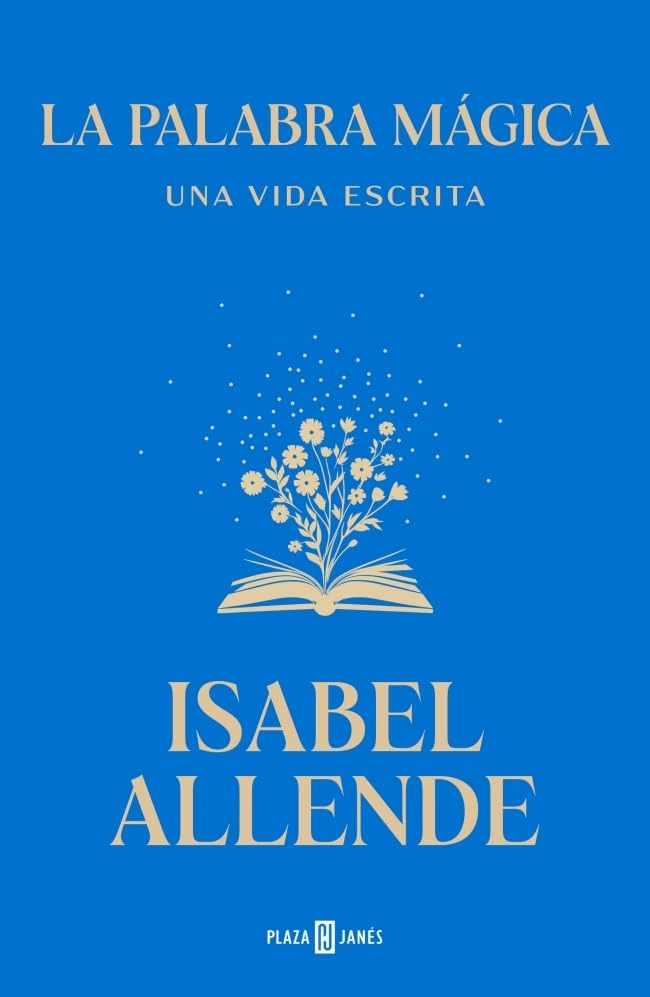
Book ReviewsLa palabra mágica Review: A Writer's Honest Masterclass
Prices can sometimes be lower on bigger marketplaces, but this link helps independent bookstores and local reading communities.
Quick Verdict
La palabra mágica: Una vida escrita by Isabel Allende is a deceptively simple book that masquerades as a writing guide but functions as something far more intimate—a spiritual conversation with one of contemporary literature's most prolific voices. This is not a how-to manual filled with rigid formulas; it's a meditation on the mysterious, almost sacred relationship between a writer and their craft. If you've ever wondered what drives someone to spend decades alone with their thoughts, translating invisible dreams into words on a page, Allende answers that question with the honesty of someone who has lived it.
What This Book Actually Is
Born from a 2024 BBC Maestro project titled Magical Storytelling, La palabra mágica emerged when Allende was asked to distill decades of creative practice into twenty structured lessons. What could have been a sterile academic exercise instead became something luminous: a series of interconnected essays that weave together Allende's personal history, her creative philosophy, and the specific techniques she's refined across more than forty years of writing.
The book opens by circling back to Allende's formative years—her childhood, her family's displacement during Chile's dictatorship, and how these ruptures became the emotional bedrock for everything she would later write. This context matters because Allende doesn't separate her life from her work. They are inseparable. The political upheaval that marked her early years didn't just inform her novels; it fundamentally shaped how she understands the power of storytelling itself.
Unlike conventional writing craft books—think Strunk & White or even Stephen King's On Writing—Allende's approach is phenomenological rather than prescriptive. She describes writing as a meditative state, a form of channeling that requires surrender rather than control. "Armar una historia es un proceso misterioso, orgánico, instintivo," she writes, emphasizing that the act of composition is less about technique and more about listening to what wants to be born through you.
The Intimate Voice That Sets This Apart
What distinguishes this La palabra mágica review from countless others is recognizing that Allende has essentially written an anti-writing-manual. Readers expecting a structured curriculum with actionable takeaways will be disappointed. Instead, what you get is something closer to sitting across from Allende at a café while she reflects on her process, her failures, her breakthroughs, and what she's learned about the strange alchemy of turning lived experience into narrative.
The writing itself reads like conversation—warm, digressive, occasionally self-aware about its own meandering quality. Allende doesn't pretend her mind works in orderly fashion. She describes it as "enredada como un plato de tallarines" (tangled like a plate of noodles), and the book's structure mirrors this organic messiness. You're not reading a blueprint; you're reading someone thinking aloud about what it means to dedicate your life to an art form that offers no guarantees.
This conversational quality is precisely why the audiobook format, which several readers specifically praised, becomes almost essential. Hearing Allende's own voice narrating her reflections on solitude, silence, and the strange visitations that come during deep creative work transforms the experience into something approaching intimacy.
Where This Book Excels
For anyone grappling with the decision to commit to writing as a serious practice, La palabra mágica offers something invaluable: permission and witness. Allende doesn't romanticize the work. She describes the loneliness, the self-doubt, the years of effort that precede any recognition. She talks about discipline—the "tenacity of a camel," word by word, error by error—but she frames discipline not as punishment but as devotion.
The book's treatment of inspiration versus discipline is particularly nuanced. Allende refuses the false binary. Yes, she experiences those moments of apparent channeling, when characters seem to move independently and stories tell themselves. But these moments only arrive after thousands of hours of deliberate, unglamorous work. The magic, she suggests, is earned through repetition and vulnerability.
Another strength is how Allende grounds her philosophy in concrete examples from her own novels. She doesn't speak abstractly about character development or narrative structure. Instead, she traces how a real event—something witnessed, overheard, or experienced—transforms through her imagination into a scene that bears only a distant resemblance to its source material. This specificity makes the book useful even as it resists being prescriptive.
The sections on research and observation are particularly strong. Allende describes how she becomes a kind of anthropologist of her own experience, noticing details, collecting fragments, building an internal archive that she can draw from years later. This approach to writing as a form of attentive living rather than isolated creation offers a counterpoint to the romantic image of the solitary genius.
What Falls Short
The primary limitation of La palabra mágica is that it offers little practical scaffolding for writers at different stages. A beginner hoping for guidance on structure, pacing, or dialogue will find precious little. The book assumes you already understand the basics and are seeking something more philosophical—a rationale for why this work matters, not instructions for how to execute it.
Some readers may also find the book's spiritual and mystical dimensions—Allende's references to meditative states, to being visited by "spirits" or "muses," to writing as a form of channeling—either inspiring or frustratingly vague. There's no attempt to demystify these experiences or explain them in psychological terms. Allende simply describes them as they feel to her, which is honest but offers limited utility for readers seeking concrete methodology.
The book is also, inevitably, shaped by Allende's particular context: decades of commercial success, international recognition, and the luxury of time and resources devoted entirely to writing. While she doesn't flaunt this privilege, readers struggling with economic precarity or competing demands on their attention may find some of her observations about "solitude" and "silence" somewhat removed from their reality.
Who Should Read This Book
This book is essential for:
- Established or aspiring literary writers seeking philosophical grounding rather than technical instruction
- Readers of Allende's novels curious about the mind behind the work
- Anyone interested in the writing life as a form of spiritual practice or meditation
- People navigating creative doubt who need reassurance that struggle and uncertainty are not signs of failure but fundamental aspects of the process
- Memoir and essay enthusiasts who appreciate intimate, conversational prose
This book will likely frustrate:
- Genre fiction writers seeking specific craft techniques
- Pragmatists looking for a structured curriculum
- Readers who prefer storytelling to self-reflection (though Allende's storytelling is excellent)
- Those seeking a traditional autobiography (it's fragmented, essayistic, not chronological)
Comparing to Similar Works
If you've read Stephen King's On Writing, you'll notice immediately that Allende takes a fundamentally different approach. King's book is direct, practical, and grounded in concrete advice about dialogue, description, and story mechanics. Allende's La palabra mágica is more akin to Natalie Goldberg's Writing Down the Bones—both emphasize writing as a spiritual practice, both value intuition alongside discipline, both see the writer's life as inseparable from the writing itself.
Compared to Anne Lamott's Bird by Bird, which combines practical advice with personal narrative, Allende tips much further toward the personal and philosophical. There's less scaffolding, more mystery, more willingness to sit with uncertainty.
Final Assessment
Is La palabra mágica worth reading? Yes—but with clear eyes about what it is. This is not a book to teach you how to write a novel. It's a book to teach you how to think like a writer, how to understand the commitment the work demands, and how to recognize that the struggle itself is not something to overcome but something to honor.
Allende has written the book she needed to write at this stage of her career: a reflection on six decades of creative practice, a gift to readers who love her work and want to understand its origins, and a kind of philosophical manifesto about why anyone would choose this difficult, solitary, essential practice.
The fact that it reads like a conversation rather than a lecture is precisely its strength. You finish the book feeling less like you've completed a course and more like you've had a long talk with someone wise about the things that matter most.
Final Score: 8/10
Justification: A luminous, honest meditation on the writing life that succeeds entirely on its own terms—not as a technical manual but as philosophical witness and spiritual companionship for serious writers.