Category:
Book ReviewsKolkhoze Review: A Masterclass in Family Genealogy
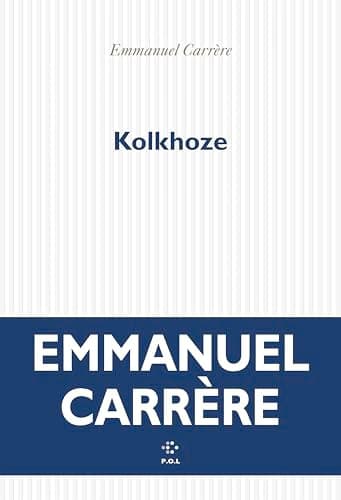
Prices can sometimes be lower on bigger marketplaces, but this link helps independent bookstores and local reading communities.
Emmanuel Carrère's Kolkhoze is a deliberately disorienting 450-page descent into family history that somehow becomes one of the most compelling reads of recent years. This isn't a conventional biography or memoir—it's a genealogical investigation wrapped in personal essay, historical documentation, and literary reflection. The Kolkhoze review landscape reveals a book that polarizes readers not through poor writing, but through its refusal to follow the expected rhythms of narrative storytelling.
What makes this book so difficult to categorize is precisely what makes it essential. Carrère constructs a labyrinth of Russian aristocratic lineage, Georgian heritage, and French bourgeois tradition, all converging on one figure: his mother, Hélène Zourabichvili Carrère d'Encausse, a lifetime secretary of the French Academy and one of France's most respected Russianists. The author uses his father's meticulous genealogical research—decades of archival work tracing family lines back through revolution, war, and displacement—as the foundation for an exploration of identity, legacy, and what we inherit from those who came before.
What It's About
The narrative begins in post-World War II Bordeaux, where a young bourgeois man marries a woman from a shattered aristocratic family: a Georgian father (possibly executed after Liberation) and a ruined German-Russian mother. This marriage becomes the gravitational center of Kolkhoze, but Carrère doesn't simply chronicle it. Instead, he spirals outward through time, examining the Zourabichvili family's entanglement with Russian imperial history, the Georgian political landscape, and the specific intellectual climate of twentieth-century France.
The book is structured as an investigation into his mother's world—not to expose secrets, but to understand how someone so formidable, so accomplished, could be so troubled by her son's earlier work, A Russian Novel, which touched on his father's wartime ambiguities. This tension becomes the emotional spine of the entire work: Carrère excavating the very history his mother spent her life studying, now doing so after both parents have died at advanced ages.
Writing & Style: Controlled Chaos
Carrère employs what one might call "styleless style"—prose so transparent it becomes invisible, allowing readers to focus entirely on the labyrinthine content. He doesn't ornament; he accumulates. Names pile upon names. Historical figures emerge, disappear, and resurface chapters later. Georgian princes, Russian revolutionaries, Nazi collaborators, French intellectuals: they form a constellation that could easily overwhelm, yet Carrère maintains narrative momentum through sheer force of attention.
The fluidity readers consistently praise isn't accidental. Despite the book's 550 pages and potentially intimidating genealogical apparatus, Carrère's prose moves with remarkable grace. He digresses, yes, but never meaninglessly. Each tangent illuminates the central obsession: understanding his mother, understanding himself through her, understanding how history sediments into family psychology.
What Works: The Emotional Architecture
The first 150 pages test patience. Genealogical tables, historical background on Georgian and Russian nobility, tangential biographical sketches—these sections read like research notes occasionally interrupted by literary consciousness. Readers should prepare for this. The book doesn't court immediate engagement.
But something shifts approximately one-third through. The accumulated genealogical detail suddenly becomes emotional scaffolding. The author's voice emerges not as detached historian but as a son trying to comprehend his mother's fierce intelligence, her stoicism, her anxiety about being exposed through her son's writing. The book transforms from genealogical investigation into something more profound: a meditation on how we become ourselves through the lives of those we inherit from.
The later sections, focusing on his parents' sixty-one-year marriage, are genuinely moving. Carrère captures his father as a man perpetually in his wife's shadow—not resentfully, but with a kind of devoted acceptance. His mother emerges as a woman of extraordinary accomplishment carrying the weight of family trauma. The book becomes an act of reconciliation, written after both parents' deaths, acknowledging ambiguities while refusing easy judgment.
Historically, the book resonates with contemporary interest in how authoritarian regimes—Soviet, Nazi, Stalinist—fractured families across Europe. Carrère's family experienced these fractures directly. His maternal grandfather disappeared under suspicious circumstances; relatives navigated collaboration and survival; displacement and reinvention became family inheritance. This historical dimension gives the genealogy genuine stakes.
What Doesn't Work: The Middle Passage
The first 150-200 pages genuinely test commitment. Readers accustomed to conventional narrative momentum will find themselves trudging through genealogical detail that feels more archival than literary. Carrère doesn't ease readers into the family history—he immerses them in it, assuming either prior knowledge or genuine patience.
Moreover, the book's structure occasionally feels arbitrary. Carrère abandons certain narrative threads, returns to them later, sometimes to diminishing effect. The constant introduction of historical figures—many of whom remain peripheral to the central emotional story—can feel like authorial self-indulgence rather than narrative necessity. Some readers will finish the book convinced Carrère needed a more rigorous editor; others will see this apparent formlessness as essential to capturing how family history actually feels: messy, digressive, resistant to neat narrative arc.
The book also assumes considerable familiarity with twentieth-century Russian and French history. Readers unfamiliar with Soviet history, French academic culture, or the specific historical moment of the 1940s may find themselves researching as they read—which some will experience as enriching, others as frustrating.
Who Should Read This
Kolkhoze is essential for readers who loved A Russian Novel and want to understand the family context that produced it. It's crucial for anyone interested in how historical trauma transmits through generations, how intellectual achievement coexists with psychological fragility, and how we narrate family history to ourselves.
This book rewards readers who approach it as exploration rather than entertainment. If you read biography for plot, if you prefer conventional narrative structure, if genealogical detail feels like punishment rather than pleasure, Kolkhoze will frustrate you. If you're willing to sit with complexity, to accept that understanding family requires accepting ambiguity, to read a book that takes its time establishing emotional resonance, this is genuinely exceptional work.
Compare it to Dept. of Speculation by Jenny Offill in its fragmented approach to family intimacy, or to The Years by Annie Ernaux in its attempt to capture historical forces through personal narrative. But Kolkhoze is ultimately its own creature—part genealogy, part memoir, part historical investigation, wholly committed to the proposition that understanding our parents is the work of a lifetime.
The Verdict
Is Kolkhoze worth reading? Yes, unequivocally, though not without caveats. This isn't a book for everyone, but for the right reader—someone willing to invest in genealogical complexity, historical depth, and the slow revelation of emotional truth—it's remarkable. Emmanuel Carrère has written a book that refuses easy categorization, that accumulates power through apparent digression, that proves genealogy can be literature. The first 150 pages demand patience. The final 300 justify it entirely.
Carrère achieves something genuinely rare: he makes family history feel urgent, personal, and historically significant simultaneously. The book is exhausting, occasionally tedious, frequently brilliant, and ultimately moving. It's a work that will likely improve in retrospect, as readers recognize how carefully Carrère has constructed emotional architecture from genealogical material.
Final Score: 8.5/10 — A challenging, rewarding masterwork that demands the right reader but delivers profound insights into family, history, and the stories we tell ourselves.