Category:
Book ReviewsIt Came from Neverland Review: Dark, Brilliant
Prices can sometimes be lower on bigger marketplaces, but this link helps independent bookstores and local reading communities.
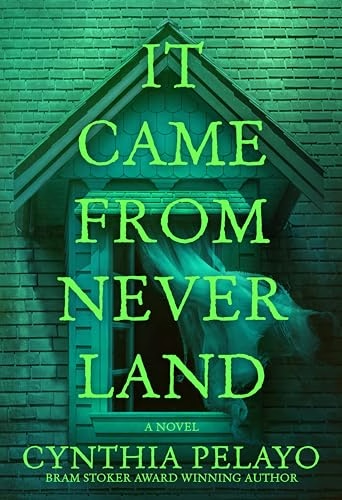
Cynthia Pelayo's It Came from Neverland is a psychological horror masterclass that obliterates the sanitized Peter Pan mythology we grew up with. This isn't a cute fairy-tale retelling—it's a haunting deconstruction of childhood trauma, grief, and the sinister cost of escapism, wrapped in gothic atmosphere so thick you can feel it suffocating you. If you loved the twisted atmosphere of Stephen King's It colliding with the twisted psychology of Mexican Gothic, this book demands your immediate attention.
The central premise is deceptively simple: Wendy Darling, now a schoolteacher and volunteer nurse during WWI, encounters a mysterious comatose patient who whispers "Peter Pan." This triggers buried memories of a darker Neverland—one where children went missing and were murdered, not whisked away to magical adventures. When her current student vanishes under suspicious circumstances, Wendy realizes Peter Pan isn't a childhood fantasy. He's a recurring nightmare she never escaped. Scotland Yard begins investigating, and Wendy becomes the prime suspect in a murder investigation that mirrors crimes from over a decade prior.
What This Book Actually Is
Let's be clear: It Came from Neverland review discussions often center on whether this is "really" horror or "really" fantasy. The answer is both, and that's precisely what makes it work. This is atmospheric psychological horror grounded in historical fiction. The WWI setting isn't window dressing—it's integral to the book's exploration of collective trauma, loss, and how entire societies cope with unimaginable grief.
Pelayo anchors the supernatural dread in a tangible world. Wendy isn't fighting a cartoonish villain in a magical realm. She's a rational woman trying to convince Scotland Yard that an entity from her childhood is orchestrating murders in 1914 London. The genius lies in the tension between what Wendy knows and what she can prove—a psychological pressure cooker that builds relentlessly.
The Writing: Prose That Haunts
Cynthia Pelayo's prose is the book's greatest strength. This isn't flowery or overwrought. It's precise, sensory, and deeply unsettling. Readers consistently report that her descriptions create an almost hallucinatory quality—you don't just read about decay and rain; you smell it. You hear the echoes. You feel the chill.
What separates this from typical gothic horror is the restraint. Pelayo doesn't rely on gore or shock value. The horror emerges from atmosphere, from the slow erosion of Wendy's certainty about her own mind, from the way childhood memories bleed into present-day investigation. It's the kind of horror that lingers in your thoughts at 3 AM, not the kind that makes you jump and forget.
The pacing is meticulous. Early chapters establish mystery and unease. The middle sections layer psychological complexity and historical detail. The final act accelerates into something genuinely shocking, yet the ending feels emotionally earned rather than manipulative. This is craft, not gimmickry.
Where It Excels
The characterization is exceptional. Wendy isn't a passive protagonist or a damsel. She's a complex woman carrying trauma, guilt, and the weight of knowing something no one believes. Her brothers remember Neverland as childhood fantasy, which creates genuine conflict—are they gaslighting her, or is she losing her grip on reality?
Peter Pan himself is terrifying because he's not explained away. He's not a metaphor for something mundane. He exists in this world as something genuinely dangerous and inexplicable. The book refuses easy psychological reductions. That's a bold choice that elevates it above standard horror fare.
The historical setting enriches rather than constrains the narrative. The trauma of WWI—soldiers returning broken, children orphaned, grief woven into the fabric of society—mirrors Wendy's personal trauma. The book understands that horror isn't just about individual fear; it's about how trauma echoes through families, communities, and nations.
The Tension Points
Here's where It Came from Neverland review opinions diverge: some readers want more concrete answers about Peter Pan's nature. Is he supernatural? Psychological? A manifestation of collective trauma? Pelayo deliberately leaves this ambiguous, and that's either brilliant or frustrating depending on your tolerance for ambiguity.
A few readers felt the mystery plot (Scotland Yard investigating Wendy) occasionally overshadows the supernatural elements, creating tonal shifts between police procedural and cosmic horror. Others found the WWI setting occasionally intrudes on the pacing, though most readers see this as adding thematic depth rather than slowing momentum.
The book is genuinely dark. If you're seeking whimsy or redemptive arcs, you'll be disappointed. This is a story about the cost of survival, the permanence of trauma, and the possibility that some nightmares never truly end.
Who Should Read This
Perfect for: Readers who loved Mexican Gothic, The Haunting of Hill House, or The Only Good Indians. Anyone fascinated by dark retellings that deconstruct beloved stories. Horror fans who prioritize atmosphere and psychology over jump scares. Literary fiction readers who appreciate craft and complexity. Those interested in how historical trauma and personal trauma intersect.
Skip it if: You want traditional Peter Pan nostalgia, cute fairy-tale retellings, or clear-cut resolutions. If you need answers about supernatural elements spelled out explicitly, this will frustrate you. If you prefer fast-paced thriller narratives over atmospheric slow-burns, this won't satisfy.
Comparisons That Matter
If you've read It by Stephen King, you understand how Pelayo channels that sense of childhood horror bleeding into adulthood, though her approach is more psychological and less epic in scope. If you've encountered The Thirteenth Tale by Diane Setterfield, you'll recognize the gothic atmosphere and unreliable memory, though Pelayo leans harder into genuine horror. This sits at the intersection of those sensibilities—literary sophistication with genuine dread.
The Verdict
It Came from Neverland is absolutely worth reading if you appreciate horror that respects your intelligence. Cynthia Pelayo has crafted something rare: a book that's simultaneously terrifying and beautiful, a retelling that honors the source material while completely subverting it, and a psychological exploration wrapped in gothic atmosphere.
Is this book for everyone? No. But for readers seeking literary horror that lingers—that makes you reconsider childhood stories and question the nature of trauma and memory—this is essential reading. The ending will stay with you. The prose will haunt you. The questions it raises won't let you go.
Final Score: 9/10 — A masterfully executed psychological horror retelling that proves dark fairy tales can be both intellectually sophisticated and genuinely terrifying.