Category:
Book ReviewsIndignity: A Life Reimagined Review - Ambitious But Uneven
Prices can sometimes be lower on bigger marketplaces, but this link helps independent bookstores and local reading communities.
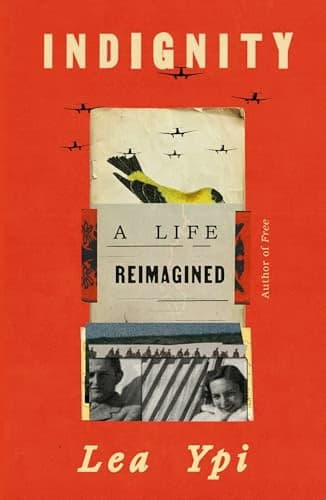
Lea Ypi's Indignity: A Life Reimagined arrives as a follow-up to her acclaimed memoir Free, but it's a fundamentally different beast—messier, more experimental, and ultimately more divisive. This hybrid investigation into her grandmother Leman's hidden past oscillates between archival investigation, imaginative fiction, and philosophical meditation on truth itself. The result is a book that will captivate readers willing to embrace narrative complexity, while frustrating those seeking the linear storytelling clarity of Ypi's debut.
The central premise is genuinely compelling: when a photograph surfaces on social media showing Ypi's grandmother and grandfather honeymooning in the Italian Alps in 1941—supposedly during a period when all family records were destroyed by communist police—Ypi embarks on a detective mission through archives, memories, and historical reconstruction. What emerges is a portrait of a woman caught between collapsing empires, shifting borders, and ideological upheaval, raising profound questions about how we know the people closest to us.
What This Book Actually Is
Indignity defies easy categorization, which is precisely its strength and its weakness. Ypi weaves together three distinct narrative modes: her own archival research into communist-era secret police files, imaginative reconstruction of her grandmother's interior life during World War II and the rise of communism in the Balkans, and broader historical investigation into Ottoman aristocracy, Greek nationalism, and Albanian political movements.
The book traces an extraordinary trajectory: Leman was born into Ottoman aristocracy in Salonica (Thessaloniki), grew up speaking French in a cosmopolitan merchant class, experienced the city's transformation into Greece following the Balkan Wars, endured Nazi occupation, and then—at a pivotal moment—moved to Albania where she met her future husband Asllan, a man whose father led a collaborationist government while Asllan himself sympathized with anti-fascist popular fronts. This biographical skeleton alone reveals why Ypi felt compelled to write this book: her family's story is a microcosm of twentieth-century European chaos.
Where the Ambition Pays Off
Ypi's Indignity review-worthy moments emerge precisely when she embraces the book's formal complexity rather than fighting it. Her investigation into how the Albanian secret police interrogated her grandmother about her past—including the mysterious 1941 photograph—reveals something genuinely unsettling: the state's obsessive documentation of private life, the way bureaucratic records become both historical evidence and instruments of control.
The historical reconstruction sections are often stunning. Ypi captures the texture of a vanished world: the linguistic plurality of Salonica before 1912, the shock of Greek incorporation, the particular anxiety of cosmopolitan elites watching fascism rise while their country was occupied. She doesn't flatten this history into simple narratives. Instead, she shows how her grandmother's generation faced impossible choices—how choosing to move to Albania, how marrying Asllan, how remaining silent under communist rule were all acts that made sense within their specific historical moment, even if they're difficult to judge from our vantage point.
This is where Ypi's philosophical inquiry becomes genuinely valuable. By refusing to condemn her grandmother from a position of moral certainty, she asks readers to grapple with a harder question: with what authority do we judge previous generations? This isn't moral relativism; it's intellectual humility about historical complexity.
The Structural Problem That Derails the Narrative
Yet here's where Indignity stumbles: the hybrid format that Ypi employs doesn't always serve the story. The fictional reconstructions of Leman's inner life, while occasionally evocative, interrupt rather than deepen the archival investigation. Readers encounter passages of imagined dialogue and reconstructed emotional experience that feel speculative in ways the archival material doesn't, creating a tonal whiplash.
The book's structure mirrors Ypi's genuine uncertainty about what she can actually know versus what she must imagine. That's conceptually interesting, but narratively it creates a diffuse reading experience. Unlike Free, which had the propulsive momentum of a personal coming-of-age story, Indignity often feels like it's working against itself—starting threads, abandoning them, circling back, digressing into historical context that, while fascinating, doesn't always connect to the central mystery of who Leman really was.
Ypi herself seems aware of this tension. She includes numerous anecdotes and character sketches from the communist archives—stories of neighbors, distant relatives, political associates—that illuminate the historical period but often feel tangential to her grandmother's narrative. The book becomes, at times, a history of mid-twentieth-century Balkan politics rather than a focused investigation into one woman's life.
The Comparison That Matters
Readers familiar with other recent memoirs that grapple with family secrets and historical trauma—works like Deborah Eisenberg's Twilight of the Superheroes or Jenny Erpenbeck's Kairos—will recognize Ypi's territory. But where those works maintain tighter formal control, Indignity sprawls. The comparison to Ypi's own Free is even more instructive: Free told a single, coherent story of a child growing up under communism, with clear emotional and narrative momentum. Indignity attempts to do multiple things simultaneously, and the result is that none of them quite achieves the force they might have in isolation.
Who Should Read This Book
This Indignity review ultimately depends on what you want from literature. If you're seeking experimental narrative forms that mirror the fragmentation of historical knowledge, if you're interested in how archives construct truth, if you're fascinated by twentieth-century Balkan history and the experience of border-crossing and identity-shifting, then this book will reward your engagement.
You should read Indignity if you value intellectual ambition over narrative smoothness, if you're willing to sit with uncertainty about what can be known versus imagined, if you appreciate philosophical inquiry embedded in biographical investigation.
You likely won't enjoy this book if you want straightforward storytelling, if you prefer memoir to be emotionally direct and chronologically clear, if you find frequent digressions frustrating, or if you approach historical fiction skeptically. The book's formal experimentation will feel like obstruction rather than illumination.
The Deeper Issue: Truth and Imagination
What lingers after finishing Indignity is Ypi's central question: why was her grandmother smiling in that 1941 photograph? The secret police asked it too. But the book never fully answers it—and that may be the point. Ypi suggests that some historical truths remain inaccessible, that imagination and empathy matter as much as documentation, that dignity requires resisting the impulse to reduce complex lives to simple narratives.
This is philosophically rigorous, but it also means the book can feel frustratingly inconclusive. Readers seeking resolution will be disappointed. Those seeking an investigation into how we construct historical meaning will find much to contemplate.
Final Verdict
Indignity: A Life Reimagined is a book that splits readers precisely because it refuses easy access. It's intellectually ambitious in ways that demand respect, yet narratively uneven in ways that demand patience. Lea Ypi's follow-up to Free shows an author willing to take formal risks, to embrace uncertainty, to resist simple answers about who we are and what we can know about the past.
Is Indignity worth reading? Yes—but with the caveat that you're signing up for a challenging, sometimes frustrating, ultimately thought-provoking experience rather than a conventionally satisfying narrative. It's a book that works better in retrospection than in the moment, its themes crystallizing after you've finished rather than propelling you forward while reading. That's not a failure; it's a different kind of success, one that requires readers to meet Ypi's ambitions halfway.