Category:
Book ReviewsI'm a Lot Review: Messy, Funny, Brutally Honest
Prices can sometimes be lower on bigger marketplaces, but this link helps independent bookstores and local reading communities.
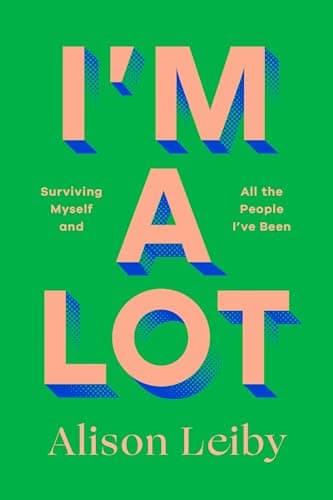
Alison Leiby's debut essay collection I'm a Lot: Surviving Myself and All the People I've Been is a polarizing memoir that refuses to package women's complexity into something digestible. The comedian and writer—known for her work on The Marvelous Mrs. Maisel—delivers fourteen personal essays that celebrate contradiction rather than resolve it. This is not a self-help book masquerading as memoir. It's a defiant middle finger to anyone expecting women to pick a lane and stay in it.
The central thesis is deceptively simple: women contain multitudes, and that's not a problem to solve—it's a feature to celebrate. Leiby anchors this exploration in her own life: she's a former jock and discount shopaholic, a Housewives stan and happily single cat mom, someone who survived a near-death experience at nineteen and emerged not enlightened, but determined to simply be. What could have been saccharine becomes sharp because Leiby refuses sentimentality. She writes about chronic pain, abortion, digital addiction, and childlessness with the same deadpan tone she uses to describe her relationship with picnics.
What It's About
I'm a Lot is structured around the various identities Leiby has inhabited: the only child, the chronic pain patient, the woman too online, the person who refuses motherhood. Each essay functions as both personal narrative and social commentary. Leiby examines how women are pressured to conform to patriarchal categories—the "Carrie or Charlotte" binary that reduces female identity to a handful of recognizable archetypes. She explores what happens when you refuse that reduction.
The book's emotional anchor is Leiby's medical history. At nineteen, a complication from back surgery nearly killed her. Rather than emerging as an enlightened survivor, she simply became someone who lives with chronic pain and knows how fragile everything is. This shapes her philosophy: there's nothing more beautiful than getting to be yourself, especially when the world insists you be palatable instead.
Writing & Style
Leiby's prose is conversational without being sloppy. She writes like she talks—which is to say, she writes like a comedian who understands that humor is often the most honest thing available. Her deadpan delivery lands because it's precise. Consider this line about being an only child: "I love that as an only child I got to have a real, individual relationship with each of my parents... this isn't about you. This is about me, because I'm an only child and everything is about me."
The essays move between tender introspection and biting social observation. Leiby can write movingly about pain and vulnerability in one paragraph, then pivot to absurdist commentary on Twitter culture or reality television in the next. This tonal flexibility is her greatest strength. She doesn't ask readers to choose between taking her seriously and laughing at her jokes—you do both simultaneously.
The collection reads more like connected standalone pieces than a unified narrative. Some readers find this liberating; others find it structurally loose. There's no traditional arc that builds toward resolution. Instead, each essay is its own small reckoning.
What Works Brilliantly
The essay on chronic pain is exceptional—Leiby articulates how women's pain is systematized into invisibility, how doctors dismiss symptoms, how society expects suffering to be performed quietly. She writes about the specific humiliation of explaining your limitations to people who don't believe you're actually limited. This resonates because it's specific rather than preachy.
Her essays on digital culture and Twitter's decline capture something genuinely important about millennial women's relationship with online spaces. She explores how women perform themselves online, the dopamine hits of engagement, and the specific betrayal of watching a platform you helped build get destroyed by billionaire whim. These essays feel urgent in a way that transcends memoir.
The abortion essay is matter-of-fact in the best way. Leiby refuses to make it a tragedy or a triumph—it's simply a decision she made, a procedure she had, a thing that happened in her life. This normalization is radical given how politicized abortion discourse has become.
Where It Stumbles
Not every essay lands with equal force. Some pieces feel thin—interesting observations stretched across a few pages without enough substantive development. A reader looking for deeper exploration of certain topics might finish an essay feeling like they've barely scratched the surface.
The collection's lack of thematic coherence bothers some readers more than others. If you're expecting a traditional memoir arc—where experiences build toward insight and growth—you'll be disappointed. I'm a Lot explicitly rejects that narrative structure. The essays don't resolve into a unified self; they celebrate the fact that no unified self exists. This is intentional, but it's also a structural choice that won't work for everyone.
There's also a question of whether the book's central premise—that women should embrace their contradictions—is genuinely radical or simply describes how most people actually live. The book argues we should stop pretending to be one thing; most readers probably already know they're multiple things. What Leiby offers isn't revelation so much as permission and company.
Who Should Read This
This book is perfect for readers who loved Dept. of Speculation by Jenny Offill or Trick Mirror by Jia Tolentino—writers who prioritize honesty over likability and fragment over linearity. If you appreciate comedic memoirs that don't punch down, if you've ever felt exhausted by the pressure to be a certain kind of woman, if you want essays about pain and disability that don't inspire pity, this is your book.
Read it if you're chronically ill and tired of people treating your condition like a minor character flaw. Read it if you're childless by choice and want validation that this is a complete life. Read it if you're interested in how millennial women navigate identity, online culture, and the specific exhaustion of being told you're "too much."
Don't read it if:
You're looking for prescriptive self-help or a clear roadmap to becoming your best self. You want a traditional memoir with rising action and climactic revelation. You prefer essays that dig deep into a single topic rather than sampling multiple aspects of a life. You're skeptical of millennial self-awareness and want to avoid it entirely.
The Verdict
I'm a Lot review reveals a book that's genuinely funny, occasionally profound, and refreshingly resistant to neat conclusions. Alison Leiby's I'm a Lot won't appeal to everyone—some readers will find it shallow, others will find it life-changing. The truth is probably both. This is a book that validates a specific kind of modern female experience: complicated, contradictory, refusing to apologize for taking up space.
Is I'm a Lot worth reading? Yes, if you're the person it's written for. Leiby knows exactly who that is. She's not trying to convince skeptics or win over people who need their memoir neatly packaged. She's speaking to women who've spent their lives being told they're "too much"—too opinionated, too loud, too needy, too sick, too ambitious, too something—and she's saying: good. Be all of it.
The book's greatest achievement is its refusal to resolve. Leiby doesn't become a better person through her essays; she simply becomes more herself. In a genre often obsessed with transformation, that's genuinely subversive.
Final Score: 7.5/10 — Uneven but memorable, with moments of real brilliance that justify its existence despite structural looseness.