Category:
Book ReviewsI Want You to Be Happy Review: Brutally Honest
Prices can sometimes be lower on bigger marketplaces, but this link helps independent bookstores and local reading communities.
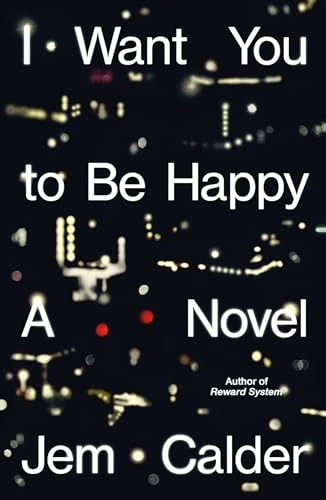
Jem Calder's debut novel I Want You to Be Happy is a deeply divisive contemporary fiction that forces readers to confront uncomfortable truths about modern romance, ambition, and the performance of intimacy in the digital age. This isn't a feel-good love story—it's a forensic examination of two emotionally mismatched people attempting connection while fundamentally operating on different wavelengths. If you're expecting warmth, redemption, or character growth, this book will frustrate you. If you're prepared for something sharper and more unflinching, it might feel like a personal attack in the best possible way.
Quick Verdict
Jem Calder's I Want You to Be Happy is a technically accomplished but emotionally punishing read that works as either a love story for the digital age or a cautionary tale—possibly both simultaneously. The novel's central relationship between Chuck, a 35-year-old copywriter, and Joey, a 23-year-old barista-poet, crackles with tension precisely because they're incompatible. Calder refuses to make this comfortable, and that's both the book's greatest strength and its most alienating feature.
What It's About
The premise is deceptively simple: two people meet in a bar and begin a relationship. But Calder uses this familiar setup to dissect something far more complex—the way modern individuals construct versions of themselves through digital communication, career performance, and curated lifestyles. Chuck has abandoned his novelistic ambitions to become a "lead copywriter" at an advertising agency (a detail he corrects constantly, revealing his fragile ego). Joey dreams of being a poet while surviving on barista wages, privately aspirational but publicly accommodating.
Their age gap isn't incidental; it's structural. Chuck represents a different digital operating system entirely—he texts with capital letters and punctuation, like corporate emails. Joey texts like a human being. This fundamental incompatibility in how they communicate becomes the book's central nervous system. Every text exchange is loaded with timestamp analysis, strategic delays, and the crushing anxiety of modern courtship where a blue tick feels like judgment.
The relationship unfolds with excruciating self-awareness. Both characters are performing versions of adulthood and sophistication while deteriorating in real time. Neither is particularly likeable, and that's precisely the point.
Writing & Style
Carder's prose is sharp and precise, with a dark comedic sensibility that recalls Sally Rooney's Normal People, though this novel has a different emotional temperature. Where Rooney often finds tenderness in dysfunction, Calder leans into the bleakness. The dual POV structure is particularly effective—watching Chuck and Joey misunderstand each other simultaneously creates a claustrophobic tension that builds throughout the narrative.
The texting sequences are genuinely unsettling. Calder captures the way we analyze every word choice, every pause, every decision about punctuation as though it carries profound meaning. If you've ever agonized over whether to include a period at the end of a text message, this book will make you feel seen and slightly ashamed. The sex scenes are deliberately awkward and forensically embarrassing—you genuinely want to evacuate your own body reading them.
What Calder understands brilliantly is that addiction in contemporary life isn't just about substances. It's about loops, notifications, and the constant hum of needing to feel something, anything, even if it's just a blue tick on a message. Both characters are addicted to the idea of connection more than actual connection itself.
What Works
The novel's greatest achievement is its unflinching examination of self-awareness as an aesthetic. Both Chuck and Joey are obsessed with appearing cultured, interesting, and intellectual while actively rotting in real time with screens and bad decisions. Depth becomes performance. Everyone is curating; no one is connecting. This observation feels genuinely important and relevant to how many of us actually live.
The characterization of Chuck is particularly effective as a portrait of emotional bankruptcy dressed up as sophistication. His recent breakup has left him functioning as a "functioning alcoholic" (a term he'd probably correct), and he mistakes his luxury flat and career stability for actual adulthood. Joey mistakes this hollow lifestyle for something aspirational, and watching her gradually realize the mistake is painful and compelling.
The novel also captures something true about how different generations experience technology and relationships. This isn't just about age; it's about fundamentally different ways of being in the world. The book gets that younger people often romanticize the stability of older people without recognizing the emptiness underneath.
What Doesn't Work
The central problem with I Want You to Be Happy is that it's essentially a 300-page argument for why these two people shouldn't be together, and that's all it offers. Once you understand the fundamental incompatibility—which becomes clear relatively early—the novel doesn't have much else to say. You spend the entire reading experience wanting Joey to leave Chuck, and the book doesn't provide sufficient reason to care whether she does.
Chuck's perspective, while technically accomplished, becomes tedious. Being inside his self-pitying, self-aggrandizing mind for extended passages feels punishing in a way that doesn't generate insight so much as irritation. Some readers will find this intentional—the book is supposed to make you uncomfortable. Others will find it simply boring.
There's also a tension in Calder's critique of flat female characters in literature (which Chuck, ironically, is guilty of writing) while Joey herself lacks real interiority or growth arc. She's sympathetic, but she's not particularly developed as a character beyond her function in the narrative—to be the younger woman making questionable choices about an older man. The novel is aware of this dynamic but doesn't transcend it.
The depiction of London also feels cynical and somewhat tired. It's a specific type of London literary fiction—the one where everyone is miserable, terminally online, and optimizing their lives while deteriorating. It's recognizable, but it's also well-trodden territory.
Who Should Read It
Perfect for: Readers who loved Normal People and want something darker and more caustic. People who are obsessively interested in how technology shapes modern romance and communication. Anyone who's ever analyzed a text message like it contained encrypted meaning. Readers who appreciate unlikeable characters and uncomfortable situations. Those who want a book that will make them question their own texting habits and romantic patterns.
Avoid if: You need character growth and redemption arcs. You prefer straightforward narratives with clear emotional payoffs. You're tired of millennial and Gen-Z ennui in literature. You want romance that feels warm rather than forensically embarrassing. You find Chuck insufferable and can't tolerate spending 300 pages in his head. You prefer plot-driven narratives over character studies. You're looking for a feel-good read.
The Comparison Question
If you're wondering whether I Want You to Be Happy compares to Sally Rooney's Normal People, here's the distinction: Rooney finds moments of genuine tenderness within dysfunction. Calder doesn't. This novel is more aligned with the bleaker aspects of contemporary literary fiction—it diagnoses the problem but doesn't offer hope. Whether that's a feature or a bug depends entirely on what you want from fiction.
Is "I Want You to Be Happy" Worth Reading?
Yes, but with caveats. This "I Want You to Be Happy" review isn't recommending it as an enjoyable escape. It's recommending it as an important document about how we actually communicate and connect (or fail to) in contemporary life. Calder has something genuine to say about performance, authenticity, and the gap between how we present ourselves and who we actually are. The problem is that what she says is bleak, and the novel doesn't transcend its own bleakness.
If you're the type of reader who finds value in discomfort, who appreciates sharp social observation over emotional catharsis, who wants to feel slightly exposed and ashamed of your own behavior—this book delivers. If you need fiction to make you feel better about the world, look elsewhere.
Final Verdict
7/10 — A technically accomplished and genuinely insightful examination of modern romance that's too content to diagnose problems without offering any reason to care about resolution.
Jem Calder's debut is sharp enough to demand attention and bleak enough to repel many readers. The novel's central insight—that we're all performing versions of ourselves through digital communication while fundamentally misunderstanding each other—is important. The execution is skilled. But the book ultimately feels like it has nothing to say beyond "isn't this depressing?" And while that might be honest, it's not quite enough.