Category:
Book ReviewsI Want to Be Famous Review: Celebrity Culture Decoded
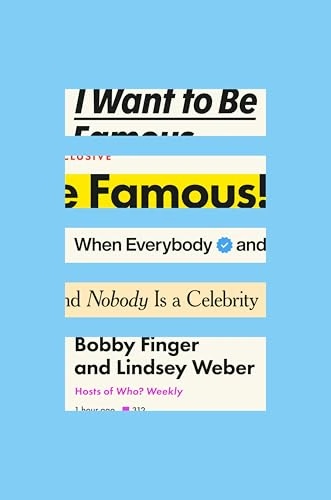
Prices can sometimes be lower on bigger marketplaces, but this link helps independent bookstores and local reading communities.
Bobby Finger and Lindsey Weber's I Want to Be Famous: When Everybody and Nobody Is a Celebrity arrives at precisely the right cultural moment—when the distinction between famous and forgotten has collapsed into algorithmic chaos. This isn't a gossipy celebrity roast or a nostalgic look backward. Instead, it's a sharp, intellectually rigorous examination of how fame itself has fundamentally transformed in the digital age, wrapped in the authors' signature comedic sensibility.
The book's central thesis is deceptively simple: celebrity now operates as a binary system. You're either a "Them"—someone whose name alone registers instant recognition (Beyoncé, Taylor Swift, Tom Cruise)—or you're a "Who," that bewildering category of allegedly famous people who prompt genuine confusion. The beauty of this framework isn't its snark; it's its clarity. In an era where Instagram influencers, TikTok stars, and traditional celebrities compete for the same attention economy, the Who/Them distinction cuts through the noise with surgical precision.
What Makes This Book Essential Reading
Finger and Weber bring a decade of podcast experience to this project, and it shows. I Want to Be Famous reads like a meticulously researched media studies thesis that somehow never forgets to be entertaining. The authors trace celebrity's evolution from the Warhol era through reality television, the rise of social media, and into the current fragmented landscape where everyone has the potential to be famous but almost nobody can maintain that status.
The book's strongest chapters dissect contemporary celebrity behavior with anthropological precision. When the authors examine stan culture, they're not just documenting fan behavior—they're exploring how parasocial relationships have become the primary currency of modern fame. Similarly, their analysis of celebrity product endorsements, from makeup lines to wellness supplements, reveals how desperation masquerades as entrepreneurship.
What elevates this beyond typical pop culture commentary is the authors' willingness to engage with uncomfortable questions. Why do we care? What does our hunger for celebrity say about us? And most pressingly: as accessibility to fame increases, why does the path to sustained relevance narrow?
The Writing and Structure
The prose is consistently engaging without being showy. Finger and Weber write with the confidence of people who've spent a decade analyzing celebrity trivia and discovered that trivia, when examined closely, reveals profound truths about culture. Their tone balances irreverence with genuine insight—they'll reference Danielle Jonas shilling for pork on Instagram one moment, then pivot to substantive media theory the next.
The book's organization follows thematic rather than chronological logic, which works beautifully. Each chapter functions as a self-contained essay that builds toward a larger argument about the unsustainability of modern fame-seeking. The extensive citations (mentioned repeatedly by readers) demonstrate serious research without ever becoming pedantic.
Where the Argument Shines
The most compelling sections examine how celebrities have become complicit in their own coverage. When celebrities break their own news on social media, when they manufacture controversy, when they post Notes app apologies—they're essentially competing with the media infrastructure that once mediated their image. The authors show how this has created a feedback loop where authenticity itself becomes a performance.
The historical context is particularly valuable. By tracing celebrity culture from the 1960s through the present, Finger and Weber demonstrate that our current chaos isn't unprecedented—it's an acceleration of existing trends. The comparison between Perez Hilton's crude celebrity mockery and contemporary anonymous gossip accounts reveals how the mechanisms of fame-obsession have evolved while the underlying impulse remains constant.
The Who/Them framework also serves as a useful corrective to outdated celebrity hierarchies. The traditional "A-list to D-list" ranking system assumes a stable, recognizable celebrity ecosystem. In reality, fame is now so fragmented that someone could be a massive TikTok personality, completely unknown to film audiences, and simultaneously a "Who" to general culture. The authors understand this better than most.
What Doesn't Quite Land
The book occasionally indulges in inside jokes that, while delightful for longtime podcast listeners, might leave general readers slightly adrift. References to recurring podcast segments feel earned rather than forced, but they do create a two-tier reading experience—one for the initiated, one for newcomers.
Additionally, while the authors excel at diagnosis, the prescriptive elements feel less developed. The conclusion gestures toward the future of fame without fully committing to predictions or solutions. Some readers may want more concrete speculation about where celebrity culture is headed, rather than just analysis of how we arrived here.
There's also a question of whether the book's scope is too broad. Attempting to cover everything from stan culture to celebrity podcasts to social media algorithms means some topics receive treatment that feels slightly surface-level, even if that surface is expertly analyzed.
Who Should Read This Book
This book is perfect for: Anyone interested in media studies, pop culture criticism, or the mechanics of contemporary celebrity. If you've ever found yourself down a Wikipedia rabbit hole about forgotten celebrities or wondered why certain people maintain fame while others vanish, this will feel revelatory. Fans of cultural criticism in the vein of Famesick or similar media analysis will appreciate the intellectual rigor beneath the entertainment value.
Skip this if: You're looking for pure gossip or celebrity scandal coverage. This isn't a tell-all or exposé. If you want entertainment divorced from analysis, you'll find the frequent theoretical asides frustrating rather than illuminating. Additionally, if you have zero interest in celebrity culture generally, the book's premise won't suddenly convert you.
The sweet spot: Readers who enjoy pop culture but think critically about it. People who listen to media-focused podcasts. Anyone who's noticed that fame feels fundamentally different than it did ten years ago and wants to understand why.
Is I Want to Be Famous Worth Reading?
Absolutely. Bobby Finger and Lindsey Weber's I Want to Be Famous succeeds because it treats celebrity culture as a legitimate subject worthy of serious analysis while maintaining a light touch. It's neither cynical nor uncritically celebratory—it's genuinely curious about what's happening in the attention economy.
Compared to similar works, this book occupies interesting territory. It's less memoir-focused than Famesick but more personal and humorous than academic media studies texts. It's more substantive than typical celebrity gossip but more accessible than dense cultural criticism. That balance is rare and valuable.
The research is thorough, the writing is sharp, and the central framework—while simple—proves remarkably useful for understanding contemporary celebrity. Most importantly, the book never loses sight of the absurdity at its core. Fame-seeking is fundamentally silly, and the authors never let readers forget that while simultaneously demonstrating why we can't look away.
Final Verdict
8/10 — A sharp, well-researched examination of modern celebrity that entertains while it educates, though occasionally sacrifices depth for breadth.