Category:
Book ReviewsHyperpolitik Review: Brilliant Diagnosis, Frustrating Execution
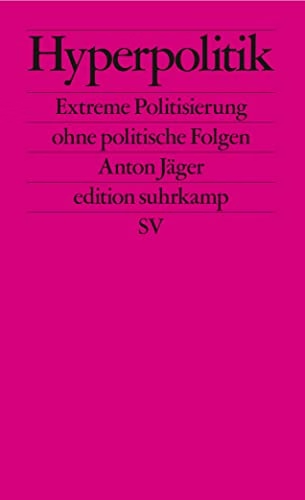
Prices can sometimes be lower on bigger marketplaces, but this link helps independent bookstores and local reading communities.
Anton Jäger's Hyperpolitik arrives as a provocative diagnosis of our political moment: we're drowning in politics without actually doing politics. The book has earned a respectable 3.78/5 rating, but that aggregate score masks a genuine divide among readers—some find it crystalline and essential, while others dismiss it as an overstuffed essay collection masquerading as serious analysis.
Let me be direct: this is a book with a genuinely important observation trapped inside mediocre execution.
What Jäger Is Actually Arguing
The core thesis is deceptively simple. We've moved from an era of "postpolitics"—where technocrats managed society while citizens passively consumed—into something Jäger calls "hyperpolitics." Everything is now political. Your coffee brand, your pronoun choice, your streaming preferences. The culture wars have escaped Twitter and invaded dinner tables.
But here's the rub: this explosion of political engagement produces almost no actual political change. Protests grow larger while policy victories shrink. People perform activism online with increasing frequency while institutional power remains untouched. We're experiencing what Jäger calls a crisis of disconnection—mass organizations that once channeled public anger into collective action have dissolved, leaving us isolated and digitally tethered.
It's a compelling observation. And it's also one you've probably already had yourself.
The Diagnosis Is Sharper Than the Prescription
Jäger traces 150 years of democratic history to show how we arrived here. The book moves through different political regimes—mass parties, welfare states, neoliberal consensus—each with distinct relationships to collective action. This historical sweep should feel authoritative. Instead, it often feels like a literature review where Jäger is more interested in citing Laclau, Rancière, and Agamben than in building original arguments.
Readers consistently report the same frustration: the book reads like a collection of related essays rather than a coherent argument. One moment Jäger is discussing U.S. mass incarceration, the next he's parsing the genealogy of postpolitical thought. The connections exist, but they're often implicit rather than explicit. You do the intellectual work of synthesis; Jäger assumes you're already halfway there.
This wouldn't be catastrophic if the book were longer. But at modest length, it feels simultaneously bloated with references and undernourished in original analysis. Several readers noted that Hyperpolitik should have been a Substack essay—a devastating critique for a book that purports to diagnose why we're all drowning in shallow digital discourse.
Where the Writing Becomes a Problem
Jäger's prose style divides readers sharply. Some find it elegant and crystalline—genuinely enjoyable to read. Others find it needlessly obscure, wielding difficult language and untranslated references ("cum grano salis") as if writing for a seminar room rather than actual readers.
Consider this passage: "Two decades of political turmoil later, these testimonies feel at once familiar and strange, like one of Magritte's domestic interiors." The simile is precise if you know Magritte's work intimately. But Magritte isn't primarily known for domestic interiors—the reference feels more like aesthetic posturing than illumination. Similarly, Jäger drops Hegelian aphorisms without explanation, assuming readers will either know them or Google them mid-book.
This isn't academic rigor; it's a failure of communication. Even dense theoretical work—think Mark Fisher or David Graeber, both of whom Jäger resembles stylistically—manages to explain itself as it goes. Jäger often doesn't.
What Actually Works
When Jäger stops theorizing and observes, he's genuinely insightful. His analysis of how mass incarceration functions as a form of depoliticization is sharp. His observation that we live in a world where "everything is suffused with politics, without any stakes whatsoever" captures something real and troubling about contemporary life.
The book also succeeds as a cultural artifact. It crystallizes thoughts many of us have struggled to articulate—the sense that we're caught between total politicization and total impotence. There's real value in that clarification, even if it's not entirely original. Sometimes you need a classy Euro-academic to confirm what you already suspected.
For readers interested in how digital technology has rewired political engagement, there are genuine insights here about isolation, atomization, and the collapse of mediating institutions. Jäger identifies a real problem: we've lost the organizational infrastructure that once converted public anger into collective action.
The Central Tension
The book's most frustrating aspect is what it doesn't resolve. Jäger diagnoses hyperpolitics but offers little concrete analysis of what comes next. His call for renewed political organization is sincere but vague. How exactly do we rebuild mass movements in an age of algorithmic fragmentation? Hyperpolitik gestures toward the question but doesn't engage it seriously.
One perceptive reader noted the irony: Jäger, writing regularly for the New York Times, seems to benefit from the very system he's critiquing. His book becomes part of the hyperpolitical apparatus—another intellectual product consumed and discussed online, generating heat but no light.
Who Should Actually Read This
Read this if: You're interested in contemporary political theory, you want a concise history of postwar democratic forms, or you're looking for validation that the current moment feels genuinely broken. You appreciate dense theoretical writing and don't mind doing some of the interpretive work yourself.
Skip this if: You're looking for practical analysis of how to rebuild political organizations, you want original insights rather than crystallized observations, or you find untranslated academic references more annoying than illuminating. If you've read Mark Fisher or David Graeber and found them insufficiently rigorous, Hyperpolitik won't satisfy you either.
The Real Question: Is Hyperpolitik Worth Reading?
Yes, but with caveats. The book succeeds as a diagnostic tool—it names something real about our political moment. It fails as a comprehensive analysis or prescription. You'll finish it feeling understood but not enlightened, validated but not transformed.
Jäger's Hyperpolitik review scores highly when readers simply want confirmation of their own discomfort. It scores poorly when they want something more: original analysis, rigorous argumentation, or actionable insight. The book occupies an uncomfortable middle ground—too theoretical for casual readers, too impressionistic for serious scholars.
The most honest assessment: this is a book that crystallizes our era's stupidity while participating in it. That's not nothing. But it's not quite enough either.
Final Verdict
7/10 — A sharp diagnosis undermined by scattered execution and the assumption that naming a problem constitutes analyzing it.