Category:
Book ReviewsHow to Know a Person Review: Brooks' Best Work Yet
Prices can sometimes be lower on bigger marketplaces, but this link helps independent bookstores and local reading communities.
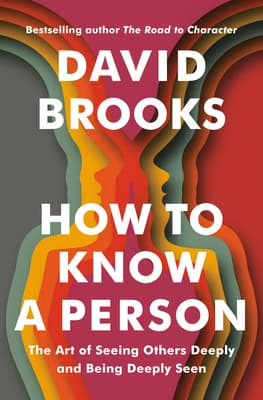
David Brooks' latest offering, How to Know a Person: The Art of Seeing Others Deeply and Being Deeply Seen, arrives at a cultural moment when we desperately need it. This is not another shallow self-help manual promising quick fixes to complex human problems. Instead, Brooks delivers something rarer: a psychologically grounded, genuinely practical guide to the lost art of truly seeing another person. The verdict is straightforward—this is essential reading for anyone exhausted by surface-level relationships and performative social interaction.
What This Book Is Actually About
The premise seems deceptively simple: most people feel invisible and misunderstood, and most of us are terrible at making others feel valued. But Brooks' central insight cuts deeper. He argues that the ability to truly know another person isn't a personality trait you're born with—it's a skill that can be developed, refined, and mastered. This reframing matters enormously. It transforms connection from something dependent on charisma or natural empathy into something achievable through deliberate practice.
The book is fundamentally about listening. Not passive hearing, but active, embodied, generous listening. Brooks explores how our attention shapes what we perceive in others, and how the questions we ask—or fail to ask—determine the depth of connection we achieve. Drawing from psychology, neuroscience, theatre, and education, he constructs a framework for human connection that feels both intellectually rigorous and emotionally resonant.
The Practical Arsenal: Methods That Actually Work
What separates How to Know a Person from the overcrowded self-help landscape is its specificity. Brooks doesn't just tell you to "listen better." He introduces concrete techniques like SLANT (Sit up, Lean forward, Ask questions, Nod, Track the speaker)—a deceptively simple method for conveying genuine attention. He discusses "loud listening," the practice of reflecting back what you hear to confirm understanding. These aren't revolutionary concepts, but their presentation here feels earned rather than prescriptive.
The book excels at addressing the question most people actually grapple with: How do I ask good questions? Brooks identifies a widespread social blindness—many people simply don't ask questions at all. They deliver monologues disguised as conversations. The reader reviews consistently highlight this revelation as transformative, particularly for those with social anxiety who mistakenly believe their problem is being "boring" rather than recognizing they're simply not asking enough about others.
Brooks also tackles the mechanics of perception itself. How do we look at someone and see something "large" in them? What draws our attention? These aren't trivial questions—they're foundational to understanding why some people feel seen while others remain invisible in crowded rooms.
Where Brooks' Argument Gets Complicated
No rigorous review of How to Know a Person can ignore its vulnerabilities. Some assertions lack empirical grounding. The discussion of botox and facial expressions—the claim that people who can't furrow their brows struggle to perceive others' worry—feels speculative rather than supported by neuroscience. Brooks occasionally generalizes about human behavior without acknowledging exceptions or cultural variations. These moments don't derail the book, but they do remind us that this is a work of synthesis and observation rather than original research.
There's also a subtle tension in Brooks' philosophy. He emphasizes the importance of seeing people as they truly are, yet much of his advice involves strategic listening techniques and intentional questioning. The line between authentic connection and performative empathy—between genuinely seeing someone and skillfully executing a listening protocol—occasionally blurs. Some readers will find this energizing; others may detect a faint whiff of manipulation lurking beneath the humanism.
The Writing: Accessible Without Being Simplistic
Brooks writes with clarity and warmth. He avoids the jargon-heavy prose that plagues academic psychology books and the saccharine tone that undermines many self-help offerings. His examples feel drawn from lived experience rather than focus groups. The book moves between theoretical frameworks and practical application smoothly, never pausing long enough for the reader to feel lectured.
The structure itself models good listening—Brooks anticipates reader questions and addresses them directly. He acknowledges counterarguments. He admits uncertainty. This intellectual humility makes the prescriptive moments feel less dogmatic than they might otherwise.
Who This Book Is Perfect For—And Who Will Struggle
This book is indispensable for anyone in a relationship-intensive profession: therapists, teachers, managers, coaches, parents. It's equally valuable for people who recognize they've been neglecting depth in their personal relationships. If you've ever felt unseen or realized you've been making others feel invisible, How to Know a Person offers both diagnosis and remedy.
It's particularly powerful for introverts and people with social anxiety who've internalized the belief that they're simply "bad at socializing." Brooks reframes connection as a learnable skill rather than an innate trait, which is psychologically liberating.
However, readers seeking cutting-edge neuroscience or groundbreaking original research will find this book less satisfying. Those allergic to any prescriptive element in their nonfiction—who resist frameworks and techniques on principle—may experience Brooks' structured approach as overly formulaic. Additionally, readers from cultures with different communication norms might find some of his assumptions about conversation and eye contact culturally specific rather than universal.
Comparing to Similar Works
If you've read Brené Brown's work on vulnerability and connection, How to Know a Person feels like a natural companion text—less focused on personal shame and more focused on interpersonal perception. It's more grounded and less inspirational than Brown's writing, which some will prefer. Compared to Daniel Goleman's Emotional Intelligence, Brooks' book is more accessible and less academically dense, making it a better entry point for general readers while potentially feeling less rigorous to psychology professionals.
The book occupies interesting territory between self-help and literary nonfiction. It has the practical ambitions of the former and the intellectual sophistication of the latter, which is exactly why it escapes the typical self-help traps that plague the genre.
Is How to Know a Person Worth Reading?
Yes, unequivocally. This is Brooks at his best—combining his trademark curiosity with genuine utility. The book delivers on its promise: it teaches you how to see others more clearly and helps others feel more truly seen. In a culture fragmenting along ideological, generational, and tribal lines, the practice of deep seeing feels almost radical.
The real measure of a book like this isn't whether every claim is perfectly supported or every technique universally applicable. It's whether it changes how you move through the world. Readers consistently report that How to Know a Person does exactly that. After finishing it, people notice themselves asking better questions. They catch themselves half-listening and redirect their attention. They see someone in their life more clearly and act on that seeing.
That's not just good self-help. That's meaningful work.
Final Verdict
David Brooks has written a book that respects both the complexity of human connection and the reader's intelligence. How to Know a Person succeeds because it refuses easy answers while still offering concrete guidance. It's simultaneously a philosophical meditation on what it means to truly see another person and a practical manual for doing exactly that. In a crowded marketplace of connection-focused books, it stands out for its rigor, warmth, and genuine utility. This is essential reading for our fragmented moment.