Category:
Book ReviewsHow Lucky Am I Review: Beautiful Art, Hollow Philosophy
Prices can sometimes be lower on bigger marketplaces, but this link helps independent bookstores and local reading communities.
Christian Watson's How Lucky Am I is a visually stunning graphic novel that achieves something rare: it makes you want to linger on every page while simultaneously rolling your eyes at the text. This is a book that succeeds brilliantly at half its ambition, which makes it frustratingly uneven rather than disappointing outright.
The premise is simple but emotionally resonant. Through the eyes of Mr. Skelly—a skeleton character who's become a social media phenomenon—Watson takes us on a journey across natural landscapes, through grief, joy, loss, and love. The central question, "How lucky am I to have lost what I wanted, to find what I deserved?" frames an exploration of acceptance, presence, and mortality. It's the kind of book that arrives at exactly the right moment in someone's life and feels like a personal letter.
What This Book Actually Is
How Lucky Am I is part illustrated memoir, part self-help affirmation collection, and entirely a product of the social media age. Watson has built a substantial following by pairing skeleton illustrations with gentle, life-affirming messages. This book is the natural evolution of that work—a physical object that captures what made his online presence compelling in the first place.
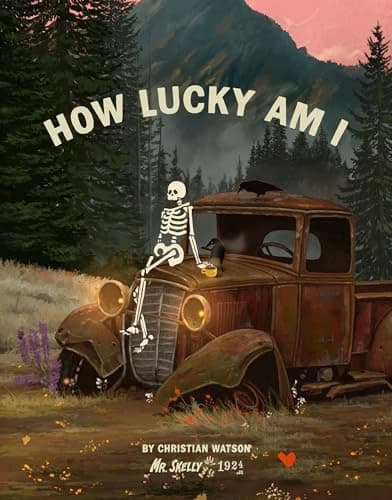
The graphic novel format is deceptive. This isn't a traditional narrative arc. Instead, it's a series of vignettes: Skelly in sun-dappled forests, beside wildflower-lined streams, on crumbling moss-covered walls, standing on grassy cliffsides. Each scene is paired with reflections on existence, loss, and gratitude. The structure mirrors how we actually consume self-help content today—in small, digestible pieces designed to fit into our fractured attention spans.
Where the Magic Happens: The Artwork
Let's be direct: you should buy this book for the illustrations and tolerate the text. Watson's hand-painted imagery is genuinely exceptional. The natural scenes aren't just decorative—they're the actual substance of the work. You can feel the moss on those walls, sense the humidity in those forests. The skeleton figure, rendered with such tenderness and personality, transforms from a memento mori symbol into something almost alive.
This is where How Lucky Am I achieves something profound. By placing a skeleton in these idyllic natural settings, Watson forces us to confront mortality without flinching. Death isn't presented as something to fear or escape; it's simply part of the landscape. The artistic choice to render these scenes with such warmth and beauty is quietly radical. In an era of doom-scrolling and ambient anxiety, these illustrations function as visual antidepressants.
The attention to detail is remarkable. Wildflowers aren't generic—they're specific botanical specimens. Trees have individual character. Skelly's posture shifts with emotional context. This is the work of an artist who has spent considerable time actually observing nature, not someone generating imagery from a template.
The Problem: When Words Betray Beautiful Images
Here's the central tension that defines the How Lucky Am I review conversation: the text frequently undermines the artwork's sophistication.
Phrases like "it is what it is" and "do the best you can" appear repeatedly throughout the book, and they land with the weight of motivational poster clichés. The accompanying text often feels incongruous with what the illustrations are actually saying. A stunning image of Skelly in a forest doesn't need the caption "DON'T GIVE UP"—the image already communicates acceptance and persistence far more eloquently.
This is the specific criticism that divides readers. Those who came for affirmations find them earnest and comforting. Those who expected philosophical depth find them platitudinous. The truth is both things are happening simultaneously. Watson is walking a tightrope between genuine wisdom and greeting-card sentiment, and he frequently tumbles toward the latter.
The repetition becomes noticeable by the book's midpoint. You begin to anticipate the inspirational beats. The pacing flattens. What works in small social media doses—a single image paired with a single reflection—starts to feel thin when collected in book form.
Where It Transcends Its Own Limitations
Then, roughly three-quarters through, something shifts. A passage about death emerges—written across several pages—that nearly redeems all the preceding clichés:
"I hope death feels like being picked up from the backseat and carried to my bed half asleep, where tucked in and eyes closed I can hear those who love me talking through a cracked door."
This section works because it's specific, vulnerable, and unexpectedly poetic. It's not a platitude; it's a genuine meditation on mortality that acknowledges both fear and comfort. The writing here matches the sophistication of the artwork. It suggests that Watson is capable of deeper philosophical work—and that makes the earlier passages feel like choices rather than limitations.
This moment also hints at what How Lucky Am I could have been: a book that trusts its images and its readers enough to say less. The most affecting sections are those where Watson steps back and lets the illustrations carry the emotional weight.
The Generational Question
One reader noted surprise at finding themselves moved by this work, questioning whether age was making them susceptible to what might otherwise feel saccharine. This is worth examining. How Lucky Am I is explicitly designed for a generation raised on social media affirmations, TikTok wisdom, and the aestheticization of mental health. For readers outside that context, the book can feel manipulative or shallow.
But there's something honest about that design choice. Watson isn't pretending to be writing for a literary audience. He's creating something that meets people where they actually are—scrolling, seeking small moments of meaning, hungry for permission to feel their feelings. In that context, the book's accessibility is a feature, not a bug.
Who Should Actually Read This
Read How Lucky Am I if:
- You're drawn to illustrated books and graphic memoirs
- You appreciate gentle reminders about presence and mortality without heavy philosophy
- You follow Watson's work online and want the complete collection
- You're going through a difficult season and need accessible comfort
- You value aesthetics and hand-crafted art over textual density
Skip it if:
- You expect philosophical rigor from your self-help reading
- You find affirmation-based literature fundamentally hollow
- You're looking for narrative complexity or character development
- You've already extracted everything valuable from Watson's social media presence
- You prefer your mortality meditations served with more intellectual substance
The Verdict: Is This Worth Reading?
How Lucky Am I is absolutely worth reading for the artwork alone. Whether the text justifies the purchase depends entirely on where you are in your life and what you expect from a book. For someone navigating grief, loss, or existential uncertainty, this could be exactly what you need. For a reader seeking literary sophistication, it will feel slight.
The book's 4.45-star rating across 552 reviews reflects this reality. It's genuinely good at what it attempts, but what it attempts is deliberately modest. There's no pretense here—Watson knows his audience and serves it well. The question isn't whether How Lucky Am I is a good book; it's whether it's the right book for you.
The Larger Context
What's interesting about Christian Watson's How Lucky Am I is how it represents a shift in contemporary publishing. Social media artists are translating their digital followings into physical books with increasing frequency. These projects exist in a liminal space—not quite traditional publishing, not quite fan objects. They succeed by being exactly what their audiences want: accessible, beautiful, emotionally direct, and unconcerned with literary gatekeeping.
In a world saturated with AI-generated imagery and algorithmic content, hand-painted illustrations carry weight. Watson's commitment to analog craft feels genuinely countercultural. That aesthetic choice matters, perhaps more than the specific words on the page.
Final Thoughts
The most honest assessment of How Lucky Am I acknowledges both its genuine strengths and its real limitations. The artwork is exceptional—worth the price of admission alone. The text is uneven—sometimes profound, often forgettable. The book succeeds most when it trusts its images to do the heavy lifting and fails most when it over-explains what the illustrations already communicate.
Is this book worth reading? If you appreciate visual art and don't demand philosophical depth, absolutely. If you want to support an artist doing genuinely beautiful work, yes. If you're seeking profound meditations on mortality and meaning, you'll find moments of real insight alongside considerable filler.
What How Lucky Am I ultimately offers is permission—permission to think about death without morbidity, to embrace what you've lost, to recognize luck in unexpected places. For readers seeking that permission, this book delivers. For everyone else, the illustrations alone might be enough.