Category:
Book ReviewsHolier Than Thou Review: Profound But Frustratingly Unfocused
Prices can sometimes be lower on bigger marketplaces, but this link helps independent bookstores and local reading communities.
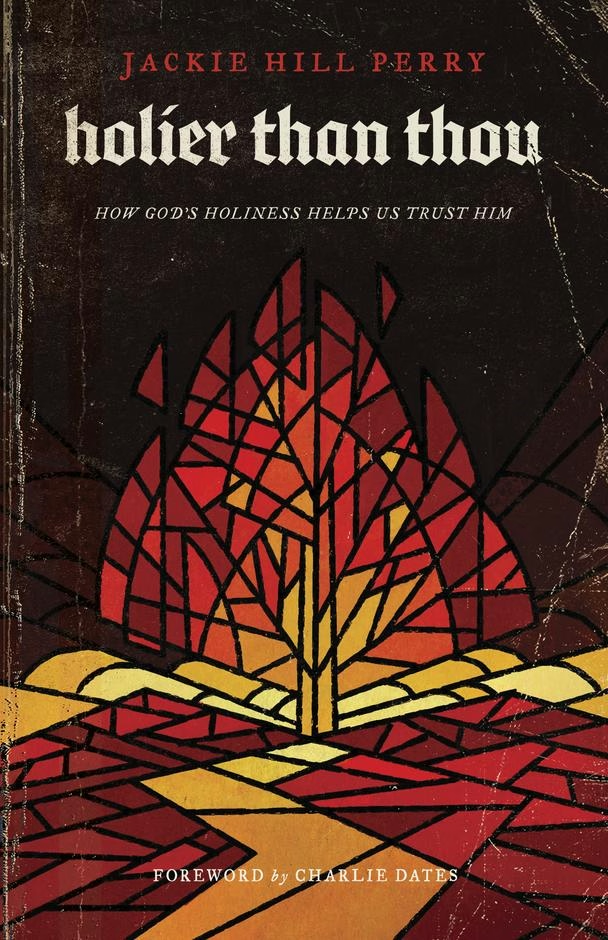
Jackie Hill Perry's Holier Than Thou: How God's Holiness Helps Us Trust Him arrives with an ambitious thesis and a straightforward promise: understanding God's holiness is the key to trusting Him. The book has garnered strong reader engagement with a 4.38/5 rating across thousands of reviews, yet the critical consensus reveals a fascinating divide. Some readers find it transformative and beautifully crafted; others describe it as choppy, meandering, and ultimately unsatisfying despite respecting Perry's ministry and intentions.
This Holier Than Thou review cuts through the polarized responses to ask the real question: Is this book worth your time, and if so, whose time specifically?
What the Book Promises
Perry's central argument is deceptively simple: if God is holy, then He cannot sin. If He cannot sin against us, then He must be the most trustworthy being in existence. This logical progression forms the heart of Holier Than Thou: How God's Holiness Helps Us Trust Him—a follow-up to Perry's acclaimed memoir Gay Girl, Good God. The book attempts to dismantle our cultural misunderstandings of holiness, which Perry argues have rendered the concept dusty, irrelevant, or worse, off-putting to modern believers.
The premise resonates because it addresses a genuine spiritual problem: we claim to trust God while living as though He might withhold good from us. We operate from the same suspicion Eve entertained in Eden—that God cannot be fully trusted with our lives. Perry's diagnosis is that this distrust stems from a fundamental misunderstanding of what holiness actually means.
The Writing: Where Style Meets Substance
Perry's signature lyrical prose is on full display throughout these pages. She's a poet by training, and it shows in her word choices, metaphorical density, and rhythmic sentence construction. For readers who gravitate toward her work, this stylistic flourish is precisely what makes Holier Than Thou memorable—passages are quotable, pithy, and designed to linger in your consciousness.
However, this same strength creates the book's primary structural weakness. At under 200 pages, Perry attempts to cover holiness in its totality: God's moral perfection, His separation from creation, His justice, His sovereignty, and how all of this connects to trust. The result is a text that reads more like a collection of interconnected meditations than a focused argument. Readers expecting a sustained exploration of the subtitle—How God's Holiness Helps Us Trust Him—often finish the book uncertain whether they've genuinely grasped that connection or simply encountered a beautiful primer on holiness generally.
The translation into Spanish, noted by some international readers, adds another layer of complexity. Capturing Perry's poetic sensibility across languages proves extraordinarily challenging, and some readers found the translated version lost crucial fluidity.
What Works Exceptionally Well
When Holier Than Thou hits its stride, it's genuinely moving. Perry's ability to stack image upon image, building toward theological insight, creates moments of real power. The core thesis—that God's holiness is not a distant, cold attribute but rather the foundation of His trustworthiness—is both scriptural and psychologically astute.
The book is thoroughly grounded in Scripture. Perry doesn't philosophize abstractly; she walks readers through biblical texts, allowing the Word to do the theological heavy lifting. This scriptural saturation gives the work credibility and substance. Readers consistently highlight how Perry connects God's holiness to practical idolatry—the false gods we construct through our beliefs about who God is and what He might withhold from us.
One particularly resonant insight appears repeatedly in reader responses: the idea that our sexual ethics, speech patterns, financial choices, and relational patterns all flow from foundational beliefs about God's character. If we genuinely believed God was holy and therefore trustworthy, our entire lives would reorganize around that conviction. This connection between theology and lived reality is where Perry's work shines brightest.
For readers already steeped in theological study, Holier Than Thou offers fresh language and accessibility without sacrificing depth. It's the kind of book that rewards slow reading and multiple passes, with new insights emerging on second encounter.
The Frustrations: Structure and Focus
The primary criticism leveled against this book—and it's a legitimate one—concerns its structural diffusion. Perry covers too much ground without maintaining sufficient gravitational pull toward her central claim. Readers report feeling the text "meander" through various holiness-related topics without always explaining how each piece connects to the overarching question of trust.
The subtitle promises a specific payoff: How God's Holiness Helps Us Trust Him. Yet readers finish the book uncertain they could articulate that connection clearly. The book provides the theological groundwork but doesn't always build the explicit bridge between premise and practical application. This is particularly frustrating for readers seeking concrete tools for deepening their trust, rather than theological exploration for its own sake.
The length—under 200 pages—creates an inherent constraint. Perry has compressed an enormous subject into a slim volume, which means individual concepts receive treatment that feels introductory rather than comprehensive. Readers familiar with R.C. Sproul's The Holiness of God or other systematic treatments sometimes find Holier Than Thou feels more like a devotional meditation than a sustained theological argument.
For some readers, this brevity is a feature; for others, it's a significant limitation.
Who Should Read This Book
Perfect for: Believers seeking to deepen their understanding of God's character without wading through dense academic theology. Readers who love Perry's poetic style and have appreciated her previous work. Anyone struggling with trust in God and willing to sit with theological concepts slowly. People who read Scripture regularly and want contemporary guidance for interpreting holiness passages. Those looking for a book that functions equally well as a personal devotional or small-group study text.
Will likely frustrate: Readers seeking a tightly argued, laser-focused exploration of how holiness specifically generates trust. Those who prefer systematic theology over lyrical meditation. Anyone wanting extensive practical application and concrete strategies for implementing theological concepts. Readers who found Perry's previous work overly poetic or who prefer straightforward, direct prose. Those new to Christian theology who might benefit from more foundational scaffolding.
Comparison to Similar Works
If you've read Sproul's The Holiness of God, Perry's book is shorter, more accessible, and more personally meditative. Sproul builds a systematic case; Perry creates an experiential encounter. Neither approach is superior—they serve different purposes.
Compared to other contemporary Christian books on trust and faith, Holier Than Thou is more theologically rigorous than many popular offerings, yet less academically dense than scholarly works. It occupies a middle ground, which explains why it resonates powerfully with some readers while leaving others wanting more.
The Verdict
Is Holier Than Thou worth reading? That depends entirely on what you're seeking. If you want beautiful theological reflection that connects God's holiness to your struggles with trust, and you're willing to do some interpretive work yourself, absolutely. If you're seeking a tightly structured argument that methodically proves its thesis, or a practical how-to guide for deepening faith, you may finish disappointed.
Jackie Hill Perry has written a book that deserves its strong reader ratings, even as it deserves the legitimate criticisms leveled against it. Holier Than Thou: How God's Holiness Helps Us Trust Him is a genuinely faithful exploration of a crucial theological concept, executed with literary grace and scriptural depth. Its primary weakness—structural diffusion across an ambitious scope—doesn't erase its strengths, but it does prevent this from being the definitive work on holiness and trust it might have been.
Final Score
7.5/10 — A beautifully written, scripturally grounded meditation on God's holiness that resonates deeply for some readers while frustrating others with its unfocused scope.