Category:
Book ReviewsHole in the Sky Review: Brilliant Setup, Fumbled Landing
Prices can sometimes be lower on bigger marketplaces, but this link helps independent bookstores and local reading communities.
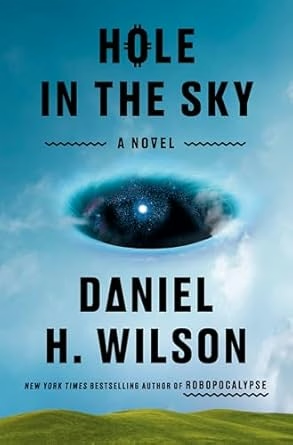
Daniel H. Wilson's Hole in the Sky is a first-contact science fiction thriller that starts as a five-star masterpiece and collapses into a frustratingly conventional ending. Published in October 2025, this novel draws on Wilson's dual expertise as a former threat forecaster for the U.S. Air Force and Cherokee Nation citizen to weave Indigenous perspectives into extraterrestrial fiction—a genuinely fresh angle in a crowded genre. Yet despite its compelling premise and culturally grounded worldbuilding, the book ultimately betrays its own ambitions through a third-act pivot that abandons everything that made it compelling.
What It's About
The narrative unfolds across three interconnected perspectives as an unidentified entity approaches Earth. Jim Hardgray, a Cherokee Nation member struggling to rebuild his relationship with his teenage daughter Tawny in Oklahoma, becomes the emotional anchor. Simultaneously, NASA astrophysicist Dr. Mikayla Johnson detects anomalies in the Voyager 1 spacecraft's telemetry on the far side of the solar system. Meanwhile, a mysterious government operative called "the Man Downstairs" monitors cryptic communications from an undisclosed bunker, triggering the ultimate alert: first contact is imminent.
Wilson orchestrates these parallel storylines with genuine tension, creating a slow-burn mystery that feels grounded in procedural realism. The early chapters nail that sweet spot between Carl Sagan's Contact and Steven Spielberg's Close Encounters of the Third Kind—cerebral without being ponderous, mysterious without resorting to cheap scares.
Writing & Style
The prose is deliberately paced and accessible, prioritizing clarity over literary flourish. This isn't a weakness; it's strategic. Wilson's background in threat assessment shows in his ability to build credible institutional detail—NASA protocols, military chain-of-command, the grinding bureaucracy of government response to existential crisis. The dialogue crackles when characters actually disagree about what they're witnessing rather than simply exposition-dumping at each other.
The book moves fast. You'll finish sections in single sittings, partly because Wilson structures scenes with genuine page-turning momentum. This is commercial fiction executed with competence, not pretension.
What Works: The First Three-Quarters
The setup is exceptional. Wilson takes time to establish stakes through character rather than spectacle. Jim's fractured relationship with Tawny carries real emotional weight—you believe he's a man trying to reconnect with his daughter while the sky literally cracks open. Dr. Johnson's professional credibility makes her observations feel earned rather than plot-convenient. The Man Downstairs remains genuinely enigmatic, a character whose motivations stay opaque enough to sustain intrigue.
The cultural dimensions elevate this beyond standard first-contact territory. By centering a Cherokee protagonist and weaving Indigenous perspectives into humanity's response to alien intelligence, Wilson asks uncomfortable questions about Western epistemology—whose knowledge systems do we trust when confronted with the impossible? This isn't tokenistic; it's genuinely integrated into the thematic fabric.
The mystery deepens methodically. Each revelation generates new questions rather than answering them. For approximately 75% of the novel, Wilson maintains a masterful balance between revelation and mystery, between personal stakes and cosmic scale.
What Doesn't Work: The Catastrophic Third Act
Then something breaks. The final quarter abandons the measured tension for increasingly outlandish cosmic horror reminiscent of H.P. Lovecraft and John Carpenter's The Thing. This tonal shift isn't inherently fatal—many successful sci-fi novels blend genres—but Wilson executes it clumsily. The "Pattern," the "Nix," and various plot mechanics strain credibility in ways that feel inconsistent with the grounded proceduralism that preceded them.
More damaging: the ending opts for a redemption arc that feels imposed rather than earned. Two of the most compelling characters—Dr. Johnson and the Man Downstairs—receive what amounts to narrative abandonment. Their storylines dangle unresolved, sacrificed for a tidy conclusion that prioritizes emotional catharsis over narrative logic. The climactic twist lands with a thud rather than a revelation, telegraphed so heavily it reads less like surprise and more like the author checking boxes.
This isn't subtle storytelling; it's heavy-handed. The ending practically shouts its own significance while simultaneously wasting the psychological complexity that made the first three-quarters compelling.
The Divisive Middle Ground
Readers consistently describe the same arc: genuine enthusiasm through the midpoint, growing disappointment as the third act unfolds. This isn't a matter of taste preference—it's a structural problem. The book sets up one kind of story (cerebral first-contact thriller grounded in procedural realism) and abandons it for another (cosmic horror with redemption subplot). Readers invested in the former feel genuinely betrayed.
The "real science" promise in the marketing also deserves scrutiny. Setting aside the aliens themselves, much of the third-act mechanics strain plausibility in ways that undercut the grounded tone. If you're reading this specifically for hard sci-fi rigor, you'll find the final act increasingly frustrating.
Who Should Read This
Read it if: You love first-contact narratives, appreciate Indigenous representation in speculative fiction, enjoy character-driven sci-fi that prioritizes mystery over action, or want a fast-paced thriller that engages with cultural epistemology. The first 250 pages are genuinely excellent and worth experiencing.
Skip it if: You demand narrative consistency from climaxes, require hard science fiction that doesn't hand-wave mechanics, or become frustrated by wasted character potential. You also might want to avoid this if you prefer endings that don't feel obligatory to traditional publishing expectations.
Middle-ground readers—those who can tolerate flawed conclusions if the journey entertains—will likely find enough value to justify the read, though with significant reservations.
The Larger Context
Wilson's Hole in the Sky arrives in a crowded first-contact subgenre that includes recent works exploring non-Western perspectives on alien encounter. The book's strength lies in its willingness to question Western institutional responses to existential uncertainty, using Cherokee protagonist and worldview to complicate assumptions about authority and knowledge. This is genuinely valuable contribution to the conversation.
Unfortunately, the execution falters precisely where it matters most: the third act. The novel doesn't fail because it's ambitious—it fails because it abandons its ambitions in service of conventional narrative resolution.
Final Verdict
6.5/10 — Hole in the Sky is a compelling first three-quarters searching for a conclusion worthy of its setup. The premise is fresh, the cultural perspectives matter, and the early mystery genuinely grips. But the third act's tonal whiplash and narrative shortcuts transform what could have been an excellent novel into a frustratingly squandered opportunity. Is Hole in the Sky worth reading? Yes—but with the caveat that you're reading it for the journey, not the destination. Borrow it before buying, or at least prepare yourself for disappointment in the final chapters. Daniel H. Wilson clearly understands how to construct tension and develop character; he simply doesn't stick the landing when it matters most.