Category:
Book ReviewsHelpless Review: A Divisive Thriller That Rewrites Everything
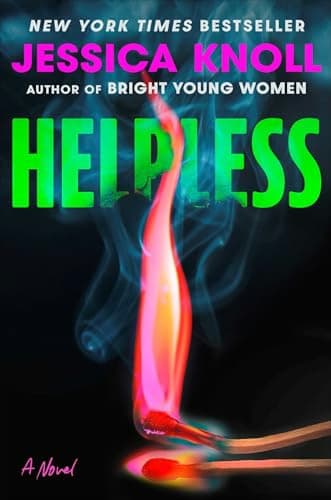
Prices can sometimes be lower on bigger marketplaces, but this link helps independent bookstores and local reading communities.
Jessica Knoll's Helpless is a psychological thriller that commits to the kind of narrative audacity most authors wouldn't dare attempt. This isn't a book that plays it safe—it's a deliberately provocative exploration of obsession, memory, and power that will either leave you exhilarated or frustrated, depending entirely on how you feel about being fundamentally misled by an unreliable narrator.
The setup is deceptively straightforward: Faye Heron, a successful Hollywood producer, returns to her college town for a funeral and encounters Henry Spalding, her ex-boyfriend from over a decade ago. What begins as an awkward reunion at a hotel bar transforms into something far darker when Henry drugs and kidnaps Faye, taking her to his remote mountain cabin. From this point forward, Helpless becomes a pressure cooker of psychological manipulation, sexual tension, and buried secrets that gradually unravel to reveal something genuinely shocking.
But here's what makes this Helpless review worth reading: the book's central twist is so polarizing that it essentially splits readers into two irreconcilable camps. Some readers describe it as a masterclass in narrative misdirection—a bold, intelligent rug-pull that recontextualizes everything you've read. Others feel it's a betrayal of the contract between author and reader, a narrative sleight of hand that prioritizes shock value over emotional coherence. Neither reaction is wrong, but both are deeply felt.
What Sets This Apart from Standard Thrillers
Knoll's previous novels—Luckiest Girl Alive and Bright Young Women—established her as a writer deeply interested in how women reclaim power from narratives that have been used against them. Helpless continues this thematic preoccupation but approaches it from an entirely different angle. Where her earlier work felt grounded in social commentary and institutional critique, this novel ventures into more explicitly psychological and erotic territory.
The relationship between Faye and Henry is the novel's true subject. Knoll doesn't present their dynamic as simple captor-and-captive; instead, she explores the intoxicating, terrifying nature of obsessive love—the way two people can be simultaneously drawn to and repelled by each other, creating a feedback loop of manipulation and desire that blurs every moral boundary. This psychological complexity is what elevates Helpless beyond standard thriller mechanics.
Writing Style and Narrative Voice
Knoll's prose in Helpless is sharp and deliberately unreliable. She writes Faye as a character who is simultaneously intelligent enough to recognize manipulation and vulnerable enough to be susceptible to it. The tension between these two aspects of Faye's personality creates constant cognitive dissonance for the reader—you're never quite sure what's happening or why, which is precisely the point.
The pacing is deliberate rather than breathless. This isn't a book that rushes you through plot points. Instead, Knoll builds pressure methodically, allowing scenes of psychological tension to breathe and expand. The dialogue crackles with subtext, and every conversation between Faye and Henry feels weighted with years of unresolved history.
What's particularly effective is how Knoll uses Faye's perspective to control information. You only know what Faye knows, and crucially, you only understand what Faye understands—or thinks she understands. This narrative constraint is both the book's greatest strength and, for some readers, its most frustrating limitation.
Where Helpless Succeeds
The psychological characterization is exceptional. Both Faye and Henry are morally complex characters who are neither heroes nor villains in any traditional sense. They're shaped by trauma, ambition, and the specific vulnerabilities that come from being young, brilliant, and desperate to be understood. Knoll refuses to make either character sympathetic through redemption; instead, she generates sympathy through understanding their damage.
The exploration of obsession is genuinely unsettling. There's an erotic charge to the captivity scenes that makes them feel dangerous and real rather than exploitative. Knoll walks a tightrope here—she's writing about dangerous desire without endorsing it, which requires considerable skill.
The final revelation, regardless of whether you love or hate it, is genuinely unexpected. In an era of predictable plot twists and telegraphed reveals, Helpless commits to a narrative turn that most readers won't see coming. This alone makes it worth discussing, even if you ultimately decide the twist doesn't work for you.
What Doesn't Work
For readers expecting a traditional thriller, Helpless will feel frustratingly slow in its first act. The captivity scenario doesn't escalate into action-packed sequences; instead, it deepens into psychological gamesmanship. If you're looking for plot momentum and external conflict, you'll find the pacing occasionally stagnant.
The ending, while undeniably bold, creates a structural problem: it fundamentally recontextualizes so much of what came before that some readers feel the book essentially invalidates its own narrative. Whether this is a feature or a bug depends entirely on your tolerance for metafictional games and unreliable narration taken to their logical extreme.
Some readers also report that the erotic content, while psychologically justified, occasionally feels gratuitous. The line between exploring dangerous desire and simply depicting it is thin, and Knoll doesn't always stay on one side of it.
Who Should Read Helpless
This book is perfect for readers who loved the psychological complexity of Gone Girl or The Silent Patient, but want something more sophisticated in its exploration of power dynamics and memory. If you appreciate narratives that play games with perspective and actively mislead you, Helpless will reward your attention. Fans of Knoll's previous work who appreciate her interest in how women's narratives get weaponized will find much to contemplate here.
You should also read Helpless if you enjoy discussions about unreliable narration as a literary technique and aren't bothered by books that ask you to question everything you've been told.
Skip this one if you prefer straightforward plots, linear storytelling, or thrillers where the protagonist's perspective is trustworthy. If you found Gone Girl manipulative rather than clever, this book will likely frustrate you. Similarly, if you're looking for a satisfying resolution where loose ends are tied up neatly, Helpless will leave you unsatisfied.
The Verdict
Helpless is a genuinely daring psychological thriller that refuses to play by conventional rules. Jessica Knoll's Helpless represents a significant departure from her previous work—more explicitly erotic, more psychologically claustrophobic, and far more willing to alienate readers in pursuit of narrative ambition. Is Helpless worth reading? Absolutely, but with the understanding that you're signing up for a book that will divide you from other readers and potentially divide you from yourself about what you think you've just experienced.
The novel's central twist will either feel like a brilliant subversion of thriller conventions or a betrayal of narrative trust. There's no middle ground, and that polarization is exactly what makes it worth your time. Even if you end up hating the ending, you'll be thinking about it for weeks. In a landscape of forgettable thrillers, that's no small achievement.
Final Score: 7.5/10 — A bold, psychologically complex thriller that prioritizes ambition and divisiveness over conventional satisfaction, making it essential reading for thriller fans willing to embrace narrative risk.