Category:
Book ReviewsHèhè Review: A Linguistic Love Letter Worth Reading
Prices can sometimes be lower on bigger marketplaces, but this link helps independent bookstores and local reading communities.
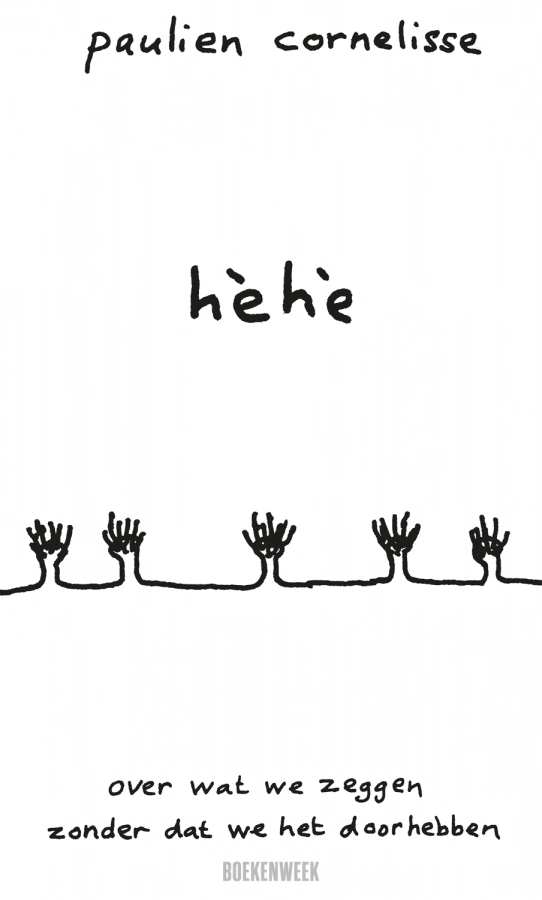
Paulien Cornelisse's Hèhè is a deceptively slim essay that does something rare: it makes you fall in love with the Dutch language all over again by examining the words we barely notice we're using. This isn't a grammar textbook disguised as literature. It's a witty, philosophical exploration of modal particles—those seemingly throwaway words like "even," "gewoon," "eigenlijk," and the titular "hèhè"—that quietly shape how we communicate, connect, and soften our interactions with one another.
The verdict is straightforward: if you care about language, you'll find this Hèhè review worth your time because the book itself is worth your afternoon. Cornelisse has written something genuinely clever that manages to be both intellectually satisfying and genuinely funny without ever feeling pretentious.
What This Book Actually Does
Cornelisse's essay divides Dutch modal particles into two categories: "gezelligmakers" (coziness-makers) and "eerlijkmakers" (honesty-makers). Words like "even" and "gewoon" soften commands and requests, making them feel more companionable. Words like "eigenlijk" and "nou" introduce uncomfortable truths or corrections, forcing a moment of authenticity into conversation.
The central argument is deceptively simple but genuinely insightful: these non-words aren't filler. They're the linguistic equivalent of the gestures and tones we use to navigate social situations without causing offense. When you tell someone "even koffie zetten" instead of "zet koffie," you're not just being polite—you're performing a specific kind of social choreography that says, "I know this is an imposition, but we're in this together."
The title word, "hèhè," becomes a meditation on a particular life stage. Cornelisse suggests it might be less about a cultural trend and more about a phase of life where you've accumulated enough weariness and enough reasons to find dark humor in existence. Teenagers, she posits, might not yet have the existential fatigue required for "hèhè." There's something both hilarious and melancholic about that observation.
The Writing: Playful but Purposeful
Cornelisse's prose style is exactly what you'd want from a book about language: it practices what it preaches. She uses the very particles she's analyzing throughout the essay, creating a meta-textual experience where you're simultaneously learning about "even" and "gewoon" while watching her deploy them strategically.
The structure feels deliberately loose, almost conversational. Paragraphs are short. Sentences breathe. There's an accessibility here that makes complex linguistic concepts feel like gossip rather than scholarship. She writes like someone genuinely excited to share an observation with a friend, not like someone delivering a lecture.
The footnotes deserve mention. Most are genuinely amusing—some readers found them occasionally forced or "flauw" (weak), which is fair criticism. But the best ones add layers of humor and meaning that reward the attentive reader. They're not essential, but they're the kind of digestible asides that make you smile while reading alone on the train.
What Makes This Essay Sing
The strongest element of Hèhè is how Cornelisse captures something most language books miss: the emotional labor embedded in everyday speech. She doesn't just explain what these particles do grammatically—she explores why we need them, what anxiety they soothe, what truths they help us tell.
There's a section where she catalogs the various positions "hè" can occupy in a sentence, from opening to middle to end, and how each position creates a different conversational dynamic. It's technically linguistic analysis, but it reads like the kind of observation you'd have in a late-night conversation about human connection.
The book also succeeds because it's genuinely short. At essay length rather than book length, it respects your time while delivering real substance. You can finish it in an afternoon, but you'll spend weeks afterward noticing how often you use the words she's analyzed. Readers consistently report becoming hyperaware of their own linguistic habits—which is the mark of writing that actually changes how you perceive the world.
The Limitations Worth Acknowledging
Some readers found the essay repetitive, particularly in how Cornelisse circles back to similar observations about social softening and honesty-telling. There's a fair point here. The core insight—that these particles serve emotional and social functions—lands firmly by the halfway point, and the remainder is elaboration rather than revelation.
The footnotes, while often charming, occasionally undermine the essay's elegance. Some feel like they're trying too hard to be funny rather than genuinely illuminating. It's a minor flaw in an otherwise tightly constructed piece, but it's worth noting if you're the type of reader who finds forced humor distracting.
Also, this is unambiguously a book for Dutch speakers or Dutch language enthusiasts. The particles Cornelisse analyzes don't have perfect equivalents in English, which means non-Dutch readers will find this fascinating but somewhat abstract. The book doesn't suffer from this limitation—it's simply not designed for a universal audience, and that's fine.
Who Should Actually Read This
Perfect for: Language nerds who get genuinely excited about how words work. Teachers of Dutch as a second language who want to understand the emotional texture of native speech. Anyone who's ever been fascinated by why certain phrases feel right and others feel wrong. Fans of Cornelisse's previous work who appreciate her ability to find profundity in the mundane. People interested in sociolinguistics, pragmatics, or the psychology of communication.
Probably not for: Readers looking for prescriptive grammar rules or a how-to guide for speaking "better" Dutch. People who find linguistic analysis tedious or overly academic (though Cornelisse avoids jargon admirably). Those expecting a full-length narrative or extended case studies. Anyone who doesn't appreciate humor built on linguistic observations.
The Comparison Point
If you've read The Sense of Style by Steven Pinker, you know how satisfying it is when a linguist writes with genuine warmth and humor about language. Hèhè occupies a similar space but is far more intimate and specific. Where Pinker writes for a broad English-speaking audience about universal principles, Cornelisse writes for Dutch speakers about the specific emotional architecture of their language. Both books prove that language writing can be intelligent without being dry.
Final Verdict
This Hèhè review comes down to a simple question: is it worth reading? Yes, emphatically, if you're interested in language. Paulien Cornelisse has written a genuinely clever essay that manages to be both intellectually rigorous and genuinely funny. It's the kind of book that makes you pay attention to your own speech patterns for weeks afterward. The essay occasionally repeats itself, and some footnotes land better than others, but these are minor quibbles with a work that succeeds at its core mission: making you see the invisible architecture of everyday Dutch speech.
The fact that it's based on the Dutch Book Week theme and published as a limited edition only adds to its charm. This is the kind of book that rewards close reading and casual browsing equally. You'll finish it quickly, but you'll think about it for much longer.
Score: 8/10 — A smart, funny, essential read for language lovers that occasionally repeats itself but never wastes your time.