Category:
Book ReviewsHead North Review: A Bold Political Manifesto Worth Reading
Prices can sometimes be lower on bigger marketplaces, but this link helps independent bookstores and local reading communities.
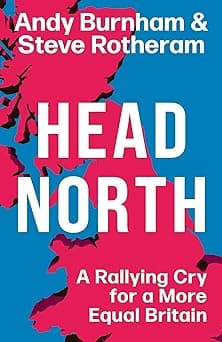
Andy Burnham and Steve Rotheram's Head North: A Rallying Cry for a More Equal Britain is a provocative hybrid of political memoir and manifesto that arrives at a pivotal moment for British governance. This is not a polished political autobiography—it's a raw, urgent call to dismantle Westminster's stranglehold on power. If you're tired of "levelling up" rhetoric that never materializes, this book demands your attention.
The central premise is deceptively simple: Britain's regional inequality isn't a bug in the system, it's a feature. Burnham and Rotheram argue that Westminster's centralized power structure has systematically failed working-class communities, particularly in the North. Their solution? A comprehensive devolution framework that redistributes political and economic power away from the capital. Whether you find this inspiring or naive depends largely on your tolerance for structural political critique.
What This Book Actually Delivers
Head North splits its narrative into two distinct halves. The first is deeply personal—a dual memoir that traces how two Scousers from working-class backgrounds became mayors determined to challenge the establishment. The Hillsborough disaster emerges as the emotional and intellectual foundation for both authors' political worldviews. Rather than treating it as historical tragedy, they position it as evidence of systematic institutional failure: a moment when ordinary people discovered that the system protects power, not people.
This personal grounding is the book's greatest strength. Burnham and Rotheram don't theorize about inequality from academic distance—they've lived it, witnessed it shape their communities, and watched Westminster ignore it. Their accounts of the Manchester Arena bombing and the Grenfell Tower disaster function as case studies in how centralized power fails its citizens.
The second half pivots to their ten-point manifesto for reimagining Britain. This is where Head North transforms from memoir into policy blueprint. The authors propose genuine regional autonomy, reformed local taxation systems, and a redistribution of investment away from London's gravitational pull. Unlike typical political books that gesture vaguely toward "change," Burnham and Rotheram offer concrete structural proposals.
The Writing: Readable But Uneven
One of the book's smartest choices is its dual-voice structure. Burnham and Rotheram write in distinct fonts throughout, which works brilliantly in the memoir section. Reading their parallel accounts of formative political moments creates a richer texture than a single narrative voice could achieve. You see how the same events shaped two men differently.
However, this innovation becomes a liability in the manifesto section. The authors overlap considerably when discussing policy solutions, creating redundancy that dilutes impact. Burnham dominates the second half, writing approximately 70% of the text, which disrupts the partnership dynamic established earlier. A tighter editorial hand could have eliminated this repetition without sacrificing substance.
The prose itself is accessible—this isn't academic political theory wrapped in jargon. Both authors write like they speak: directly, with occasional passion breaking through the surface. This readability is intentional. They're not writing for Westminster insiders; they're writing for people in Manchester, Liverpool, and beyond who've been overlooked by those insiders.
What Works Brilliantly
The book's greatest achievement is transforming regional inequality from an abstract policy problem into a human story. By anchoring political arguments in lived experience—Hillsborough, Manchester Arena, Grenfell—Burnham and Rotheram make the case that centralized power isn't just inefficient, it's dangerous.
Their critique of how Westminster handled the Covid-19 pandemic is particularly sharp. The Tier 3 controversy in Greater Manchester revealed how decisions made in London could devastate Northern economies without meaningful consultation. This isn't theoretical; readers witness a mayor fighting for his region while the government treats negotiation as weakness. It's a masterclass in showing rather than telling why devolution matters.
The ten-point manifesto, while not revolutionary, is remarkably detailed. Unlike most political books that end with vague calls for "systemic change," Burnham and Rotheram propose specific mechanisms: regional investment banks, reformed business rates, reformed governance structures. Whether you believe they're achievable is another question, but they're not hiding behind platitudes.
The Limitations
For all its strengths, Head North has notable blind spots. The book is fundamentally optimistic about the capacity of regional devolution to solve problems that may require national solutions. Climate change, national healthcare policy, and defense spending don't neatly fit into regional governance structures. Burnham and Rotheram acknowledge this occasionally but don't fully grapple with the tensions.
There's also an implicit assumption that mayors from the North will automatically govern more effectively than Westminster politicians. This is a generous leap. Regional power concentrated in the wrong hands could simply relocate injustice rather than eliminate it. The authors address this somewhat through their emphasis on democratic accountability, but skeptics will find the argument incomplete.
The book also struggles with the question of implementation. Even if you accept every argument about why devolution matters, the practical pathway from manifesto to reality remains fuzzy. How do you actually dismantle Westminster's power? What happens when the capital city resists? These questions hover over the text unanswered.
Who Should Read This
Perfect for: Anyone frustrated with British politics' London-centric approach. Readers interested in regional inequality, devolution debates, or practical political reform. People who want memoir that connects personal experience to systemic critique. Those curious about how mayors are thinking beyond their immediate constituencies. Anyone who appreciated books like Strangers in Their Own Land by Arlie Russell Hochschild—which similarly grounds political analysis in lived experience.
Will likely frustrate: Westminster loyalists convinced that centralized governance is necessary for coherence. Readers seeking detached political analysis rather than advocacy. People who think mayors are overstepping their remit. Those expecting a balanced examination of devolution's drawbacks. Anyone who prefers political theory to political memoir.
The Verdict on This Review
Head North is absolutely worth reading—not because it's flawless, but because it articulates a genuine alternative vision for British governance. Burnham and Rotheram have written the book that their positioning demands: part personal testimony, part political blueprint, entirely urgent.
This isn't a book that will change Westminster's mind. It's a book designed to change your mind about what Britain could be. Whether that's inspiring or frustrating depends on your starting point. But the book's greatest success is making regional inequality impossible to ignore, grounding abstract policy debates in the concrete reality of communities that Westminster has taken for granted.
Final Verdict
8/10 — A compelling hybrid of memoir and manifesto that combines lived political experience with a detailed vision for structural change, undermined slightly by uneven pacing and optimistic assumptions about implementation.
Is Head North Worth Your Time?
Yes, if you're interested in British politics beyond Westminster theater. Yes, if you want to understand why regional mayors increasingly see themselves as alternatives to national government. Yes, if you believe inequality demands structural solutions rather than rhetorical gestures.
The book's power lies not in perfect argumentation but in the credibility of its authors. Burnham and Rotheram have chosen to leave Westminster to work in the North. They're not theorizing from distance; they're reporting from the frontlines of regional governance. That authenticity—more than any policy proposal—makes Head North essential reading for anyone concerned about Britain's future.