Category:
Book ReviewsHappier Here With You Review: Cozy But Frustratingly Shallow
Prices can sometimes be lower on bigger marketplaces, but this link helps independent bookstores and local reading communities.
Quick Verdict
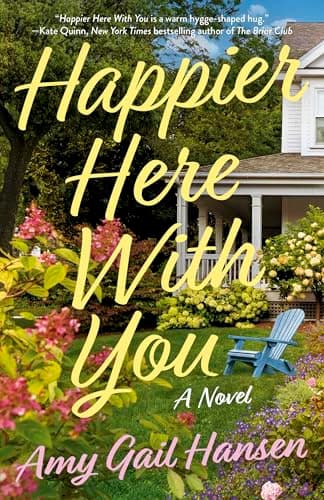
Happier Here With You by Amy Gail Hansen is a comfort read that delivers exactly what its cover promises: a warm, hygge-infused escape about family, food, and second chances. However, this Happier Here With You review reveals a book that plays it safe to a fault—so predictable and emotionally restrained that it reads more like a Hallmark screenplay than a fully realized novel. At its best, it's the literary equivalent of hot tea and a cozy blanket. At its worst, it's a missed opportunity to explore genuinely complex family trauma with the depth it deserves.
What It's About
Maggie Brodbeck is a burnt-out museum curator and food historian juggling single parenthood, professional ambition, and barely-contained grief five years after her husband's death. When her estranged great-aunt Alice—a woman Maggie hasn't seen since childhood—extends an invitation to spend time at Rosehill Farm in Wisconsin, Maggie and her five-year-old daughter Hannah make the journey. What unfolds is part romance, part family mystery, and part historical excavation, as Maggie discovers generations-old recipes, reconnects with her love of cooking, and unearths the heroic World War II history of her great-grandmother Rose, who served in the Women's Land Army.
The narrative weaves between present-day Rosehill and Rose's wartime experiences, gradually revealing why Maggie's mother cut Alice out of their lives decades ago.
The Promise vs. The Delivery
There's a genuine tension at the heart of this Happier Here With You review that's worth examining. The book's central conflict—why Maggie's mother kept her from knowing Alice for three years—hinges on something surprisingly mundane: embarrassment about outsourcing childcare. Readers expecting a dramatic revelation, a betrayal, or genuine wrongdoing will find themselves disappointed. Instead, Hansen offers a gentler truth: sometimes family rifts stem not from cruelty but from shame and miscommunication.
This is either the book's greatest strength or its most glaring weakness, depending on your tolerance for emotional subtlety. Some readers find this refreshing restraint; others see it as a failure to justify the emotional weight such a separation should carry.
Writing & Style: Competent But Uninspired
Hansen's prose is clean, accessible, and occasionally lovely—particularly when describing food preparation or the rhythms of farm life. The dual timeline structure (present-day Maggie and wartime Rose) works without feeling gimmicky, and the historical context about the Women's Land Army adds genuine educational value.
However, the writing often lacks emotional specificity. Dialogue tends toward exposition rather than revelation. Characters tell us how they feel rather than showing us through action or internal conflict. A scene might read: "She felt nervous. He seemed happy." What's absent is the sensory detail, the physical manifestation of emotion, the subtext that makes readers feel something rather than simply understand it intellectually.
The book reads like a competent first draft that never quite evolved into something more ambitious.
What Works: The Comfort Factor Is Real
Let's be clear: if you're seeking a genuinely comforting read, Happier Here With You delivers. The descriptions of baking, cooking, and tending a farm have an almost meditative quality. The relationship between Maggie and Alice develops with a natural, unhurried rhythm that feels authentic. There's real warmth here, and for readers dealing with burnout, grief, or the relentless pace of modern life, this book functions exactly as intended—as a literary escape hatch.
The Women's Land Army subplot is genuinely interesting and historically significant. Many readers encounter this aspect of WWII history for the first time through this novel, and Hansen handles it with respect and curiosity. Rose's story, though told in broad strokes, adds dimension to the contemporary narrative.
The romance subplot with Brady, the local pastry chef, is uncomplicated and sweet without being saccharine—a rarity in contemporary fiction. It serves the story rather than consuming it.
What Doesn't: Character Depth and Emotional Complexity
The most consistent criticism across reader responses points to a fundamental shallowness in characterization. Maggie is likable but not particularly complex. She's grieving, burnt out, and seeking balance—all valid emotional states, but they're never explored with real psychological depth. We don't see her wrestling with contradictions, making difficult choices that reveal character, or confronting uncomfortable truths about herself.
Alice is perhaps the most intriguing character, yet she remains somewhat enigmatic by design rather than by necessity. We never fully understand her emotional landscape or the cost of her decades-long silence.
Most troublingly, the book glosses over what should be significant trauma. Maggie was separated from her primary caregiver for three years as a child. That's not a minor plot point—it's the kind of experience that shapes attachment patterns, trust, and identity. Yet the book treats it as something to overcome through baking and stargazing rather than something to genuinely process.
The characters feel archetypal rather than fully human: the burnt-out professional, the wise elder, the charming love interest. They behave as the plot requires rather than as complex people with competing desires and genuine agency.
The Predictability Problem
If you've consumed any contemporary women's fiction in the past five years, you can predict almost every major plot point. The estrangement will be resolved. The romance will develop. The recipes will unlock family secrets. The protagonist will find balance and contentment. There are no real surprises, no moments where the story subverts expectations.
For some readers, this predictability is a feature, not a bug. It allows them to relax into the narrative without anxiety. For others, it undermines emotional investment. If you know exactly where you're headed, the journey matters less.
Historical Context: The Rise of "Cozy Fiction"
It's worth noting that Happier Here With You arrives during a significant publishing moment. Since the pandemic, there's been measurable growth in demand for comfort-focused fiction—books that prioritize emotional safety and resolution over conflict and ambiguity. Publishers have responded by acquiring more books in this vein. Hansen's novel sits comfortably within this market trend, which explains both its appeal and its limitations. It's a book designed to soothe rather than challenge.
Who Should Read It
Perfect for:
- Readers seeking comfort reads without dark themes or violence
- People interested in WWII history and the Women's Land Army
- Fans of Kristin Hannah or Beatriz Williams looking for something lighter
- Anyone dealing with burnout who needs permission to slow down
- Readers who enjoy food-centric narratives
Skip it if:
- You want psychological complexity or emotional depth
- You prefer character-driven stories with genuine conflict
- You're fatigued by predictable contemporary romance
- You need your family drama to actually feel dramatic
- You value linguistic ambition or stylistic innovation
Comparable Reads
If you're trying to decide whether Happier Here With You is right for you, consider how you felt about The Midnight Library by Matt Haig (similar therapeutic pacing, similar emotional restraint) or The House in the Cerulean Sea by TJ Klune (comfort-focused but with more personality in the prose). This novel sits closer to Hallmark movie territory than to something like Lessons in Chemistry by Bonnie Garmus, which tackles similar themes—women, work, food, history—with considerably more narrative complexity.
The Food Historian Angle
One element that elevates this novel slightly is Maggie's profession. As a food historian, her relationship to cooking and recipes carries intellectual weight. The idea that food embodies family history, cultural memory, and personal identity is genuinely compelling. Hansen explores this more effectively than she explores most other aspects of the narrative. The recipes function as windows into the past, which is a clever narrative device that mostly works.
Final Verdict: 6.5/10
Is Happier Here With You worth reading? That depends entirely on what you need from a book right now. If you're seeking a warm, safe, emotionally unchallenging escape that celebrates the value of homemaking, family connection, and slowing down, absolutely read it. The book succeeds at what it attempts. However, if you want genuine character development, emotional complexity, or narrative surprises, you'll find yourself frustrated by its reluctance to go deeper. It's a pleasant read that never quite becomes a memorable one—competent comfort fiction that plays it far too safe to achieve real impact.
The book's 4.43-star rating across thousands of readers reflects this split verdict: it works beautifully for its intended audience and falls flat for readers expecting more substantial storytelling. There's nothing wrong with comfort reads, but there's also nothing transcendent here. It's a solid afternoon with a warm blanket and hot tea, not the transformative reading experience the premise promises.