Category:
Book ReviewsGreat and Unfortunate Things Review: Divisive
Prices can sometimes be lower on bigger marketplaces, but this link helps independent bookstores and local reading communities.
Quick Verdict
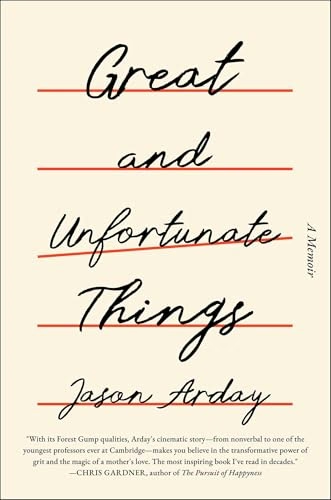
Great and Unfortunate Things by Jason Arday is a polarizing memoir that attempts to chronicle an extraordinary journey from non-verbal autism diagnosis to Cambridge professor—but readers are sharply divided on whether the narrative holds up. The book delivers genuine emotional resonance and important disability representation, yet struggles with believability and internal consistency that undermine its central message. If you value inspirational stories about overcoming systemic barriers, it's worth engaging with; if you're skeptical of feel-good narratives that seem too neat, you'll likely find yourself questioning the author's account.
What This Book Actually Delivers
Jason Arday's memoir sits at an uncomfortable intersection: it promises the emotional sweep of When Breath Becomes Air and the underdog triumph of Educated, but delivers something messier and more contested. The book traces Arday's life from a childhood diagnosis that experts deemed catastrophic—he was deemed unlikely to ever speak or live independently—to his eventual appointment as one of Cambridge's youngest professors. His mother Giff emerges as the narrative's true force, rejecting institutional placement and instead drawing on West African proverbs, music, and unconventional methods to unlock her son's potential.
The core story is undeniably compelling: a family refusing to accept medical verdicts, a mother's unwavering belief, and a son who defies expectations. This is the kind of narrative that resonates in our current moment, when conversations around neurodiversity, disability justice, and social mobility dominate cultural discourse. Arday's appointment at Cambridge as a Black professor working on social mobility issues adds another layer of significance to his trajectory.
Where the Writing Falters
Here's where Great and Unfortunate Things review discussions become genuinely contentious: the execution undermines the message. Multiple readers have flagged structural problems that suggest heavy ghost-writing intervention (credited to Eve Claxton) without adequate narrative integration. The memoir reads inconsistently—some passages feel authentic and grounded, while others veer into territory that strains credibility.
The pacing deteriorates noticeably in the second half. What begins as a compelling chronicle of childhood struggles and maternal devotion increasingly relies on convenient plot resolutions and dramatic moments that feel constructed rather than lived. Personal anecdotes that might work as isolated stories become suspect when examined within the larger narrative arc, raising questions about whether events were remembered or retrofitted to serve a predetermined story structure.
The writing itself, separate from credibility concerns, suffers from poor pacing and underdeveloped character arcs. If you approach this as memoir, the narrative inconsistencies become obstacles. If you try reading it as something closer to fiction, the implausibilities and deus ex machina moments multiply rather than diminish.
What Actually Works
Despite its structural challenges, Jason Arday's Great and Unfortunate Things succeeds in several important ways. The exploration of autism spectrum disorder from an insider perspective provides genuine educational value. Arday articulates the gap between medical diagnoses and human potential in ways that feel urgent and necessary. His mother Giff emerges as a genuinely compelling figure—not a saint, but a woman making pragmatic, creative decisions within constrained circumstances.
The book's meditation on social mobility, disability, and institutional barriers resonates because these are real problems. Arday's willingness to challenge both medical establishment assumptions and educational gatekeeping offers legitimate social commentary. For readers seeking representation of neurodivergent perspectives in memoir form, there's material here worth engaging with, flaws and all.
The emotional core—a son's determination and a family's collective refusal to accept diminished expectations—remains powerful even when you're skeptical about specific narrative details. This is a book that provokes genuine thought about how we categorize human potential and who gets to decide what's possible.
What Doesn't Land
The credibility crisis is real and worth taking seriously. Skeptical readers aren't being unfair when they question whether certain anecdotes hold up to scrutiny. The ghost-writer's hand becomes visible in ways that undermine the authenticity the memoir depends on. Personal stories feel increasingly like they've been shaped for narrative impact rather than preserved as remembered experience.
There's also a tonal problem: the book tries to maintain inspirational momentum while simultaneously claiming not to romanticize struggle, but this balance collapses repeatedly. The result is a narrative that feels both saccharine and defensive—trying to have it both ways without fully committing to either approach.
For readers approaching this from an academic or critical perspective, the psychological and physiological claims made throughout the book warrant fact-checking that Simon & Schuster apparently didn't conduct rigorously. This isn't a minor issue in a memoir that positions itself as both personal testimony and broader commentary on disability and neurodiversity.
Who Should Actually Read This
Perfect for: Readers seeking disability memoirs with insider perspective. People interested in social mobility narratives and educational equity. Those looking for representation of autism spectrum experiences. Readers who value inspirational stories even when they're imperfectly executed. Families navigating neurodiversity diagnoses who want to see alternative approaches to institutional recommendations.
Will likely frustrate: Readers who value strict narrative coherence and credibility. Those skeptical of feel-good stories that seem too convenient. People approaching memoirs from a critical, fact-checking perspective. Readers who dislike obvious ghost-writing or narrative construction. Anyone seeking emotionally engaging rather than intellectually interesting disability narratives.
Comparing to Similar Memoirs
Unlike Educated by Tara Westover, which builds credibility through specific, verifiable details and emotional restraint, Great and Unfortunate Things relies more heavily on narrative momentum and inspirational tone. Where Educated earns reader trust through careful, sometimes painful honesty about ambiguity, Arday's memoir often feels like it's selling rather than exploring.
Compared to When Breath Becomes Air by Paul Kalanithi, which achieves emotional power through philosophical depth and intellectual rigor, this book prioritizes plot momentum over genuine reflection. Kalanithi's memoir works because it trusts readers to find meaning in complexity; Arday's sometimes feels like it's packaging meaning for easy consumption.
The Verdict
Is Great and Unfortunate Things worth reading? That depends entirely on what you're seeking. If you want an inspirational disability narrative that will make you believe in human potential, yes—despite its flaws. If you're looking for a rigorously honest, carefully constructed memoir, you'll likely find yourself frustrated.
The book matters because Arday's story—a non-verbal child becoming a Cambridge professor—challenges real assumptions about disability and potential. But the execution matters too, and this memoir doesn't always deliver the narrative integrity its subject deserves. You can engage meaningfully with the book's ideas while remaining skeptical about specific claims. That tension is actually where the most interesting reading happens.
Final Score: 6.5/10
Important story compromised by narrative choices and credibility questions, but still worth reading if you approach it critically rather than accepting it wholesale.