Category:
Book ReviewsGrand: The Autobiography of Gromit Review
Prices can sometimes be lower on bigger marketplaces, but this link helps independent bookstores and local reading communities.
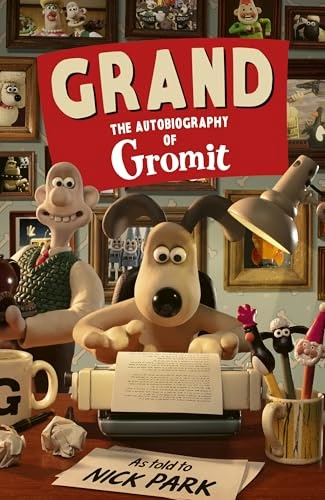
Nick Park's Grand: The Autobiography of Gromit arrives as a curious experiment: translating one of British animation's most beloved visual comedies into prose form, told entirely from the perspective of a silent dog. The premise is audacious, and the execution is divisive—which is precisely what makes this book fascinating. With Martin Freeman's narration in the audiobook version, Park has created something that works beautifully for devoted fans of Wallace and Gromit, though it stumbles considerably for readers approaching the franchise fresh or expecting something beyond elaborate retellings of the films.
Let's be direct: this book is not for everyone, and that's not a flaw—it's a feature. If you're seeking a standalone narrative that functions as both introduction and original work, Grand will disappoint. If you're a Wallace and Gromit devotee looking to spend more time in that universe, you'll likely find it rewarding. The critical question isn't whether Grand is good—it demonstrably is, as evidenced by its 4.35/5 rating across hundreds of readers. The question is whether it's for you.
What This Book Actually Is
Nick Park's Grand operates on a fascinating structural principle: it weaves together domestic snapshots of Wallace and Gromit's life with extensive retellings of the franchise's most iconic films, all filtered through Gromit's sardonic, eloquent voice. The framing device is charming—Wallace has abandoned his typewriter project (currently mounted with inexplicable wheels and a flame-thrower, despite the household ban on flame-throwers), leaving Gromit to tell the story himself.
The book follows a repeating cycle: glimpses of ordinary domestic life, complete recounts of films like The Wrong Trousers and A Grand Day Out, then returns to Gromit's own narrative threads. There's a through-plot involving what the book calls "Baker's Dozen"—a subplot that accumulates significance and lands with a satisfying twist that reviewers consistently highlighted as a genuine highlight.
This structure is both the book's greatest strength and its most significant limitation. For fans who've watched the films repeatedly, extensive plot recaps feel redundant. For newcomers, the assumption that you've seen all six shorts and films creates a dense, occasionally impenetrable experience.
The Voice: Where Grand Genuinely Shines
Gromit's voice in this autobiography is the book's true triumph. Park writes the silent dog as eloquent, sharply witty, and deeply observant—a character whose internal monologue contradicts everything we thought we knew about him while somehow feeling entirely authentic. The wordplay is relentless: Gromit's books have punny titles (think Paws and Prejudice energy), and the humor extends through clever observations about domestic life, invention mishaps, and the peculiar relationship between man and dog.
Martin Freeman's narration in the audiobook version deserves particular praise. Freeman captures Gromit's dry wit while voicing the supporting cast with distinct personality, making the audiobook version the superior experience for most listeners. His performance elevates what could have been a novelty into something genuinely entertaining.
What emerges most powerfully is the emotional core: Gromit's profound, almost overwhelming love for Wallace. This isn't sentimental—it's portrayed with the same deadpan wit that characterizes the entire narrative. The book explores what it means to care deeply for someone chaotic, well-meaning, and perpetually on the verge of disaster. This emotional dimension is where Grand transcends mere fan service and becomes something more substantive.
The Central Problem: Translation Issues
Here's the critical tension: Wallace and Gromit were designed for animation. The franchise's genius lies in visual gags, elaborate slapstick sequences, and the contrast between Wallace's verbose schemes and Gromit's silent competence. These elements don't translate seamlessly to prose, no matter how clever the writing.
Readers who know the films well report feeling the absence of visual information acutely. The famous chase sequences that climax each film become summarized plot points. The physical comedy that drives the humor loses its impact when described rather than shown. For these readers, Grand reads as a "watered-down summary," to use one reviewer's phrase, that somehow manages to be both too detailed (endless plot recap) and insufficiently detailed (missing crucial visual beats).
This creates an odd reading experience: you're neither getting a satisfying new narrative nor an adequate textual representation of the existing films. The book occupies an awkward middle ground that frustrates readers coming from different angles.
Who Should Actually Read This
This book is perfect for: Devoted Wallace and Gromit fans who want an excuse to inhabit that universe between releases. Readers who enjoy British humor, puns, and anthropomorphic narration. Audiobook listeners who appreciate strong voice acting. People looking for a quick, approachable read that doesn't demand extensive concentration. Fans of humorous memoirs and comedic first-person narratives. Anyone who wants to understand Gromit's perspective on their relationship with Wallace.
This book will frustrate: Readers seeking a standalone narrative that works without prior franchise knowledge. People who dislike heavy reliance on puns and wordplay. Those expecting original storytelling rather than film adaptations. Casual fans who watched Wallace and Gromit years ago and don't remember the details. Readers who prefer visual comedy and become bored by textual descriptions of physical gags. Anyone approaching this as a genuine autobiography rather than a comedic reframing.
The book itself acknowledges its insider status. It's written explicitly for "diehards," as one reviewer noted—and it succeeds on those terms while inevitably failing for those outside that circle.
The Verdict on Writing Quality
Setting aside the structural questions, Park's prose is genuinely well-crafted. The humor is sharp without being forced, the emotional beats land effectively, and the voice remains consistent and engaging throughout. The book doesn't feel like a novelty cash-in; it feels like a genuine creative project from someone who understands these characters deeply.
The pacing is brisk. Despite being a substantial read, Grand moves quickly enough that it functions as an ideal gift for casual readers—approachable enough for someone who doesn't read frequently, but substantive enough to reward attention. The book respects your time without sacrificing wit or depth.
The Honest Assessment
Is Grand: The Autobiography of Gromit worth reading? That depends entirely on your relationship with the source material. For Wallace and Gromit devotees, it's absolutely worth your time—a clever, heartfelt extension of a beloved universe that offers genuine new insights into Gromit's perspective. For everyone else, it's a harder sell. The book doesn't work as an introduction to the franchise, and it doesn't work as a standalone narrative. It works as what it is: fan service elevated to genuine art through strong writing and performance.
Compare this to similar projects: it's more successful than most novelizations of visual media, but it still carries the inherent limitations of translating screen-based comedy to prose. It occupies the same space as The Princess Bride novelization—beloved by fans but somewhat inaccessible to outsiders—though it's considerably lighter in tone and scope.
The most telling indicator of this book's success: readers who loved it immediately wanted to reread it and recommend it to fellow fans. Readers who disliked it didn't feel cheated so much as disappointed that the medium didn't match the material. That's not failure—that's the natural friction between two different art forms.
Final Verdict
Grand: The Autobiography of Gromit succeeds brilliantly within its defined audience and struggles outside it. For Wallace and Gromit fans, this is essential reading. For everyone else, it's a well-executed novelty that won't transform your understanding of the franchise or provide the standalone experience you might be seeking. The writing is sharp, the voice is distinctive, and the emotional core is genuine—but the book's reliance on extensive film recaps and insider knowledge creates an impenetrable barrier for newcomers. If you've watched the films and loved them, Grand is absolutely worth your time. If you haven't, start with the animations first.