Category:
Book ReviewsGod's Country Review: Thriller Masquerading as Philosophy
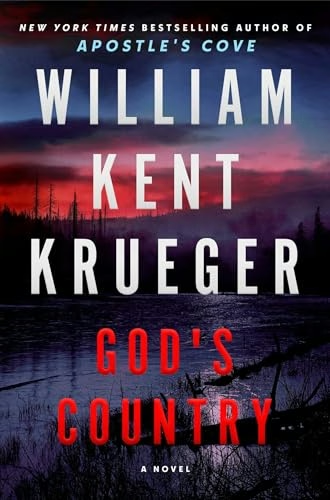
Prices can sometimes be lower on bigger marketplaces, but this link helps independent bookstores and local reading communities.
William Kent Krueger's God's Country is a deceptively complex thriller that prioritizes moral introspection over narrative surprise—and that's either its greatest strength or its most frustrating limitation, depending on what you want from a mystery novel.
This 21st Cork O'Connor novel opens with an unsettling premise: Cork's grandson and son both experience visions of a wolf devouring Cork's heart. Ignoring these omens, Cork embarks on a family canoe trip into Minnesota's Boundary Waters, only to discover his friend Cordell Bishop missing and in danger from two ruthless criminals—the Kennedy brothers—hunting their father's hidden fortune. What follows is less a traditional whodunit and more a philosophical interrogation wrapped in a thriller's packaging.
What You're Actually Getting
If you approach God's Country expecting a conventional mystery with genuine suspense and unpredictable twists, you'll likely feel disappointed. The plot trajectory becomes apparent early, and the resolution follows an almost inevitable path. Several reviewers noted this predictability: the outcome feels predetermined, as though the dominoes were always meant to fall in exactly this sequence. In some ways, this echoes the fatalistic worldview the book explores, but it doesn't make for edge-of-your-seat reading.
What you're actually getting is something more literary and meditative. Krueger braids together multiple thematic threads—the Anishinaabe parable of two wolves battling in the human heart, Indigenous spirituality, Catholic moral philosophy, and the Windigo myth—into a cohesive argument about what happens when good people choose darkness to fight darkness. This is No Country for Old Men territory: a book more interested in the nature of violence and moral compromise than in solving a crime.
The Boundary Waters as Character
Krueger's greatest achievement here is making the Minnesota wilderness feel like a living, breathing protagonist. The Boundary Waters doesn't merely provide scenery; it functions as a mirror reflecting the internal struggles of its characters. Readers consistently praised the vivid, immersive descriptions—the black flies, mosquitoes, and leeches create genuine atmospheric tension. You can feel the damp cold, smell the pine, sense the isolation.
This environmental immersion serves the book's deeper purpose: juxtaposing the rugged beauty of nature against the darkness lurking in human hearts, including Cork's own. The wilderness becomes a testing ground, a place where civilization's rules don't apply and characters must confront their truest selves. It's reminiscent of how Cormac McCarthy uses landscape in Blood Meridian, though Krueger's approach is more accessible and emotionally grounded.
Cork's Moral Reckoning
The heart of God's Country lies in Cork's internal struggle with revenge. This isn't about whether he'll catch the bad guys—it's about what he'll become in the process. Krueger refuses to paint any character as a simple villain or hero. The Kennedy brothers aren't cartoonish antagonists; they're desperate men driven by their own logic and losses. Cork himself teeters dangerously close to becoming the predator he's hunting.
This moral complexity is genuinely sophisticated. Cork's dual heritage—Native American spirituality and Catholic upbringing—gives him two complementary but distinct frameworks for processing violence, justice, and divine will. That internal tension feels earned and authentic, not forced.
Where the Book Stumbles
The predictability issue cuts deeper than mere plot mechanics. Because readers can anticipate the outcome from early chapters, much of the emotional weight depends on whether you connect with Cork's philosophical journey. If you don't, you're left watching a thriller that refuses to thrill, a mystery that stops being mysterious.
Additionally, the secondary characters that make the Cork O'Connor series beloved—his family, his police department colleagues, his community—are largely absent. This is intentional; Krueger strips away the familiar support system to isolate Cork with his darkest impulses. But longtime series fans expecting the rich ensemble dynamics of previous installments may feel shortchanged.
The book also assumes readers care deeply about Cork's spiritual and philosophical evolution. If you're looking for pure plot-driven entertainment, this meditative pacing will feel glacial.
Standalone or Series Read?
Despite being the 21st book in the series, God's Country works reasonably well as a standalone. Krueger provides sufficient backstory about Cork and his family to orient newcomers. However, the book gains additional resonance if you understand Cork's history, his relationship with Henry Meloux (the old Ojibwe mentor), and the spiritual traditions that have shaped him across previous novels. Think of it like starting The Dark Tower series with book four—technically possible, but you're missing crucial context.
Who Should Read This
Perfect for: Readers who loved The River We Remember and other literary thrillers that prioritize character psychology over plot mechanics. Fans of authors like Louise Penny, Tana French, or Donna Tartt who appreciate mysteries that explore moral ambiguity. People interested in Indigenous perspectives on spirituality and ethics. Anyone who values atmospheric, beautifully written prose over breakneck pacing.
Skip it if: You want a traditional whodunit with genuine mystery and surprising twists. You prefer fast-paced thrillers where plot momentum matters more than philosophical depth. You're looking for a light, entertaining read. You need your antagonists clearly defined as "good" or "evil" rather than morally complex.
The Verdict
God's Country by William Kent Krueger is worth reading if you're willing to meet it on its own terms—as a philosophical meditation disguised as a thriller rather than a thriller that happens to have philosophical elements. It's beautifully written, thematically rich, and genuinely thought-provoking. But it's also predictable, slow-burn, and occasionally frustrating in its refusal to surprise.
Compare it to Tana French's In the Woods (literary mystery with psychological depth but frustrating resolution) or Louise Penny's How the Light Gets In (series entry that deepens character while delivering plot satisfaction). God's Country lands closer to French's territory—more interested in interior landscapes than exterior ones.
The 4.37/5 rating on most platforms reflects this split response: readers either appreciate Krueger's ambitious thematic architecture or feel let down by predictable plotting. There's no middle ground here.
Final Score: 7.5/10
A sophisticated, beautifully crafted meditation on morality and darkness that works better as an argument than as an experience—worth reading for the prose and philosophy, even if the plot doesn't deliver traditional thrills.