Category:
Book ReviewsFour Thousand Weeks Review: Brutally Honest
Prices can sometimes be lower on bigger marketplaces, but this link helps independent bookstores and local reading communities.
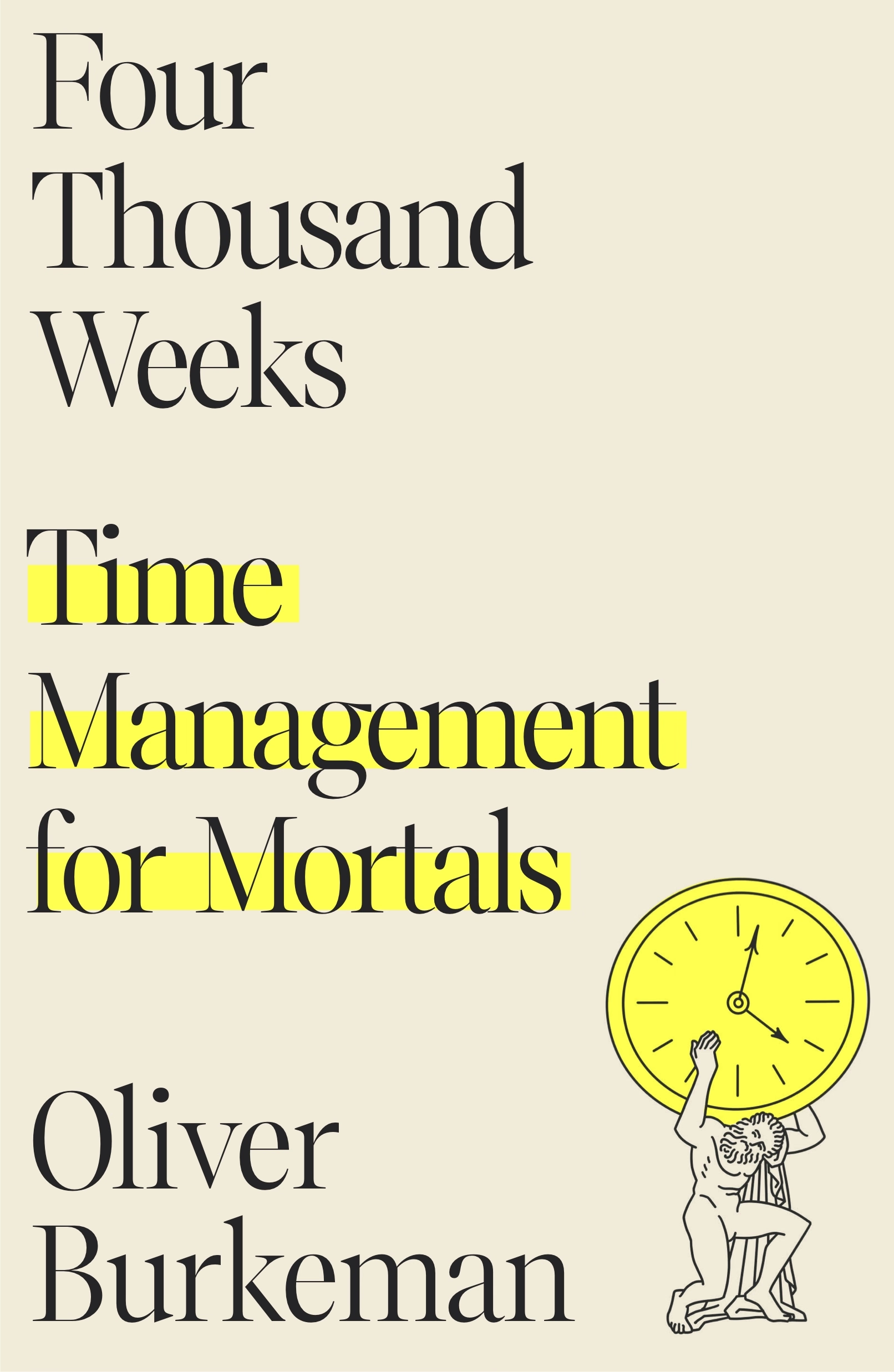
Oliver Burkeman's Four Thousand Weeks: Time Management for Mortals is not the productivity book you think it is—and that's precisely why it matters. Rather than offering another collection of hacks to squeeze more accomplishments into your calendar, Burkeman delivers something far more subversive: a philosophical reckoning with the fundamental futility of trying to "get everything done" in a single lifetime. This is a book that asks you to accept an uncomfortable truth—that your to-do list will never be empty, your ambitions will always exceed your time, and that's actually okay.
The premise is deceptively simple. If you live to eighty, you have approximately 4,000 weeks. That's it. No amount of productivity optimization changes this mathematical reality. Yet our entire culture has constructed an elaborate mythology around time management, promising that with the right system, the right app, the right mindset, you can finally achieve that mythical state of "having it all together." Burkeman's central argument is that this pursuit doesn't liberate us—it enslaves us. We become anxious, hurried, and perpetually dissatisfied, always chasing a horizon that recedes faster than we can run toward it.
What Makes This Book Different
Most productivity literature operates on a fundamental premise: your problem is poor execution. If you just organized better, prioritized harder, or eliminated more distractions, you'd succeed. Four Thousand Weeks flips this entirely. The problem isn't your execution—it's the entire framework. Burkeman argues that the anxiety we feel around time isn't a personal failing; it's a cultural choice we've made, and we could choose differently.
This distinction matters because it shifts the burden from self-improvement to self-acceptance. You're not broken. The system is. Drawing on philosophers from Seneca to contemporary psychologists, Burkeman constructs an argument that our obsession with productivity is historically recent—a product of industrial capitalism and digital culture, not an eternal human condition.
The Core Argument: Embracing Finitude
The book's central insight is that accepting your limitations is more liberating than denying them. When you stop pretending you can do everything, you can actually choose what matters. This sounds obvious in theory, but Burkeman shows how deeply we resist it in practice. We fill our calendars not because we must, but because we fear the emptiness that might result from saying no.
One of the book's most provocative moments comes when Burkeman discusses the Keynesian observation that "in the long run we are all dead." Rather than being depressing, he argues this is genuinely freeing. If nothing you accomplish survives forever, then the pressure to accomplish extraordinary things diminishes. You're free to pursue things for their intrinsic value—because you enjoy them now, in this moment—rather than as stepping stones to some imagined future satisfaction.
This philosophical reframing distinguishes Four Thousand Weeks from comparable works like Cal Newport's Deep Work or David Allen's Getting Things Done. Those books assume your goals are fixed and help you achieve them more efficiently. Burkeman's book questions whether your goals are even worth pursuing in their current form.
What Works Exceptionally Well
Burkeman's writing is genuinely engaging—funny, humane, and never preachy. He acknowledges the counterarguments to his philosophy and doesn't pretend they don't matter. The book includes practical tools that emerge naturally from the philosophy rather than feeling tacked on. His "fixed-volume" approach to productivity (maintaining a limited to-do list of genuinely important items rather than an infinite backlog) and his advocacy for "serializing" projects (completing one significant thing before starting another) are concrete enough to implement immediately.
The historical and philosophical grounding is substantial. Burkeman doesn't just assert that we should relax about productivity; he demonstrates how our current anxieties are recent inventions, shaped by specific technological and economic forces. This historical perspective is genuinely illuminating and more intellectually satisfying than most self-help offerings.
The audiobook narration by the author himself adds another dimension—Burkeman's dry wit comes through clearly, making even the more philosophical passages feel conversational rather than didactic.
Where the Philosophy Breaks Down
The book's greatest weakness emerges when you apply its logic to collective action. If we're all supposed to embrace our limitations and focus on intrinsic satisfaction, what happens to social movements? Civil rights activists didn't achieve change by accepting their finitude and enjoying the present moment—they sacrificed, strategized, and pursued outcomes that seemed impossible. The book doesn't adequately address this tension between individual acceptance and collective ambition.
Some readers will find Burkeman's philosophy borders on apathy. If nothing really matters in the end, why pursue anything beyond personal comfort? The author attempts to answer this, but the response feels slightly underdeveloped compared to the rest of the argument. There's a philosophical gap between "accept your limitations" and "pursue meaningful projects" that the book doesn't entirely bridge.
Additionally, there's noticeable repetition. Burkeman returns to his core themes multiple times throughout the book. While this reinforces the message, it can feel redundant, particularly in the middle sections. The book might have been stronger at 200 pages rather than its current length.
The Practical Tools (They Actually Matter)
Despite its philosophical focus, Four Thousand Weeks includes surprisingly concrete advice. The five key questions Burkeman poses—about uncomfortable growth, impossible standards, self-acceptance, imposter syndrome, and detachment from outcomes—provide genuine scaffolding for rethinking your relationship with time and productivity.
The ten tools for embracing finitude range from the obvious (limit your to-do list to ten items) to the more subtle (serialize your projects rather than multitasking). These aren't revolutionary, but they flow logically from the book's philosophy and feel earned rather than imposed.
Who Should Read This
This book is essential for anyone who's felt trapped by productivity culture—the person who checks off tasks but never feels satisfied, who reads productivity books hoping the next one will finally solve the puzzle, who lies awake wondering if they're doing enough. If you've ever felt that the problem isn't your system but the entire premise that you should be able to "have it all," this book will feel like permission.
Four Thousand Weeks is also valuable for anyone in a knowledge worker role, particularly those in tech, consulting, or creative fields where the work is theoretically infinite and the pressure to optimize is relentless.
However, this book will frustrate readers who are genuinely seeking practical productivity hacks. If you want a better calendar system or time-blocking method, look elsewhere. Similarly, if you're driven by ambitious goals and find meaning in pursuing them relentlessly, some of Burkeman's philosophy may feel like rationalization for underachievement. The book asks you to question your ambitions rather than help you achieve them faster.
Writing Style and Accessibility
Burkeman writes with unusual clarity for a book that engages serious philosophy. He avoids jargon without oversimplifying, and his examples are concrete and relatable. The book moves at a good pace—it's genuinely readable in a way that philosophical self-help often isn't. This accessibility is a significant strength; the ideas wouldn't matter if they were buried in dense prose.
Is Four Thousand Weeks Worth Reading?
Yes, but with caveats. This isn't a book for everyone, and it's important to understand what you're getting. If you're looking for a productivity system, you'll be disappointed. If you're looking for permission to stop trying to optimize every hour of your existence and to instead focus on what actually matters to you, this book is genuinely valuable.
The Four Thousand Weeks review consensus among serious readers is that it's a book that changes how you think about time, even if it doesn't change how you manage it. The philosophical reframing alone—moving from "how do I do more?" to "what actually deserves my finite time?"—is worth the read.
Compared to similar works, Four Thousand Weeks is less practical than Getting Things Done but far more intellectually substantive. It's more philosophical than Atomic Habits but more grounded and funny than typical philosophy books. It occupies a unique space: genuinely useful without being prescriptive.
Final Verdict
Burkeman's central insight—that accepting your limitations is more liberating than denying them—is genuinely important. The book delivers this message with humor, intelligence, and enough practical tools to make it actionable. Yes, there are philosophical gaps, and yes, the repetition occasionally wears thin. But the core argument lands hard, and many readers report that it fundamentally shifts how they think about time and productivity.
This is a book that works best if you're ready to question your assumptions about productivity and success. If you are, it's genuinely transformative. If you're not, it will feel like a philosophical lecture masquerading as a self-help book. Read it if you suspect our culture's obsession with productivity might be making you miserable. Avoid it if you're looking for better ways to do everything you already planned to do.