Category:
Book ReviewsFind Me Where It Ends Review: A Haunting Meditation on Mortality
Prices can sometimes be lower on bigger marketplaces, but this link helps independent bookstores and local reading communities.
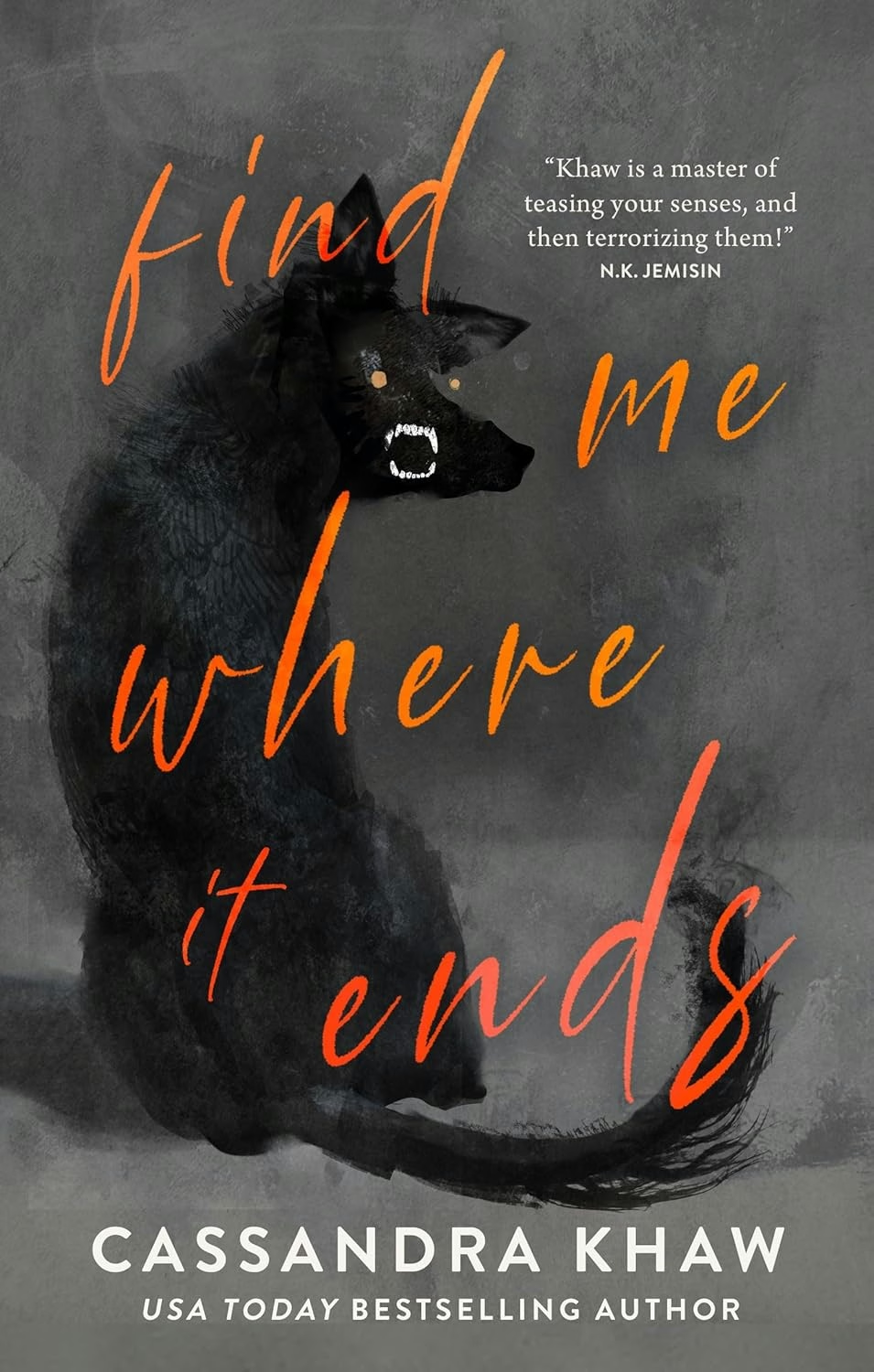
Cassandra Khaw's Find Me Where It Ends is not the horror novel you think you're picking up. This USA Today bestselling author has crafted something far more unsettling than jump scares or supernatural thrills—a lyrical, devastating exploration of suicidal ideation wrapped in the metaphor of a black dog that arrives at a woman's doorstep as Death itself. It's beautiful, brutal, and absolutely not for everyone. But for readers willing to sit with discomfort, this novella offers something genuinely rare: a work that refuses to romanticize despair while simultaneously treating it with profound humanity.
What This Book Actually Is
Forget everything you know about horror as a genre. Cassandra Khaw's Find Me Where It Ends operates in an entirely different register. The premise is deceptively simple: Antigone, a woman from a family where death traditionally arrives in the form of a black dog, wakes to find her own black dog at her door. Rather than fear it, she welcomes it inside—and therein lies the entire philosophical and emotional weight of this 200-page novella.
This isn't a story about a supernatural creature stalking a victim. It's an intimate portrait of someone contemplating whether to continue living, using the conceit of Death as a companion to explore the mental and emotional machinery of that contemplation. The black dog becomes a physical manifestation of depression, exhaustion, and the seductive pull of permanent rest.
The Writing: Where Khaw Excels
The prose in Find Me Where It Ends is genuinely exceptional. Khaw writes with a lyrical precision that makes even the darkest passages feel almost dreamlike. Sentences linger. Metaphors deepen rather than collapse under their own weight. The narrative structure—divided into sections marked by time ("2 months before," "1 week after")—creates a countdown effect that heightens the tension without ever becoming melodramatic.
What distinguishes Cassandra Khaw's approach here is her refusal to explain or spell out Antigone's internal state. Instead of telling us she's depressed, Khaw shows us the bone-deep exhaustion, the hollowed-out parts of herself that Antigone has sacrificed for others, the way even basic survival feels like an act of rebellion. The supporting characters—family members and loved ones who genuinely care but often make things worse—are drawn with equal nuance. Their well-intentioned interventions sometimes cause harm precisely because they come from love and genuine concern, which is painfully, realistically true.
What Works: The Emotional Gut-Punch
The central metaphor is the engine that drives everything. The black dog works as both literal presence and psychological symbol, allowing Khaw to explore death and suicidal ideation without ever reducing either to simple diagnosis or solution. This is the book's greatest achievement: it captures how devastating hopelessness can become overwhelming without ever trivializing that experience or offering false comfort.
The ending deserves specific mention. Where many books about death and despair either collapse into sentimentality or bitter nihilism, Khaw finds a third path—one that acknowledges both the inevitability of mortality and the stubborn, inexplicable fact of continued existence. That final line about magic will haunt readers long after the final page.
The audiobook narration is also remarkably well-executed, though some readers noted the choice of a male narrator for a female protagonist creates an interesting (if sometimes disorienting) distance from Antigone's interiority.
What Doesn't Work: Genre Expectations and Accessibility
If you're seeking a horror novella in the traditional sense—something with scares, supernatural tension, or genre thrills—you'll be disappointed. Find Me Where It Ends is horror only in the sense that confronting mortality and mental illness is horrifying. It's meditative where readers might expect propulsive, introspective where they might want external conflict.
More significantly, this book carries genuine trigger warnings around suicide and suicidal ideation. The narrative structure, with its countdown format, intensifies this for some readers. Several reviewers noted that while the writing is beautiful, the emotional weight proved too much—not because of poor execution, but because Khaw executes her vision so effectively that it lands with full force. This isn't a flaw, but it is a limitation on accessibility.
The novella's brevity, while elegant, also means certain character relationships and plot threads remain deliberately underdeveloped. Some readers will find this restraint admirable; others will wish for more expansion and context.
Is Find Me Where It Ends Worth Reading?
Yes—with significant caveats. This is a book that earns its four-star average (948 ratings on Goodreads) not through universal appeal, but through the intensity of connection it creates with its intended audience. It's comparable to works like My Heart Is a Chainsaw by Stephen Graham Jones in its refusal to separate horror from genuine human suffering, or to The Vegetarian by Han Kang in its use of physical metaphor to explore psychological states.
The Find Me Where It Ends review conversation online reveals genuine polarization—not because some reviewers missed the point, but because the book's central themes simply won't resonate with every reader. Some found it transformative; others found it too heavy. Both responses are valid.
Who Should Read This
Perfect for: Readers who appreciated Mexican Gothic or The Only Good Indians (books that blur genre boundaries), those interested in mental health narratives that avoid cliché, anyone who's experienced depression or suicidal ideation and wants to see it treated with nuance and respect, literary fiction readers willing to venture into speculative territory, and anyone seeking short, dense reads that reward close attention.
Skip it if: You're looking for traditional horror with external conflict, you prefer plot-driven narratives, you're in a vulnerable mental space regarding suicidal ideation, or you need books that provide resolution and hope in conventional ways.
The Verdict
Find Me Where It Ends is a masterwork of controlled emotional intensity—8/10. Cassandra Khaw has created something that functions simultaneously as meditation, metaphor, and mirror, refusing easy answers while treating its subject matter with the gravity it deserves.