Category:
Book ReviewsFantasma Review: Brutally Honest, Brilliantly Crafted
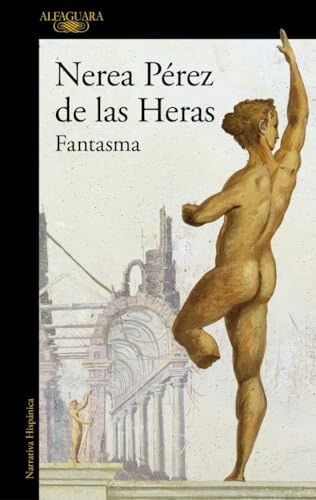
Prices can sometimes be lower on bigger marketplaces, but this link helps independent bookstores and local reading communities.
Quick Verdict
Nerea Pérez de las Heras's Fantasma is a masterclass in transforming personal tragedy into universal reflection. This non-fiction account of losing part of her leg in a boating accident becomes something far larger: a searing critique of public healthcare, urban accessibility, and how society treats bodies that don't fit the "normal" template. The Fantasma review consensus is overwhelmingly positive, though some readers find the author's polished prose occasionally shields deeper emotional rawness.
What This Book Actually Is
Don't approach Fantasma expecting a straightforward disability memoir or inspirational survival story. Pérez de las Heras explicitly rejects both the "triumph over tragedy" narrative and the victim lament. Instead, she constructs something more ambitious: a layered essay that uses her 2023 accident as a lens to examine identity, memory, embodiment, and the fragility we all pretend isn't there.
The accident itself—a propeller injury during a Mediterranean summer—becomes the ghost that haunts the narrative. But the real substance emerges in what follows: the discovery of a new body, the bureaucratic nightmare of Spanish healthcare, the architectural hostility of cities designed for an imaginary "standard" human, and the quiet revolution of learning to exist differently. This is political memoir disguised as personal testimony.
The Narration Changes Everything
The audiobook edition, narrated by Pérez de las Heras herself, deserves special mention. Her voice transforms the reading experience entirely. There's an intimacy in hearing her deliver lines about pain, vulnerability, and dark humor that a printed page simply cannot replicate. The tonal shifts—from laugh-out-loud observations to throat-tightening honesty—land with devastating precision when delivered by the author.
Listeners report an almost whiplash effect: laughing at a perfectly-timed joke about her body's new absurdities, then confronting a paragraph about grief or social exclusion that lands like a punch. This isn't accidental. It's the architecture of the book itself.
What Works Brilliantly
Pérez de las Heras's greatest strength is refusing sentimentality while maintaining profound humanity. She documents the pain without performing it. Early chapters detail the practical horror of post-accident recovery—the phantom limb sensations, the indignity of relearning basic functions, the shock of seeing yourself in a mirror and not recognizing what's there.
But she never wallows. Instead, she pivots to investigation. Why does Spanish public healthcare crumble under the weight of actual need? How did mass tourism transform Mediterranean islands into spaces hostile to anyone with mobility challenges? What does it mean that her accident automatically relocated her into a social category most people pretend doesn't exist until it happens to them?
The book's political teeth are genuinely impressive. Pérez de las Heras connects her personal loss to systemic failures: housing crises, healthcare defunding, architectural ableism, and the way society collectively gazes at disabled bodies with confusion and discomfort. These aren't tangents—they're the real subject matter, with the accident serving as the entry point.
Her treatment of friendship and love is equally moving. The people who show up, the ones who disappear, the complicated ways relationships recalibrate around a changed body—these observations feel earned, not performed. There's gratitude here, but also honest acknowledgment of how disability can expose the fragility of human connection.
Where It Stumbles
The criticism that emerges from careful readers isn't about the content but the presentation. One thoughtful reviewer noted that while Pérez de las Heras explicitly discusses how theater taught her to see herself from the outside, the entire book seems written from that external vantage point. Every phrase arrives polished. Every potential misunderstanding is preemptively defused. Every emotional beat is carefully modulated.
This creates a paradox: a book about vulnerability that sometimes feels over-controlled. The author's intelligence and self-awareness—genuine assets—occasionally function as armor. Readers seeking rawer, messier emotional excavation might find themselves respecting the work while feeling held at arm's length.
There's also a tension between the book's ambitions. When Pérez de las Heras focuses on her immediate experience—the phantom limb, the first shower, the conversation with her partner—the writing crackles. When she shifts into broader social commentary, the personal stakes sometimes dilute. Both modes work individually; the seams between them occasionally show.
Who Should Read This
This book is essential for anyone seeking honest engagement with disability, embodiment, and how trauma reshapes identity. It's crucial for healthcare policy advocates, urban planners, and anyone who works in accessibility. It's valuable for readers interested in contemporary Spanish culture and how the Spanish healthcare system functions (or doesn't).
It's also genuinely engaging for people who simply appreciate excellent writing and reporting. Pérez de las Heras is a journalist first, and that rigor shows. Her research is thorough, her arguments are substantive, and her prose is consistently intelligent.
Who might struggle? Readers seeking emotional catharsis or conventional memoir arc might find the intellectual distance frustrating. Those who prefer their non-fiction more narrowly focused might be bothered by the genre-blending. And readers uncomfortable with disability as a topic—or who want inspiration porn rather than systemic critique—should look elsewhere.
The Title's Genius
"Fantasma" works on multiple levels. A phantom limb is the ghost of a body part that no longer exists but continues to send signals. But it's also the ghost of a former self, the phantom of a life that was interrupted, the haunting of normalcy once you realize how fragile it always was. The title encapsulates the book's central insight: we're all haunted by versions of ourselves that no longer exist, all shaped by absences as much as presences.
The Verdict
Is Fantasma worth reading? Absolutely. This is important work—intellectually rigorous, emotionally intelligent, and genuinely necessary. It succeeds at being simultaneously personal and political, intimate and analytical, heartbreaking and funny. The Fantasma review landscape reflects a book that accomplishes what it sets out to do, even if some readers wish it occasionally took more emotional risks.
The audiobook format is particularly recommended. Hearing Pérez de las Heras deliver her own words adds a dimension that transforms good writing into a genuine experience. Whether you encounter this as audio or print, prepare for something that will shift how you think about bodies, systems, and what it means to rebuild a life.