Category:
Self-HelpDopamine Detox Review: Oversimplified But Oddly Effective
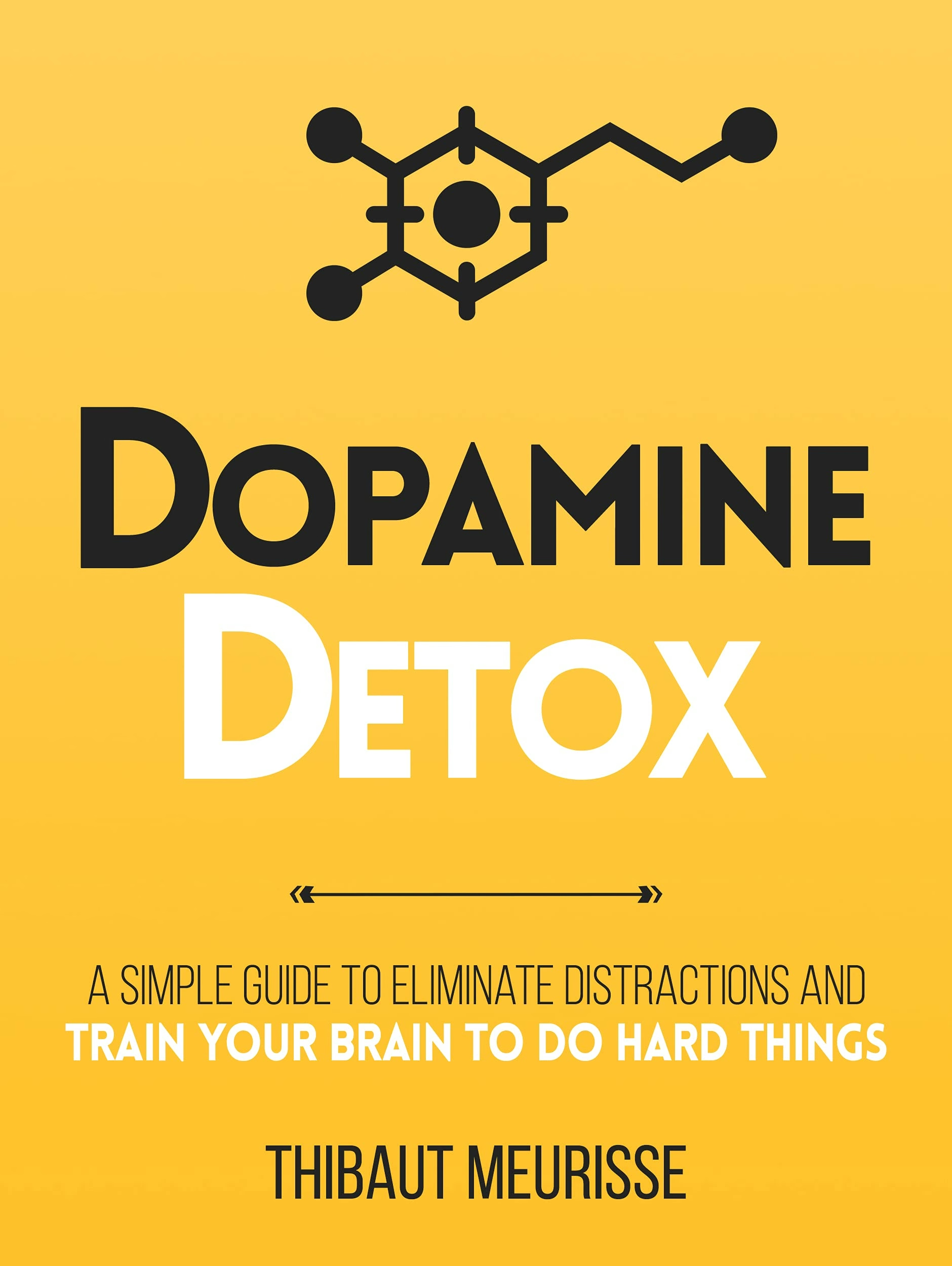
Thibaut Meurisse's Dopamine Detox: A Short Guide to Remove Distractions and Train Your Brain to Do Hard Things arrives at a moment when digital distraction has become the default state of human consciousness. The book promises to help readers escape the grip of endless notifications, social media feeds, and low-effort entertainment—a premise that resonates with millions struggling to focus on meaningful work. But does this slim 70-page guide deliver genuine insight, or does it peddle the same oversimplified productivity gospel we've heard a thousand times before?
The honest answer is both. This Dopamine Detox review reveals a book that works brilliantly for some readers while frustrating others with its reductive worldview and lack of scientific rigor.
What This Book Actually Tackles
Meurisse's core argument is straightforward: your brain has been hijacked by stimuli engineered by tech companies to be maximally addictive. Every ping, every algorithmic recommendation, every autoplay feature is designed to trigger dopamine release—the neurotransmitter associated with motivation and reward. Over time, this constant bombardment raises your baseline dopamine threshold, making ordinary tasks feel impossibly boring.
The solution, according to Meurisse, is a "dopamine detox"—a deliberate period of removing high-stimulation activities to reset your brain's reward system. Once recalibrated, you'll find that genuinely important work becomes more appealing, and you'll develop the mental stamina to tackle difficult tasks without constant digital escape routes.
It's an intuitive premise. Anyone who's tried to focus while their phone buzzes in their pocket understands the pull. The neuroscience underlying the concept has real merit: dopamine dysregulation does play a role in procrastination and attention problems. But here's where Dopamine Detox begins to falter.
The Science Problem
Meurisse presents dopamine as almost a villain—something to be feared and managed rather than understood. He oversimplifies how dopamine actually works in the brain. Dopamine isn't just about pleasure; it's about motivation, prediction, and goal-directed behavior. Enjoying a Netflix series isn't your brain being "hijacked"—it's your brain doing exactly what it evolved to do: seek rewarding stimuli.
The book provides almost no citations or references to peer-reviewed research. For readers seeking evidence-based guidance, this is a significant gap. Compare this to books like Indistractable by Nir Eyal or The Distracted Mind by Adam Gazzaley and Larry Rosen, which ground their arguments in actual neuroscience and provide extensive citations. Those books acknowledge the complexity of attention; Meurisse's Dopamine Detox review reveals a work that treats it as a simple on-off switch.
The action steps promised in the book are vague and repetitive. "Don't check emails," "avoid social media," "eat healthier"—these aren't controversial or novel suggestions. They're the productivity equivalent of "get eight hours of sleep"—technically true but offered without practical scaffolding for implementation.
Who This Book Actually Works For
Here's the paradox: despite these limitations, readers report genuine behavioral change. Some have uninstalled Instagram. Others have rediscovered the ability to work for hours without distraction. The book's brevity—readable in two hours—means it doesn't require the sustained attention its own philosophy demands, which is either clever or ironic depending on your perspective.
For people drowning in digital noise and seeking permission to simply stop—to put down their phones without guilt—this book provides that. It validates the intuition that something feels wrong about constant connectivity. For someone who has never seriously examined their relationship with technology, Dopamine Detox can serve as an effective wake-up call.
The book works best for readers who:
- Are already somewhat self-aware about their distraction habits
- Have stable employment and financial security (more on this below)
- Don't struggle with ADHD, OCD, or other neurodevelopmental conditions
- Are neurotypical and respond well to straightforward behavioral advice
- Seek motivation more than methodology
Where This Book Fails
The most damaging critique isn't about oversimplification—it's about invisibility. Meurisse's framework assumes a reader with considerable privilege. He suggests buying healthier food without acknowledging that organic produce costs more and requires preparation time. He recommends a "dopamine detox" period without considering readers working multiple jobs or managing family chaos. He advocates patience and long-term thinking while using Jeff Bezos as an example—someone with inherited wealth and venture capital backing.
For people living paycheck to paycheck, the advice to "stop hustling and think long-term" isn't wisdom; it's gaslighting. For parents managing ADHD children or people with anxiety disorders, the suggestion that distraction is merely a choice you're making is not just wrong—it's harmful.
The book also conflates all digital activity as equally problematic. Scrolling TikTok and checking work emails aren't the same dopamine experience, yet Dopamine Detox treats them identically. It doesn't distinguish between distraction and genuine leisure, implying that anything not "productive" is wasted time. This is a deeply impoverished view of human flourishing.
Meurisse repeats his core points so frequently that the book feels padded despite its brevity. The examples become stale. The proposed exercises lack depth—there are no meaningful worksheets or structured frameworks, just prompts asking you to "be specific."
The Real Issue: Productivity Moralizing
What ultimately undermines Dopamine Detox is its implicit moral hierarchy: work is good, leisure is suspect, and if you enjoy entertainment, something is wrong with your brain. This isn't productivity advice; it's asceticism dressed in neuroscience language.
Human beings need downtime. Watching Netflix isn't a sign of hijacking; it's rest. Playing video games develops problem-solving skills and provides social connection. Scrolling social media, while often mindless, isn't inherently evil. A life of constant optimization and delayed gratification isn't healthier—it's just exhausting.
The book's polarizing nature becomes clear in reader responses: people either find it liberating or oppressive, depending on whether they already believe entertainment is suspect.
Writing and Presentation
Meurisse writes in clear, accessible English. The book is easy to read—perhaps too easy. There's little friction, which matches the book's philosophy but undermines its credibility. Serious arguments require serious treatment. The casual tone, while approachable, makes it difficult to take the scientific claims seriously.
The structure is logical: problem, explanation, solution, action steps. But the execution is thin. Each section could accommodate more nuance, more evidence, more acknowledgment of counterarguments.
Is Dopamine Detox Worth Reading?
It depends entirely on your starting point. If you're tech-overwhelmed and seeking permission to disconnect, yes. If you want evidence-based guidance on attention and motivation, no—read something else. If you're already skeptical of productivity culture, this will frustrate you. If you're seeking scientific depth, you'll be disappointed.
The Dopamine Detox review ultimately reveals a book that punches above its weight for a specific audience while missing the mark for many others. It's not bad; it's incomplete. It's not wrong; it's reductive. It works, but not for the reasons Meurisse thinks it works, and not for everyone.
Final Verdict
This book succeeds as a nudge—a lightweight intervention that helps some readers make meaningful changes. It fails as a comprehensive guide to attention, neuroscience, or human motivation. It's most valuable for people who don't think too critically about its premises and least valuable for those who do.
The 3.88-star rating on Goodreads perfectly captures its divisive nature: genuinely helpful for some, actively frustrating for others, with little middle ground. Before reading, ask yourself: Do I want a simple behavioral push, or do I want to understand what's actually happening in my brain? Your answer determines whether Dopamine Detox is worth your time.