Category:
Book ReviewsDon't Call Me Jupiter Review: Brutally Honest Hippie Memoir
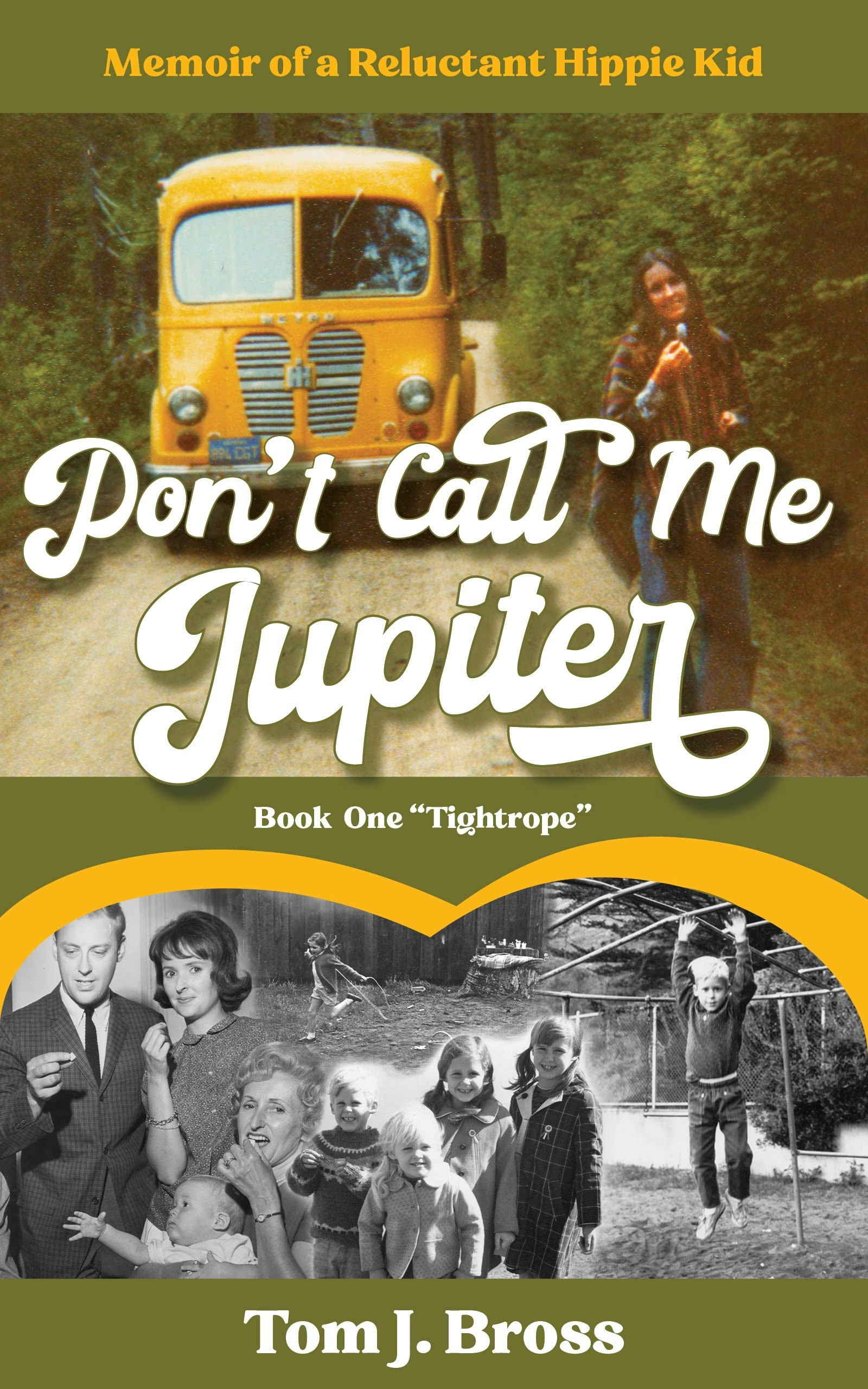
Prices can sometimes be lower on bigger marketplaces, but this link helps independent bookstores and local reading communities.
Tom J. Bross's "Don't Call Me Jupiter: Memoir of a Reluctant Hippie Kid" is a darkly comedic coming-of-age story that doesn't shy away from the messy reality behind the peace-and-love aesthetic of 1970s counterculture. This is not a nostalgic celebration of the Age of Aquarius—it's a raw, unflinching account of what happens when a charismatic mother drags her family into the hippie lifestyle, leaving her children to navigate abandonment, instability, and the psychological wreckage that follows.
The premise alone should tell you whether this memoir is worth your time: a 12-year-old Tom gets shuffled between his mother's ex-lovers' garages and friends' spare rooms as his family transforms from Midwestern Catholic conservatives into California free spirits. It's the kind of premise that sounds almost comedic until you realize these were real children experiencing real trauma wrapped in the rhetoric of spiritual enlightenment.
What This Book Actually Is
This is a memoir structured as therapy sessions. Bross frames his narrative through the lens of his adult self sitting in a therapist's office, feet propped on a footstool, recounting decades of family chaos. That framing device matters—it signals from page one that this isn't a straightforward chronological journey. Memory doesn't work linearly, and neither does grief, and Bross understands this intuitively.
The story begins in 1974 when his family relocates from Davis to San Anselmo to join a "God Family." Two months later, they're back in Davis with nowhere to live. His siblings get distributed among friends' homes like unwanted furniture. Tom lands in a garage. From that dreary vantage point, he begins unpacking the truly strange transformation his family underwent—one led by what he calls "the Martha Stewart of Hippies," his mother, who orchestrated their descent into a lifestyle defined by psychedelic experimentation, drug use, and an almost willful rejection of conventional stability.
The Writing: Sharp, Specific, Unapologetic
Bross writes with a precision that elevates this beyond typical memoir territory. He doesn't generalize about the 1970s or wax philosophical about the counterculture movement. Instead, he renders specific moments with almost novelistic detail—the exact feeling of abandonment, the particular humiliation of poverty, the specific jokes his family used to deflect from deeper pain.
The humor is genuinely funny, not the forced levity of someone trying to make trauma palatable. When reviewers mention "laugh-out-loud" moments, they're not exaggerating. Bross has mastered the tonal balance between comedy and devastation, allowing readers to laugh at absurd situations while simultaneously feeling the weight of what those situations meant for a vulnerable child.
The prose style itself is conversational without being sloppy. Bross trusts his reader to follow his associative leaps between past and present, between his therapist's office and his childhood bedroom. This approach works because his voice is so distinctive and commanding that you want to follow him anywhere.
What Works Exceptionally Well
The central tension of this book—the gap between the mythology of the hippie movement and its actual impact on real families—is its greatest strength. Bross doesn't position himself as a victim raging against his parents' choices. Instead, he examines the seductive logic of that era, the genuine idealism that motivated people like his mother, and the catastrophic consequences for those who couldn't opt out.
The portrayal of his mother is particularly nuanced. She's not a villain in a straightforward sense. She's a woman searching for meaning, for reinvention, for escape from the constraints of her previous life. That she pursued this reinvention at the expense of her children's stability is the tragedy—not because she was cruel, but because she was blind to anyone else's needs but her own.
The structure itself deserves credit. By anchoring the narrative in therapy sessions, Bross creates a meta-commentary on the act of processing trauma. He's not just telling you what happened; he's showing you what it takes to make sense of what happened. The non-linear timeline feels intentional and earned, not gimmicky.
Readers familiar with similar memoirs like "The Glass Castle" by Jeannette Walls will recognize the territory—unconventional parents, childhood instability, the complicated love that persists despite dysfunction. But where Walls leans toward magical realism in her storytelling, Bross grounds everything in psychological specificity.
Where It Falls Short
The book's primary weakness is that it's explicitly positioned as the first in a trilogy. Some readers will experience this as a cliffhanger; others will experience it as manipulation. The "redemption" that apparently arrives in the final book—through an act of "selfless family love"—is notably absent here. This first volume is essentially a descent into dysfunction without resolution.
For readers seeking a complete emotional arc within a single book, this will feel incomplete. The narrative ends not with closure but with the author still in therapy, still processing, still unresolved. That's realistic and psychologically honest, but it's also a structural choice that demands the reader commit to a trilogy to get the full story.
The pacing occasionally drags. Some chapters feel like they're spinning wheels, adding atmospheric detail without advancing the narrative. This is a minor quibble for readers who love immersive storytelling, but it's worth noting for those who prefer tighter plotting.
Who Should (and Shouldn't) Read This
Read this if you: grew up in unconventional families and want validation that your experience wasn't unique, appreciate memoirs that don't sanitize dysfunction for reader comfort, enjoy 1970s cultural history from an insider's perspective, or want to understand the psychological cost of ideological movements on the people living inside them.
Skip this if you: are looking for inspirational redemption narratives, prefer your memoirs to conclude with neat resolution, have unprocessed trauma around parental abandonment (this book will hit hard), or expect the hippie movement to be portrayed as universally positive.
One reviewer who encountered the book as a local connection—having grown up near Tom's family—noted that it finally answered questions that had puzzled them since childhood. "What, the mother is just gone?! How does that happen?" That's the book's central question, and it's a powerful one.
The Audiobook Factor
It's worth noting that this book is available through Audible as part of a subscription package that includes all three volumes. For audiobook listeners, Bross's conversational voice likely translates exceptionally well to the format. The therapy-session framing becomes even more intimate when heard rather than read.
Final Verdict
8/10 — "Don't Call Me Jupiter" is a fearlessly honest memoir that transforms personal trauma into something universally resonant, though it demands reader commitment to a trilogy for full satisfaction.
Is "Don't Call Me Jupiter" worth reading? Absolutely—if you're prepared for a book that treats the 1970s counterculture not as a romantic era but as a lived reality with genuine consequences. Bross has written something rare: a memoir that's simultaneously hilarious and heartbreaking, specific to his family's story and universal in its exploration of how we survive abandonment. The book's 4.17/5 rating across thousands of readers reflects its polarizing nature—some find it cathartic and brilliantly rendered, while others find it too dark or too incomplete.
The real question isn't whether this book is good. It clearly is. The question is whether you're ready for the particular kind of honesty Bross offers.