Category:
Book ReviewsDon't Be Evil Review: Honest but Uneven Tech Memoir
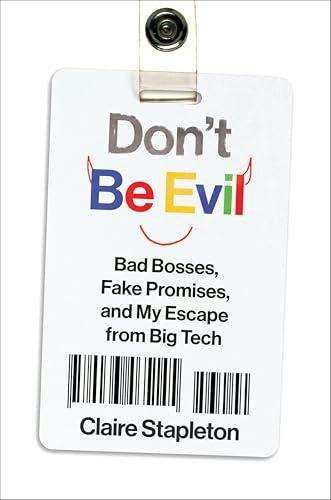
Prices can sometimes be lower on bigger marketplaces, but this link helps independent bookstores and local reading communities.
Quick Verdict
Don't Be Evil: Bad Bosses Fake Promises and My Escape from Big Tech is a provocative insider account that exposes Google's moral decay, but Claire Stapleton's memoir struggles with self-awareness and the uncomfortable truth that she benefited enormously from the system she critiques. It's a timely, engaging read that raises important questions about corporate complicity—yet it's also a cautionary tale about the limits of performative activism from the comfortable middle.
What This Book Is Really About
Stapleton spent twelve years at Google, rising to a comfortable middle-management position in marketing before orchestrating the 2018 Google walkout—one of the most visible tech worker rebellions in recent memory. Her memoir traces the journey from starry-eyed "Noogler" to disillusioned organizer, documenting the cognitive dissonance of working for a company that claimed to "do no evil" while systematically protecting powerful men accused of sexual harassment, amplifying extremist content, and prioritizing shareholder value over employee welfare.
The centerpiece is the Andy Rubin scandal: the Android founder received a $75 million severance package despite credible sexual harassment allegations. This moment crystallized what many Google employees had been feeling for years—that the company's progressive values were marketing theater, and executives would always choose reputation management over accountability.
The Strengths: Authentic Disillusionment
Stapleton writes with genuine insight about the insidious nature of corporate culture at scale. Her description of how Google systematically gaslights employees, how it deploys diversity initiatives as PR cover, and how it manufactures employee compliance through perks and prestige rings true. The sections examining her own complicity—the moments she followed orders she knew were wrong, the times she self-censored—demonstrate real self-examination.
Her account of organizing the walkout is valuable historical documentation. She captures the genuine hope that collective action might change things, the exhaustion of maintaining pressure while working a demanding job, and the bitter realization that Google simply absorbed the criticism and moved on. This is useful material for anyone trying to understand why even high-profile worker organizing at tech companies has yielded minimal structural change.
The writing is sharp and often funny. Stapleton earned her internal reputation for wit—her observations about Google's performative wokeness and the absurdity of corporate all-hands meetings land effectively. The book moves briskly, and she has a gift for capturing the surreal experience of working somewhere that feels both utopian and dystopian simultaneously.
The Critical Problem: Unexamined Privilege
Here's where Claire Stapleton's memoir becomes genuinely frustrating: she appears unwilling to reckon with the central contradiction of her story. She made millions. By her own account, a mid-level employee who joined Google in the mid-2000s and stayed through 2018 would have accumulated substantial wealth through salary and stock appreciation—easily multiple millions. When she finally left, Google gave her a year of severance, six months of maternity leave equivalent, and paid for her employment lawyer.
This is not a story of oppression. This is a story of a privileged person experiencing the standard disappointments of working at a large corporation, cushioned by extraordinary compensation.
The deeper problem is that Stapleton's activism appears proportional to her personal risk tolerance. She was willing to organize a walkout. She was willing to speak publicly. But when a Black woman colleague—facing substantially more precarious circumstances—pushed the group to maintain pressure after Google predictably failed to meet the walkout's demands, Stapleton demurred. She was comfortable rocking the boat until it threatened her job security and golden parachute. The moment actual sacrifice became necessary, her commitment evaporated.
This isn't presented as a limitation or a failure. It's presented as a reasonable boundary. But that's precisely where rocking the boat stops mattering.
Comparison to Similar Works
Readers often compare this to Careless People: A Cautionary Tale of Power, Greed, and Lost Idealism, and the comparison is instructive. That book examines systemic corruption with unflinching clarity about the author's own entanglement. Stapleton's memoir, by contrast, often reads like a victim narrative from someone who was never actually victimized—just disappointed that the system she benefited from wasn't as noble as she'd imagined.
It's also worth comparing to How to Do Nothing by Jenny Odell, which explores similar themes of disengagement from corporate culture but with more philosophical rigor and less self-pity. Odell asks harder questions about complicity; Stapleton mostly narrates her own awakening as though it's a revelation rather than a common experience among comfortable professionals.
What Doesn't Work
The book's central weakness is that Stapleton never fully interrogates why she stayed for twelve years. She describes recognizing problems, witnessing unethical decisions, and feeling increasingly alienated—yet she remained, collecting stock grants and building her resume. The explanation that "I needed the job" doesn't hold: she had options that most workers don't possess. The explanation that "I was hoping things would change" reads as naïve in retrospect.
Her repeated invocation of being called "the bard of Google"—which appears at least five times—feels like she's still seeking validation from the institution she's critiquing. It's a subtle but telling detail that suggests incomplete reckoning with her own ego investment in Google's mission.
The book also suffers from uneven pacing. The opening chapters capture the intoxicating early days of Google with real energy, but the middle section becomes repetitive. We get the point that Google prioritizes PR over principle. The walkout itself, which should be the climax, is oddly anticlimactic—partly because Stapleton's own account suggests the organizing was more performative than substantive.
The Divisive Question: Is This Activism or Memoir?
Readers split sharply on what Stapleton is actually claiming. Some see a brave whistleblower documenting corporate malfeasance. Others see a well-compensated employee seeking absolution through selective narrative. The truth is probably both: this is a memoir from someone who participated in meaningful activism and who benefited enormously from the system she's critiquing, and who never quite grapples with that contradiction fully.
The book would be stronger if it leaned into that tension rather than skating past it. Acknowledge that she was complicit. Acknowledge that her activism was constrained by self-interest. Acknowledge that her story is one of privilege disappointed, not oppression overcome. That would be genuinely radical.
Who Should Read This
Read this if: You work in tech and recognize these dynamics from your own experience. You're interested in recent tech industry history and want an insider perspective on the 2018 Google walkout. You want to understand how corporate culture manufactures consent and why even well-meaning employees become complicit in unethical decisions. You enjoy memoir that grapples with disillusionment.
Skip this if: You're looking for a revolutionary manifesto—this is a memoir from someone whose commitment to change was always conditional on personal safety. You're tired of wealthy people claiming victimhood. You want rigorous analysis of tech industry power structures rather than personal narrative. You've already read similar accounts of corporate culture and want something substantially different.
The Real Value
Despite its limitations, Claire Stapleton's memoir documents something important: the moment when a generation of tech workers realized their employer's values were negotiable. The book captures the specific disorientation of discovering that a company you helped build, that shaped your identity, that claimed to be changing the world, was actually just another profit-maximizing machine willing to sacrifice employees for shareholders.
That's a valuable document. It's just not the courageous whistleblower narrative Stapleton seems to believe she's written.
Final Verdict
Don't Be Evil is a readable, often insightful memoir that works best as a historical record of tech industry disillusionment rather than as a manifesto for change. Stapleton is a sharp observer of corporate culture, and her account of Google's moral compromises rings true. But the book's failure to interrogate her own complicity and privilege—despite her twelve-year tenure and substantial financial benefit—undermines its moral authority. It's a memoir worth reading if you're interested in tech industry history, but it's not the reckoning it imagines itself to be.
Final Score: 6.5/10
Sharp, timely, and historically valuable, but compromised by the author's unwillingness to fully reckon with her own entanglement in the system she critiques.