Category:
Book ReviewsDinners with Ruth Review: Memoir Mislabeled
Prices can sometimes be lower on bigger marketplaces, but this link helps independent bookstores and local reading communities.
Quick Verdict
Nina Totenberg's Dinners with Ruth: A Memoir on the Power of Friendships is a misleading title attached to what is fundamentally a comprehensive personal memoir rather than an intimate portrait of her legendary friendship with Ruth Bader Ginsburg. While the book delivers genuine insight into a celebrated journalist's life and career, readers expecting a RBG-centric narrative will feel bait-and-switched. That said, if you approach this as a sweeping account of female friendship, ambition, and professional transformation in late-20th-century America, it's genuinely rewarding.
What This Book Actually Is
Totenberg's memoir opens with her pivotal 1972 phone call to a young attorney named Ruth Bader Ginsburg, a moment that would launch nearly fifty years of friendship. However, this isn't a book structured around that relationship. Instead, it's a sprawling, chronological journey through Totenberg's own life—her famous violinist father Roman Totenberg, her early journalism career, her marriages, her colleagues at NPR, and yes, her friendship with Ginsburg, which occupies roughly equivalent space as her relationships with Cokie Roberts, Linda Wertheimer, and various Supreme Court Justices.
The title promises intimacy centered on dinners and a singular friendship. What you actually get is a richly detailed account of Totenberg's professional rise and personal evolution, with Ginsburg as an important but not dominant character in that narrative.
The Title Problem Is Real
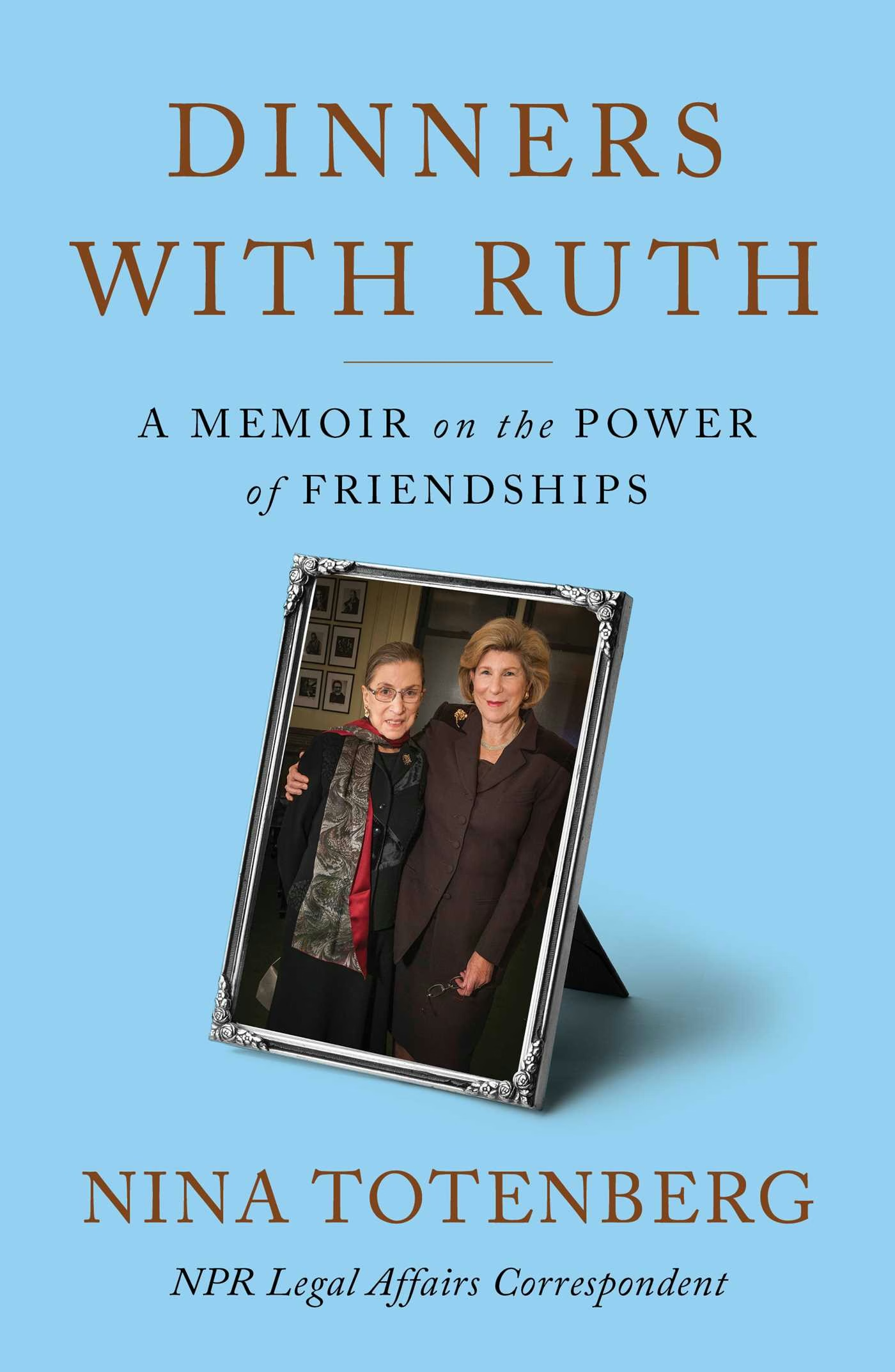
This isn't nitpicking—it's a fundamental marketing disconnect that affects reader satisfaction. The cover imagery and title positioning create an expectation of a dual biography or intimate friendship memoir in the vein of The Friendship: Hobbes and Locke or similar works that center on a specific relationship as the organizing principle. Instead, readers encounter something closer to Becoming or other expansive personal memoirs where multiple relationships receive attention.
One reader aptly noted that Ginsburg appears "only slightly more prominently" than other figures in Totenberg's orbit. This isn't a flaw in the book's execution—it's a flaw in its presentation. The subtitle, "A Memoir on the Power of Friendships," more accurately reflects what's between the covers.
What Actually Works Here
Once you recalibrate your expectations, Dinners with Ruth becomes a genuinely valuable read. Totenberg's account of women navigating male-dominated institutions—whether journalism or law—in the 1970s and beyond carries real historical weight. Her portrayal of Ginsburg's legal reasoning, explained during that initial phone call about sex-based discrimination, captures a pivotal moment in American legal history with clarity and personal warmth.
The book excels at showing how female friendships functioned as professional armor and emotional sustenance. Totenberg writes compellingly about how she and Ginsburg understood that "clothes were armor for women who wanted to be taken seriously." This isn't superficial—it's a sharp observation about how women strategically navigated workplaces that viewed them as interlopers.
Totenberg's reflections on mutual support through grief and loss—her first husband's illness and Ginsburg's eventual widowhood—reveal genuine emotional depth. These aren't sentimental passages; they're honest accounts of how friendship sustained both women through devastating personal crises.
The Writing and Narration
Totenberg narrates the audiobook herself, which is typically an advantage for memoirs. However, several listeners noted that her "reedy" voice, while clear and competent, lacks the natural warmth that makes long-form audiobook narration immersive. This is a minor issue but worth considering if you're choosing between formats. The written version may actually serve better for sustained reading.
The prose itself is journalistic—clear, precise, and well-organized, but not particularly lyrical. Totenberg writes like the reporter she is: direct, factual, and efficient. Some readers will appreciate this no-nonsense approach; others seeking more literary memoir may find it somewhat utilitarian.
A Bonus: The Violin Music
The audiobook includes recordings of violin music performed by Totenberg's father, Roman Totenberg, a child prodigy who performed his concert debut at age eleven. This adds a unique dimension to the listening experience and reinforces the book's exploration of family legacy and artistic achievement.
Who Should Actually Read This
Perfect for: Readers interested in women's professional history, legal reform movements, journalism, or accounts of female friendship across decades. Those fascinated by Ruth Bader Ginsburg but already familiar with her judicial legacy may find Totenberg's personal perspective refreshing. NPR listeners and fans of Totenberg's reporting will enjoy understanding her background and career development.
Will disappoint: Anyone seeking a focused, intimate portrait of the Totenberg-Ginsburg friendship. Readers expecting the book to center on actual dinners and specific shared moments will find the structure scattered. Those wanting a deep dive into Ginsburg's life and work (rather than Totenberg's) should look elsewhere.
The Larger Context
This book arrives in a publishing landscape saturated with Supreme Court memoirs and biographies. Unlike Just a Minute: A Memoir of My Life So Far (Ginsburg's own account) or recent Ginsburg-focused biographies, Totenberg's approach is deliberately sidelong—Ginsburg matters not as the subject but as a mirror reflecting Totenberg's own journey. This is actually a fresh angle, even if the marketing doesn't signal it.
The book also contributes valuable documentation of how women journalists, lawyers, and professionals built networks and support systems during a transformative period in American history. In an era when workplace mentorship and female solidarity are actively discussed, Totenberg's account feels timely and relevant.
Final Verdict
7/10 — A worthwhile memoir undermined by misleading packaging, but rewarding once expectations align with reality.
Is Dinners with Ruth worth reading? Yes, but not for the reasons the title suggests. Approach it as Nina Totenberg's personal story—one that happens to include Ruth Bader Ginsburg—and you'll find genuine value in her reflections on friendship, professional ambition, and women's advancement. The book's greatest strength is its honest portrayal of how women supported each other while breaking institutional barriers. Its greatest weakness is that the publisher oversold the Ginsburg angle, creating a misleading impression that may prevent the right readers from picking it up while frustrating those seeking something else entirely.
The Dinners with Ruth review ultimately depends on what you're actually seeking. As a personal memoir? Solid. As a Ginsburg-focused friendship narrative? Disappointing. Make sure you're choosing the right book for your interests before committing.