Category:
Book ReviewsDessert Can Save the World Review: Joy Over Recipes
Prices can sometimes be lower on bigger marketplaces, but this link helps independent bookstores and local reading communities.
Quick Verdict
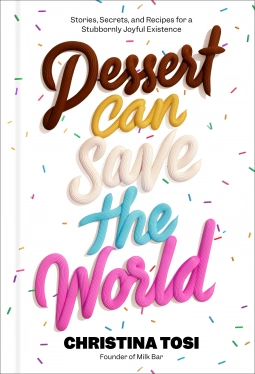
Dessert Can Save the World: Stories, Secrets, and Recipes for a Stubbornly Joyful Existence by Christina Tosi is a deceptively complex book that masquerades as a cookbook but operates primarily as a philosophy manifesto wrapped in memoir. This isn't a straightforward recipe collection—it's a meditation on choosing joy as a radical act, delivered by someone who built a multi-million-dollar empire on the premise that dessert matters. The James Beard Award-winning founder of Milk Bar has written something genuinely worth your time, though perhaps not for the reasons you might expect when you pick it up.
What This Book Actually Is (And Isn't)
When you see "Dessert Can Save the World" on a shelf, your brain immediately categorizes it as a cookbook. That's your first mistake—and Christina Tosi's most brilliant marketing move. Yes, there are recipes scattered throughout these pages. Yes, some are recognizable Milk Bar favorites. But calling this book a cookbook is like calling Eat, Pray, Love a travel guide. It's technically accurate and completely misleading.
This is a self-help book disguised as culinary memoir. It's Tosi's personal philosophy of intentional joy-making, illustrated through stories about her childhood, her rise in the competitive New York food world, and the women who shaped her relentless optimism. The recipes function as punctuation marks in a larger argument: that the spirit of dessert—the deliberate choice to create something beautiful and pleasurable—can fundamentally transform how you move through life.
The Philosophy That Actually Lands
Tosi's central thesis sounds almost aggressively simple: happiness is a choice, and you can practice it daily through small acts of deliberate joy-creation. She introduces concepts like "joy trails" (intentional moments of delight) and "dirty dessert secrets" (the unorthodox, imperfect ways we actually make things work) that reframe how we think about success and satisfaction.
What makes this argument work, rather than collapse into vapid positivity, is Tosi's unflinching honesty about failure. She doesn't pretend the path to building Milk Bar was linear or that her optimism never wavers. She talks openly about struggling, about moments when the "stubbornly joyful" approach felt impossible. This vulnerability is what separates Dessert Can Save the World from the endless parade of toxic-positivity self-help books flooding the market.
The book also benefits from Tosi's genuine reverence for the women who shaped her—particularly her mother, Greta. These aren't saccharine tributes; they're specific, detailed portraits of how love and intention get transmitted across generations, often through the act of baking.
The Writing: Conversational and Uneven
Tosi writes like she talks: with infectious enthusiasm, casual profanity, and a tendency toward hyperbole. Some readers find this voice irresistible. Others find it exhausting. There's no middle ground here. Her sentences are often short, punchy, and designed to energize rather than illuminate. She uses exclamation points liberally and isn't afraid of repetition when she wants to drive a point home.
The memoir sections are genuinely engaging—Tosi's personal stories have narrative momentum and emotional stakes. The self-help philosophy sections are less polished, sometimes veering toward the preachy or oversimplified. When she's telling a story, you're hooked. When she's dispensing wisdom in abstract terms, the writing occasionally loses its grip.
What Actually Works
The strongest sections are those where Tosi connects her personal experiences directly to actionable insights. Her discussion of unapologetically expressing your true self in professional settings, drawn from her own experience as a woman in the male-dominated restaurant world, feels earned and specific. She's not offering generic advice; she's sharing hard-won wisdom from someone who succeeded by being authentically, aggressively herself.
The recipes themselves, while secondary to the book's larger project, are genuinely interesting. They're not overly complicated, but they're not basic either. More importantly, each recipe is preceded by context—why Tosi makes it, what it means to her, how it fits into her philosophy. This framing transforms them from mere instructions into small essays about intention and care.
The book also succeeds as a portrait of a particular kind of American success story: the scrappy entrepreneur who builds something meaningful by refusing to compromise on her vision. Tosi's path to founding Milk Bar is instructive for anyone interested in food business, creative entrepreneurship, or simply how someone builds a brand on authenticity.
Where It Falters
The book's biggest weakness is its tonal inconsistency. It wants to be simultaneously a deep memoir, a practical self-help guide, a cookbook, and an inspirational manifesto. These don't always coexist comfortably. Some chapters feel rushed, as if Tosi is checking boxes rather than fully exploring ideas. The self-help sections, in particular, sometimes collapse into clichés about "following your passion" and "being authentic"—wisdom that feels less revolutionary than the book's framing suggests.
There's also a class dimension that the book doesn't adequately grapple with. Tosi's philosophy of joy-creation and celebrating small moments is genuinely appealing, but it's delivered by someone who has achieved substantial financial success and professional recognition. The advice to "just bake a cake" and spread joy hits differently when you have the resources to build a multi-location business around that philosophy. The book occasionally reads as tone-deaf to readers navigating genuine scarcity or systemic barriers to joy.
For readers expecting a comprehensive Milk Bar cookbook, you'll be disappointed. There aren't enough recipes, and they're not organized in a way that makes this function as a practical kitchen reference. If you're buying this book for the recipes alone, you're making a mistake.
Who Should Actually Read This
Perfect for: People who love memoir, aspiring entrepreneurs interested in personal branding, home bakers who want inspiration beyond technique, anyone drawn to unapologetic optimism, readers of books like Crying in H Mart by Michelle Zauner or Braiding Sweetgrass by Robin Wall Kimmerer who appreciate food writing that extends beyond the plate.
Will likely frustrate: Readers seeking a serious, comprehensive cookbook, people skeptical of self-help frameworks, those looking for rigorous culinary instruction, anyone who finds relentless positivity exhausting rather than energizing, readers wanting deeper engagement with the business aspects of Milk Bar's growth.
The Comparison That Matters
If you've read Salt, Fat, Acid, Heat by Samin Nosrat, you know the difference between a book that teaches technique and a book that teaches philosophy. Dessert Can Save the World is closer to Nosrat's work than it is to a traditional cookbook—it's about understanding the why beneath the how. If you appreciated the memoir elements of Nothing Fancy by Alison Roman or the philosophical food writing in Crying in H Mart, this book shares that DNA.
Final Verdict
Is Dessert Can Save the World worth reading? Yes, but with caveats. If you're expecting a cookbook, manage those expectations downward. If you're seeking a memoir about building Milk Bar, you'll get that, but it's secondary to a larger meditation on joy. If you're open to a book that refuses to fit neatly into one category and rewards you for embracing its contradictions, you'll likely find something genuinely valuable here.
Christina Tosi's Dessert Can Save the World succeeds most when it stops trying to be everything and simply lets Tosi's voice—honest, enthusiastic, and stubbornly optimistic—carry you through. The recipes are a bonus. The philosophy is the point. And the philosophy, imperfect as it sometimes is, lands often enough to justify the read.
Final Score: 7.5/10
A genuinely engaging hybrid that works despite its contradictions, offering real wisdom wrapped in an unconventional package—imperfect but impossible to dismiss.