Category:
Book ReviewsDelusional Review: Bennett's Best Case Yet
Prices can sometimes be lower on bigger marketplaces, but this link helps independent bookstores and local reading communities.
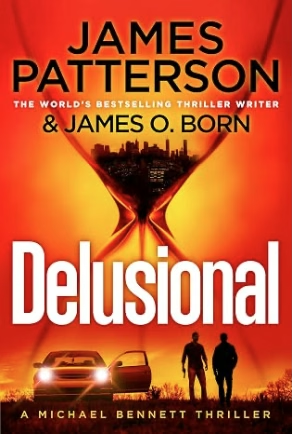
James Patterson's Delusional marks a turning point for the Michael Bennett series at its 18th installment. After nearly two decades of New York City-bound investigations, Bennett finally leaves Manhattan—and the series is better for it. This isn't a tired cash grab from the world's most prolific thriller writer; it's a genuinely compelling entry that proves Patterson and co-author James O. Born still know how to construct a page-turner that matters.
What This Book Is Really About
The premise sounds deceptively simple: Detective Michael Bennett investigates a string of bombings in New York City while simultaneously being pulled to Montana to help his partner Rob Trilling, whose family is under siege. But Delusional is far more ambitious than that elevator pitch suggests. Patterson weaves together three seemingly unrelated criminal threads—NYC bombings, a military base burglary, and small-town violence in Bozeman—into a narrative that explores how ideology, desperation, and delusion can radicalize ordinary people into becoming threats to society.
The bomber subplot carries unmistakable echoes of Ted Kaczynski, the Unabomber. Like Kaczynski, Patterson's antagonist operates from a twisted philosophical framework, convinced that violence serves a higher purpose. The comparison isn't accidental; it's thematically central. Delusional interrogates the terrifying gap between a perpetrator's self-justification and the objective reality of their crimes. The killer genuinely believes they're making the world better. Everyone else sees terrorism.
This moral complexity elevates the thriller beyond standard procedural fare. It's not just "catch the bad guy." It's "understand why someone becomes convinced that mass murder is righteous."
The Structure That Makes It Work
Patterson's trademark short, punchy chapters return here—and they're deployed with surgical precision. The pacing never falters. You can finish this book in two sittings without feeling rushed; the narrative momentum is that relentless. Born's contribution to the procedural elements is evident in the investigative sequences, which feel grounded in actual detective work rather than Hollywood shortcuts.
What's genuinely surprising is how effectively the Montana subplot integrates with the New York investigation. This isn't a distraction or a subplot that feels tacked on. By the final act, the two cases converge in ways that feel earned rather than contrived. The real estate development angle involving a predatory California developer adds economic realism to the violence—these aren't random attacks; they're motivated by concrete grievances, even if the response is monstrously disproportionate.
Bennett Evolves Without Losing His Soul
Michael Bennett at book 18 could easily have become a caricature. Instead, he's grown. His household now includes 10 adopted children and a baby on the way with his current wife, Mary Catherine. His partner Rob Trilling is dating his daughter. The personal stakes have multiplied exponentially, and Patterson uses this brilliantly. Bennett's willingness to drop everything and fly to Montana isn't just loyalty; it's the action of a man whose life has become genuinely complicated by love and responsibility.
The Bennett family dynamics remain the series' secret weapon. Amid explosions and investigations, we get moments of genuine warmth—the chaos of a massive blended family, the quiet moments of partnership with Mary Catherine, the professional respect between Bennett and his colleagues. These aren't filler. They're what make us care whether Bennett survives the next bombing.
Where It Stumbles
If there's a weakness, it's that the villain's perspective, while intriguing, occasionally tips toward repetitive. We spend considerable page-time inside the bomber's head, and while this serves the thematic purpose of showing how delusion operates, some readers will find these sections drag slightly. The philosophical justifications, no matter how twisted, can feel familiar if you've read similar material.
Additionally, the resolution in Montana, while satisfying, moves with slightly less precision than the New York investigation. The final confrontations feel a beat rushed compared to the methodical detective work that precedes them. It's a minor stumble—the book doesn't collapse under this—but it's noticeable.
The Co-Authorship Question
This is James O. Born's ninth collaboration with Patterson on the Bennett series, and the partnership has clearly solidified. Born brings procedural authenticity and character consistency that prevents these books from feeling like assembly-line products. Unlike some Patterson collaborations that feel like the co-author is simply executing Patterson's outline, Delusional reads like a genuine partnership where both voices contribute meaningfully.
Is Delusional Worth Reading?
Absolutely, but with caveats. If you're a devoted Michael Bennett reader, this is essential—it's genuinely one of the stronger entries in the series, and the Montana expansion suggests the franchise still has room to evolve. If you're new to Bennett, this works as an entry point, though you'll miss some character history and family context that rewards long-term readers.
If you're comparing this to similar thrillers, Delusional sits comfortably alongside David Baldacci's procedural work or Tess Gerritsen's medical thrillers—competent, engaging, and constructed with genuine craftsmanship. It's not as psychologically intricate as something like The Silence of the Lambs, nor is it attempting to be. It's a well-executed thriller that respects your time and intelligence.
Who Should Read This
Perfect for: Existing Bennett series fans, readers who enjoyed Baldacci's Absolute Power or similar procedural thrillers, people who appreciate tight plotting and fast pacing, those interested in the psychology of radicalization and how ideology justifies violence.
Skip if: You demand literary ambition alongside your thrillers, you're fatigued by the serial killer/bomber subgenre, you prefer character studies to plot-driven narratives, you found previous Bennett entries repetitive.
The Bigger Picture
What's remarkable about Delusional in 2025 is how timely it feels without being preachy. The themes of government distrust, ideological radicalization, and the blurred lines between activism and terrorism resonate in our current moment. Patterson doesn't hammer these themes; he lets them emerge naturally from the investigation.
The thriller market is crowded. Publishers release hundreds annually. Most disappear within months. Delusional won't revolutionize the genre, but it proves that Patterson and Born understand what makes thrillers work: momentum, stakes that matter, characters we invest in, and the fundamental human question of how ordinary people become extraordinary threats.
Final Verdict
8/10 — A genuinely strong thriller that proves the Michael Bennett series still has gas in the tank, elevated by timely themes, solid procedural work, and the willingness to expand beyond Manhattan.