Category:
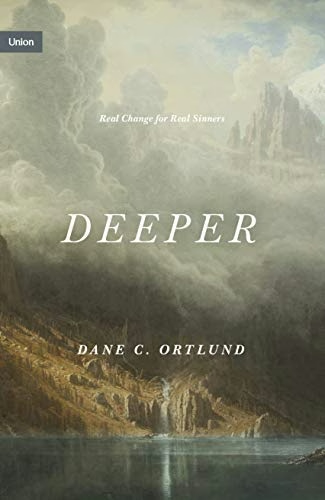
Book ReviewsDeeper Review: Gospel-Centered Growth Without the Gimmicks
Prices can sometimes be lower on bigger marketplaces, but this link helps independent bookstores and local reading communities.
Dane C. Ortlund's Deeper: Real Change for Real Sinners arrives at a critical moment in evangelical Christianity. The market is saturated with sanctification shortcuts—formulaic steps to spiritual victory, self-help spirituality wrapped in Bible verses, and the persistent myth that discipleship is primarily about trying harder. Ortlund rejects all of this. Instead, he makes a provocative argument: Christian growth happens not through increased effort or behavioral modification, but through deeper intimacy with the gospel itself. This is a thesis that either liberates readers or frustrates them, depending on what they've been taught to expect from the Christian life.
Quick Verdict
Deeper is a theologically robust, warmly written meditation on sanctification that cuts through evangelical confusion with surgical precision. If you're exhausted by performance-based Christianity, this book offers genuine rest. If you're looking for a practical roadmap with actionable steps, you'll find Ortlund's approach feels incomplete. It's not a flaw—it's intentional.
What This Book Actually Does
Ortlund structures Deeper as nine meditations rather than a systematic theology. This matters. He's not writing a textbook; he's writing an invitation. The central claim is deceptively simple: we grow by going deeper into the gospel, not by going wider in our efforts. This stands in direct opposition to decades of evangelical teaching that positioned sanctification as a climb—higher, further, faster, more disciplined.
The book engages historical figures throughout Christian tradition—particularly Puritan writers like John Owen—to show that this gospel-centered approach isn't novel. It's a recovery. Ortlund argues that modern evangelicalism has inherited a works-based sanctification model disguised in spiritual language, and the result is a church full of burned-out believers who feel perpetually inadequate.
The Theological Architecture
Ortlund's framework rests on a critical distinction: the difference between positional sanctification (what's already true of us in Christ) and progressive sanctification (what we're becoming). Most evangelical teaching collapses these categories, implying that our spiritual identity is something we must achieve through discipline and obedience. Ortlund reverses this. He argues that understanding and resting in our positional reality in Christ is actually what fuels progressive change.
This creates a theological tension that's worth examining. Ortlund isn't dismissing the biblical call to "work out your salvation with fear and trembling" (Philippians 2:12-13). Instead, he's repositioning the motivation. We don't obey to become righteous; we obey because we're already righteous in Christ. The difference is subtle but profound—and it's where readers either experience liberation or confusion.
The book draws heavily on the concept of union with Christ, a doctrine that's experienced a renaissance in Reformed theology over the past two decades. Ortlund makes this abstract concept concrete through meditation and reflection, helping readers understand what it means to be "in Christ" not as metaphor but as lived reality.
Writing Style: Warmth Without Sentimentality
Ortlund writes with an unusual combination of theological depth and pastoral tenderness. He's not dumbing down complex doctrine, but he's also not performing for academics. The prose is accessible without being simplistic. Short sentences punctuate longer theological expositions. Personal vulnerability appears throughout—Ortlund doesn't present himself as having arrived, but as a fellow traveler wrestling with the same struggles.
This stylistic choice makes Deeper feel like a conversation with a wise friend rather than a lecture from an authority figure. It's particularly effective for readers who've been burned by triumphalist Christianity or who've experienced shame-based discipleship. The tone itself becomes part of the message: this is a book about grace, and it reads like grace.
What Works Exceptionally Well
The diagnosis is accurate. Ortlund correctly identifies a pervasive problem in evangelical churches: the assumption that spiritual growth is primarily a matter of discipline, accountability, and self-improvement. Anyone who's sat through a conference on "5 Steps to Victory" or "7 Habits of Highly Effective Christians" will recognize the target of his critique. This book names something many believers have felt but couldn't articulate—that the relentless self-optimization narrative is exhausting and ultimately unbiblical.
Historical grounding provides credibility. By drawing on Puritan theology, medieval mysticism, and patristic writers, Ortlund demonstrates that gospel-centered sanctification isn't a modern innovation. This historical scaffolding helps readers trust that Ortlund isn't promoting a fringe interpretation but recovering a neglected mainstream tradition.
The meditation format is brilliant for its intended purpose. Rather than a linear argument, the nine chapters invite repeated engagement. Readers report highlighting passages, returning to chapters, and allowing ideas to "marinate." This structure acknowledges that transformation isn't intellectual—it's spiritual. You don't just understand this book; you live into it.
Practical without being reductive. While Ortlund doesn't offer a ten-step program, he's not entirely abstract either. He discusses prayer, Scripture meditation, and community in ways that give readers concrete practices. The difference is that these practices are framed as means of enjoying Christ rather than methods of achieving growth.
Where the Book Struggles
The tension between grace and effort remains unresolved. Ortlund emphasizes resting in Christ's finished work, but he also affirms the biblical call to vigorous striving. He quotes Philippians 2:12-13 to show these aren't contradictory, but readers seeking clarity on how to hold these together might find the book leaves them still wrestling. This isn't necessarily a weakness—sometimes books should provoke wrestling rather than provide answers—but it's worth noting.
Minimal engagement with ongoing temptation and sin. The book's title promises "real change for real sinners," but it doesn't deeply explore the mechanics of how gospel-centeredness actually interrupts the cycle of habitual sin. A reader struggling with a specific pattern of disobedience might finish Deeper inspired but still wondering: "Yes, but how do I actually stop doing this thing?" Ortlund would likely argue that's the wrong question, but that doesn't eliminate the pastoral concern.
Limited diversity of examples. The meditations draw primarily on Reformed theological tradition and Puritan writers. While this is Ortlund's tradition and strength, readers from Pentecostal, Anabaptist, or other evangelical backgrounds might feel the book doesn't speak to their particular contexts and concerns.
Who Should Read This Book
Perfect for:
- Long-time Christians exhausted by performance-based spirituality
- Pastors and leaders recognizing burnout in their congregations
- Anyone who's felt shame-based or guilt-driven in their faith
- Readers of Ortlund's previous work (Gentle and Lowly) wanting to deepen that exploration
- People seeking to understand union with Christ beyond abstract theology
Will likely frustrate:
- Readers seeking practical step-by-step programs for behavior change
- Those uncomfortable with Reformed theological language and frameworks
- People wanting more concrete case studies and contemporary examples
- Individuals preferring systematic theology to meditative reflection
Comparison to Similar Works
If you've read Tim Keller's The Meaning of Marriage or The Reason for God, you'll recognize Ortlund's ability to make theological concepts emotionally resonant. However, where Keller often works through practical implications systematically, Ortlund invites contemplation. Deeper is closer in spirit to J.I. Packer's Knowing God—a book meant to be savored rather than consumed, reread rather than checked off a list. It's also a natural follow-up to Ortlund's Gentle and Lowly, which introduced readers to Christ's compassion; this book shows how that compassion becomes the engine of transformation.
The Verdict
Deeper: Real Change for Real Sinners is worth reading if you're ready to question whether your current approach to spiritual growth is actually biblical. Ortlund makes a compelling case that evangelical Christianity has often confused sanctification with self-improvement, and that the antidote is not less discipline but a different foundation for discipline. The book is theologically rich, pastorally warm, and genuinely transformative—if you're willing to let it challenge your assumptions.
The real question isn't whether this book is good (it is), but whether you're ready for what it's asking you to do: stop trying so hard to become someone you already are in Christ.
Final Score: 8.5/10 — A theologically sophisticated, beautifully written meditation on gospel-centered growth that liberates some readers and leaves others wanting more practical guidance.