Category:
Book ReviewsDe dichter en de duivel Review: Marsman's Final Masterpiece
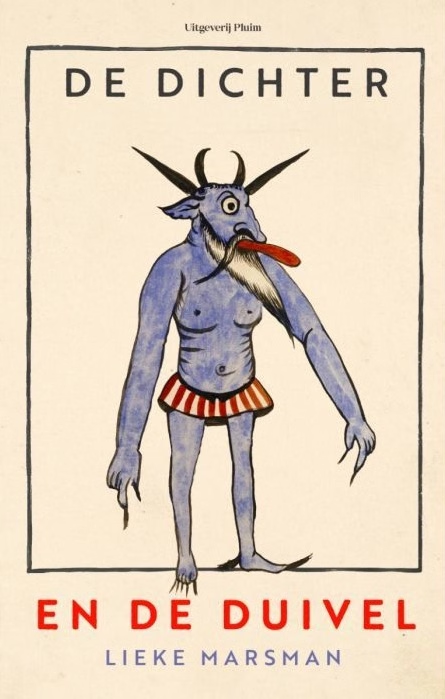
Lieke Marsman's final work, De dichter en de duivel, is a defiant political manifesto disguised as a hallucinogenic descent through contemporary Dutch society. This is not a gentle poetry collection. It's a savage uppercut aimed directly at the hollow machinery of neoliberalism, influencer culture, and the compromised gatekeepers who've drained meaning from public discourse. The book arrives as both a profound artistic achievement and an unmissable cultural document—the last words of an artist who refused to look away from what's broken.
What This Book Actually Is
De dichter en de duivel operates as a modern reimagining of Dante's Inferno, but with a distinctly Dutch sensibility and contemporary targets. The premise is deceptively simple: a poet discovers that her basement offers access to an underground realm where people trade fragments of their souls to absolve themselves of their sins. As she descends deeper, she encounters politicians, ex-ministers, columnists, influencers, and opinion-makers—all of whom have bartered their integrity for comfort and relevance.
What distinguishes Marsman's De dichter en de duivel review-worthy approach is her refusal to make this a straightforward satirical exercise. The work pulses with genuine rage beneath its structured architecture. This isn't clever literary point-scoring; it's a poet watching her country calcify and deciding to document exactly how it happened.
The Structural Brilliance
Marsman constructs her descent with architectural precision. Each circle of this contemporary hell reveals a different species of moral compromise. The genius lies in how she juxtaposes two registers of language—the elevated, poetic register against the flattened, corporate-speak of politicians and media figures. When she embeds actual quotations from real public figures into her verse, the effect is devastating. These people condemn themselves through their own words, exposed as hollow by the simple act of being placed beside genuine language.
The most audacious sequence involves a literal boxing match between the poet and the machinery of the system. She fights. She loses. But in losing, she preserves something the victors cannot touch: her refusal to sell her voice. This isn't metaphorical hand-wringing. It's a concrete articulation of why artistic integrity matters when everything else has been commodified.
Where Marsman's Vision Succeeds
The book's primary strength is its unflinching specificity. Rather than gesturing vaguely at "corruption" or "the system," Marsman names names. She quotes real statements. She catalogs real failures. This specificity transforms the work from abstract complaint into concrete indictment. Readers encounter not strawmen but actual architects of contemporary Dutch policy and media dysfunction.
The writing itself crackles with energy. Marsman's earlier collections—In mijn mand and Op een andere planeet—demonstrated her technical mastery, but De dichter en de duivel channels that mastery toward explicitly political ends. The language never feels didactic or preachy. Instead, it accumulates force through precise imagery and devastating juxtaposition.
Perhaps most importantly, the book captures something true about contemporary despair that other writers have struggled to articulate. There's a specific exhaustion that comes from watching institutions fail systematically while those responsible face no consequences. Marsman doesn't offer false comfort or redemptive narratives. She simply documents the descent and asks: who still has the courage to refuse?
The Tensions Worth Acknowledging
Not every reader will embrace De dichter en de duivel's uncompromising stance. Some will find the political focus narrow or the critique too Dutch-specific for broader resonance. One legitimate criticism: the book's universal applicability may suffer from its anchoring in specific Dutch political figures and media personalities. International readers unfamiliar with these contexts might miss layers of the satire.
There's also a tonal shift from Marsman's previous work. Op een andere planeet embraced irrationality and personal mythology—aliens, faith, idiosyncratic meaning-making. De dichter en de duivel abandons that singularity for something more conventionally political. Readers who cherished Marsman's willingness to contradict her intellectual reputation may experience this as a retreat into safer territory. That's a defensible reading, though the book's ferocity suggests otherwise.
The Dante structure, while effective, occasionally feels imposed rather than organic. The framework serves the content, but there are moments where the scaffolding becomes visible in ways that slightly diminish the impact.
Who Should Actually Read This
This book is essential for anyone interested in contemporary Dutch politics and culture. It's vital for readers who believe poetry can be a legitimate form of social critique. It's powerful for those exhausted by the compromises of mainstream discourse and hungry for unvarnished artistic resistance.
It's also worth reading if you've appreciated Marsman's previous work and want to understand her final artistic statement. The book functions as a kind of testament—not in the sense of a will or bequest, but as testimony to what she witnessed and how she chose to respond.
Conversely, readers seeking escapism or comfort should look elsewhere. This isn't a book that offers solace or redemptive arcs. It's a book that insists on seeing clearly, which can be painful. Readers allergic to political content or those who prefer their poetry divorced from contemporary reference points will find little here to embrace.
The Question of Timing and Legacy
The book's significance is inevitably shaped by Marsman's death in 2024. This is her final collection, her last public utterance. That context matters—not in a way that should inflate mediocre work, but in acknowledging that these words now carry the weight of finality. Readers encounter De dichter en de duivel knowing they're reading the conclusion of an artistic project that will never develop further.
This creates a particular kind of poignancy. The book's refusal to offer easy answers or redemptive conclusions feels less like artistic choice and more like a permanent statement. The poet descends, confronts the devil, and the encounter offers no resolution—only clarity about the impossibility of victory within corrupted systems. That bleakness reads differently when you know it's the final thing an artist will say.
Is De dichter en de duivel Worth Reading?
Absolutely. This De dichter en de duivel review arrives at an unequivocal recommendation, though with caveats about what kind of reading experience you're signing up for. The book is challenging, politically engaged, and formally sophisticated. It refuses easy sentiment and comfortable conclusions. It's the work of an artist at full power, deploying every technical skill toward something that matters.
The book ranks among the most significant recent Dutch literary works precisely because it insists that poetry can do something newspapers and political commentary cannot: it can preserve the texture of lived experience and moral clarity in language that refuses to calcify. In an era of flattened discourse, Marsman's insistence on precision and specificity feels radical.
Final Verdict
9/10 — A masterwork of political poetry that refuses compromise and demands to be heard, even (or especially) when it makes readers uncomfortable.