Category:
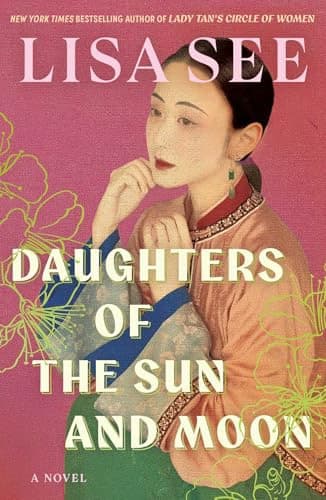
Book ReviewsDaughters of the Sun and Moon Review: Historical Fiction Done Right
Prices can sometimes be lower on bigger marketplaces, but this link helps independent bookstores and local reading communities.
Lisa See's Daughters of the Sun and Moon is a meticulously researched historical fiction novel that tackles one of America's most shameful and overlooked chapters: the treatment of Chinese women in post-Civil War Los Angeles. This is not a gentle story about cultural integration—it's a visceral account of three women navigating racism, exploitation, and survival in 1870s California, and it demands to be read.
The novel's central conceit is deceptively simple: three Chinese women arrive in the dusty pueblo of Los Angeles in 1870, each carrying different circumstances and expectations. Yet See transforms this premise into something far more complex. The narrative unfolds through multiple perspectives and time periods, creating a layered portrait of resilience that feels both historically grounded and emotionally immediate.
What This Book Is Actually About
The story centers on three women whose lives intersect in the same adobe block. Dove arrives as the bound-footed daughter of an imperial scholar, destined for an arranged marriage to a merchant three times her age. Petal is sold by her own father during a famine, trafficked across the Pacific, and forced into sexual slavery. Moon, educated and English-speaking, carries the physical mark of a failed footbinding—a limp that diminishes her value despite her intelligence and beauty.
What makes Daughters of the Sun and Moon review-worthy is how See refuses to treat these women as victims first and people second. Yes, they endure horrific circumstances. Yes, anti-Chinese sentiment permeates every transaction and interaction. But the novel's real power lies in how these three women forge an unlikely friendship that becomes their salvation.
The narrative structure itself deserves attention. Moon speaks from 1926, looking back across 55 years with the hard-earned wisdom of an octogenarian. Petal narrates in raw, immediate present tense. Dove appears in third-person perspective. This layered approach prevents the story from feeling like a museum exhibit—it breathes with competing voices and temporal urgency.
The Historical Context That Makes This Matter
See grounds her fiction in meticulous archival research. In 1870, Los Angeles was barely a town: 5,000 inhabitants, 110 saloons, six policemen, and virtually no law enforcement regarding sex work or drunkenness. Into this lawless frontier came approximately 47 Chinese women—a staggering number when you consider the systematic exclusion policies that would follow.
The novel builds inexorably toward the Chinese Massacre of October 24, 1871, when an angry mob attacked the pueblo and murdered 19 Chinese residents. This wasn't a minor historical footnote—it was one of the worst mass lynchings in American history, yet it remains virtually absent from standard American history curricula. See's decision to center her narrative around this event transforms the novel from entertainment into historical reclamation.
The recurring phrase throughout the book—"eating bitterness," a Cantonese expression for enduring hardship without complaint—becomes a thematic anchor. Each woman eats her own variety of bitterness, and See never simplifies their responses to trauma. Some women find agency through unexpected relationships. Others discover power through economic independence. A few find solace in friendship itself.
Where See's Writing Excels
The prose is accessible without being simplistic. See balances historical detail with narrative momentum—you learn about Chinese immigration policies, San Francisco's tong system, and the economics of concubinage without ever feeling lectured. The dialogue captures period-appropriate speech patterns while remaining comprehensible to contemporary readers.
See's characterization is her greatest strength. Dove's naiveté isn't portrayed as stupidity but as the product of sheltered imperial privilege suddenly thrust into brutal reality. Petal's rage and hunger feel earned, not performed. Moon's careful navigation of her position as a doctor's wife—respected enough to survive, but marked enough to be perpetually vulnerable—captures the impossible calculus women of color navigated during this era.
The friendship between these three women transcends sentimentality. It's built on shared trauma, mutual need, and the recognition that survival requires collective action. See doesn't shy away from showing how circumstance binds them together, but she also demonstrates how genuine affection emerges from proximity and shared struggle.
Where the Novel Stumbles
The most consistent criticism from readers concerns the ending. Some feel the resolution arrives too tidily for a story about women living through systemic violence and discrimination. The Chinese Exclusion Act wouldn't be repealed until 1943, and the social discrimination lasted far longer. See compresses certain historical timelines and combines events for narrative efficiency—choices that work dramatically but may frustrate readers seeking unflinching historical accuracy.
The novel also occasionally relies on exposition when showing would be more powerful. Some scenes explaining Chinese cultural practices or immigration mechanics interrupt the narrative's momentum, though See's author's note acknowledges what she compressed and what she drew directly from court records and contemporary accounts.
Additionally, while the multiple narrative perspectives create richness, they can occasionally feel unbalanced. Dove's third-person narration sometimes feels less intimate than Moon's retrospective first-person or Petal's immediate present-tense account, which may leave readers feeling less connected to her arc.
Who Should Read This Book
Perfect for: Readers who love historical fiction grounded in archival research. Those interested in Asian-American history, women's history, or overlooked chapters of American immigration. Book club participants seeking meaningful discussion material. Fans of Lisa See's previous work who appreciate her commitment to centering marginalized voices in historical narratives. Anyone wanting to understand how racism functioned in 19th-century America and its lasting impact.
Not for: Readers seeking light, feel-good historical fiction. Those uncomfortable with depictions of sexual exploitation and violence. Readers who require strictly chronological narratives or single-perspective storytelling. Those seeking a comprehensive historical account rather than a novelistic interpretation (though See's author's note helps clarify her sources).
Comparison to Similar Works
If you've read The Nightingale by Kristin Hannah, you'll recognize See's approach: historical fiction that centers female resilience during violent upheaval. However, Daughters of the Sun and Moon is more structurally complex and less reliant on romantic subplots as narrative drivers. Compared to Yoko Ogawa's The Hotel Iris, See's novel is more historically anchored and less metaphorical, prioritizing specific historical events over abstract explorations of power dynamics.
See's novel sits comfortably alongside works like The Poppy Wife by Peter Levesque or Pachinko by Min Jin Lee—books that trace diaspora experiences through intimate family narratives while maintaining rigorous historical grounding. The difference is that See focuses on a specific, compressed historical moment rather than spanning generations.
Why This Book Matters Now
Beyond its literary merits, Daughters of the Sun and Moon addresses themes disturbingly relevant to contemporary America: xenophobia, the commodification of vulnerable women, systemic racism, and the scapegoating of immigrant communities. See doesn't draw explicit parallels—she doesn't need to. The parallels are uncomfortably obvious to any reader paying attention.
The novel also serves a crucial archival function. These women's stories were largely erased from historical record. Chinese women in 1870s America were either invisible or hypervisible as objects of fascination and disgust. See's novel restores their agency and complexity to the historical record, even as it acknowledges the limitations of what can be known about their inner lives.
The Verdict
Daughters of the Sun and Moon is a powerful, necessary work of historical fiction that earns its acclaim through meticulous research, complex characterization, and thematic depth. Is it perfect? No—the ending feels slightly rushed, and some expository passages interrupt narrative flow. Is it worth reading? Absolutely. This is essential reading for anyone interested in American history, immigration narratives, or the resilience of marginalized communities. See continues to prove why she's the preeminent chronicler of Chinese-American women's experiences, and this novel represents some of her finest work.
The book's 4.23-star rating across thousands of readers reflects genuine quality with minor reservations—exactly what you'd expect from a sophisticated historical novel that refuses easy answers. Every American should read this book, not as entertainment but as historical reckoning.