Category:
Book ReviewsDad, Love, Me Review: Brutally Honest Memoir
Prices can sometimes be lower on bigger marketplaces, but this link helps independent bookstores and local reading communities.
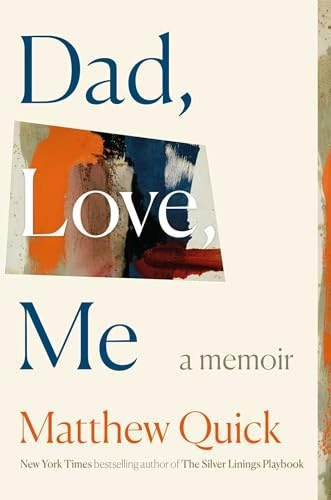
Matthew Quick's Dad, Love, Me: A Memoir arrives as something rare in contemporary memoir writing—a book that refuses sentimentality while still reaching for redemption. This is Quick's most vulnerable work to date, a departure from the novelist who gave us The Silver Linings Playbook. Where that bestseller channeled pain into fiction, this memoir tears away the narrative distance entirely. Quick writes directly to his dying father, and the effect is devastating.
The core tension that makes this Dad, Love, Me review essential reading is this: Quick spends decades seeking approval from a man incapable of giving it, achieves massive professional success anyway, and then must confront whether forgiveness is even possible when dementia erases the very person he's trying to forgive. This isn't a heartwarming reconciliation story dressed up as memoir. It's messier, more complicated, and far more honest than that.
What This Memoir Actually Does
Quick structures Dad, Love, Me as a letter to his ailing father—a formal device that could have felt gimmicky but instead creates intimacy and urgency. The narrative weaves between three timelines: childhood trauma, adult depression and addiction, and the present moment when his father's Alzheimer's diagnosis forces a reckoning.
The childhood sections are genuinely difficult to read. Quick's father wasn't just distant; he was actively cruel. When young Matthew announced his dream of becoming a novelist, his father's response was immediate: "Idiot!" That single word became the soundtrack to Quick's life—echoing through decades of self-doubt, manifesting as panic attacks and depression even after The Silver Linings Playbook became a New York Times bestseller and inspired an Oscar-winning film.
What's striking is that professional validation didn't heal the wound. Quick had achieved everything his father supposedly wanted for him, yet the approval never materialized. Instead, Quick spiraled into anxiety and addiction, his success feeling hollow because it couldn't fill the parental void.
The Psychological Excavation
The turning point comes when Quick begins working with a Jungian analyst he calls "Zeus." This section of Dad, Love, Me is where the real psychological work happens. Quick doesn't just describe his trauma; he actively unpacks it in real time, showing readers the messy, non-linear process of understanding how childhood abuse shapes adult mental health.
Quick's honesty about his own depression and suicidal ideation is refreshing in a genre often sanitized for mass consumption. He doesn't perform recovery or pretend that therapy offers quick fixes. Instead, he describes creative paralysis, writer's block, the blank page as unbearable. For anyone who's experienced depression, this rings true in ways most memoirs don't capture.
The book's power intensifies when Quick's father is diagnosed with dementia. Now there's a deadline. Quick and his wife leave coastal North Carolina and move to Beaufort, South Carolina, just around the corner from his parents. He's racing against cognitive decline to achieve the connection that was never there.
Where the Writing Excels
Quick's prose in this memoir is stripped down and direct—no flourishes, no pretension. This is appropriate for a book about a man learning to communicate his needs clearly for the first time. The vulnerability on the page feels earned rather than performed.
The sections describing his father's dementia progression are particularly powerful. Quick captures the disorientation of watching a parent become increasingly unreachable, even as you're trying to reach them. There's a tragic irony here: just as Quick finally has the emotional language to express his pain and need, his father loses the cognitive capacity to understand it.
The memoir also succeeds because Quick refuses easy answers. He doesn't suddenly forgive his father and feel healed. Forgiveness, when it comes, is complicated and incomplete. Quick shows up anyway—and that's the actual subject of the book, not reconciliation but the decision to keep loving someone who never knew how to love you back.
What Doesn't Quite Work
At times, the Jungian analysis sections feel slightly abstract. While Zeus's guidance is clearly transformative for Quick, some readers may find the theoretical framework less engaging than the raw emotional content. The book occasionally pauses its forward momentum to explore psychological concepts that, while relevant, can feel like detours.
The memoir's structure—jumping between timelines—serves its purpose but occasionally creates disorientation. Some readers will find this intentional fragmentation mirrors trauma's non-linear nature. Others may wish for more straightforward chronology.
Additionally, while Quick's father is the book's central figure, he remains somewhat opaque. We see him primarily through Quick's perception and memory, which is inevitable in memoir but means we never quite access the father's inner life or motivations. This is less a flaw than a limitation of the form itself.
Who This Book Is For (And Who It Isn't)
Dad, Love, Me is essential reading for anyone navigating a damaged parent-child relationship, particularly those dealing with aging parents or dementia. It speaks directly to the specific pain of loving someone who hurt you, complicated further by their cognitive decline. Men struggling with mental health issues, shame, and emotional expression will find validation here.
The book also resonates with anyone who's achieved external success while feeling internally hollow—the high-achiever who realizes that accomplishment can't fill certain wounds.
However, this isn't a book for readers seeking comfort or inspirational narrative arcs. If you want a story where forgiveness equals healing and everyone learns their lesson, this will frustrate you. Quick refuses that false resolution. Similarly, readers uncomfortable with discussions of mental illness, addiction, abuse, and suicidal ideation should approach with caution.
Comparison to Similar Memoirs
Unlike Cheryl Strayed's Wild, which frames personal crisis as a journey toward self-discovery through external adventure, Dad, Love, Me is an internal excavation. Quick doesn't hike the Pacific Crest Trail; he sits in a therapist's office and confronts what he's been running from.
Compared to Tara Westover's Educated, another memoir about family trauma and estrangement, Quick's work is less about breaking free and more about the complicated decision to stay connected. Westover's narrative arc involves physical and intellectual escape. Quick's involves staying put and learning to exist alongside pain rather than escape it.
The Verdict
Dad, Love, Me: A Memoir by Matthew Quick is genuinely important work—not because it offers easy answers but because it models emotional honesty in a genre that often rewards narrative tidiness. This Dad, Love, Me review comes down to a simple question: Is it worth reading? Yes, absolutely, particularly if you've ever felt starved of parental love or struggled with depression and shame.
The book won't fix your relationship with your father. It won't cure your depression. But it will make you feel less alone in those struggles, and it will challenge you to show up for the people in your life anyway—even when forgiveness feels impossible.
Quick has written a book that does exactly what he hoped it would: it helps people, especially men, talk about feelings they've been taught to suppress. It transforms private pain into shared understanding. That's not just good memoir writing; that's radical generosity.