Category:
Book ReviewsCo-Intelligence Review: Pragmatic AI Guide with a Blind Spot
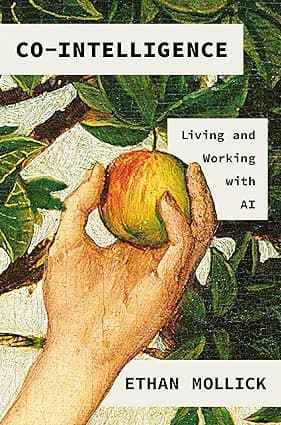
Prices can sometimes be lower on bigger marketplaces, but this link helps independent bookstores and local reading communities.
Ethan Mollick's Co-Intelligence: Living and Working with AI arrives at a moment when AI anxiety dominates popular discourse. Wharton professor Mollick stakes out surprisingly optimistic middle ground—neither Silicon Valley cheerleader nor apocalypse-monger. His core argument: treat AI as a thinking partner, not a tool, and you'll unlock transformative potential in education, work, and creative problem-solving. The book has generated passionate responses, with readers either praising its practical wisdom or critiquing its shallow engagement with what AI actually is. This Co-Intelligence review examines whether Mollick's pragmatism holds up under scrutiny.
Quick Verdict
Mollick delivers genuinely useful tactical advice for educators and professionals navigating AI adoption. His framework for "treating AI like a person" yields concrete results. But the book sidesteps harder philosophical questions about AI's nature, leaving readers who want deeper analysis disappointed. If you need practical strategies, read it. If you want to understand what's actually happening, look elsewhere.
What This Book Actually Does
Unlike most AI books that oscillate between utopian and dystopian extremes, Co-Intelligence focuses on the immediate, practical question: how do I actually use this technology better? Mollick documents his experiments with ChatGPT, Claude, and Gemini across multiple contexts—from teaching MBA students to drafting business proposals to creative writing.
The central thesis is disarmingly simple: AI systems respond better when you anthropomorphize them. Tell an AI to act as a critical reader, a skeptical sales prospect, or a curious outsider, and it performs differently than generic prompts. Mollick provides specific examples: asking Claude to roleplay as a particular type of person yields more useful responses than treating it as a neutral question-answering machine.
For educators, this approach solves a genuine crisis. When ChatGPT arrived, institutions panicked. Some banned it. Others pretended it didn't exist. Mollick's solution: make AI literacy mandatory. Require students to use these tools effectively. Raise the bar since every student now has a virtual team. This reframes the threat as opportunity.
Where Mollick Excels
The book's greatest strength is its refusal to treat AI adoption as binary. Mollick acknowledges real limitations while pushing past hype-cycle thinking. He's refreshingly honest about what current AI can't do—he notes that ChatGPT famously fails at simple Tic-Tac-Toe threat detection, yet can write a perfect Python script to play the game flawlessly.
His advice for experimentation is sound. Try tasks you think AI might fail at. Gather actual data about capabilities rather than relying on headlines. This empirical approach cuts through noise.
For business professionals and educators, the tactical content delivers immediate value. The prompting strategies, role-playing frameworks, and implementation approaches are battle-tested. Readers consistently praise the book's usefulness for specific professional contexts.
Mollick also avoids the trap of treating AI as magic. He repeatedly emphasizes that these systems are not conscious, not sentient, not thinking in ways humans think. Yet paradoxically, he argues you'll use them better if you interact with them as though they were.
The Fundamental Problem
Here's where Co-Intelligence review discussions become contentious: Mollick never adequately resolves the tension between his technical understanding and his practical advice.
AI systems work through statistical pattern matching. They predict the next most probable token based on training data. When you ask ChatGPT to continue "To be or not to ___," it completes the Shakespeare quote because that's the most statistically likely continuation in its training corpus. This isn't thinking. It's sophisticated autocomplete.
Mollick acknowledges this mechanism but then encourages treating AI as an alien mind or co-intelligence. The contradiction bothers readers who want intellectual rigor. If AI is just a statistical summarizer of human-created content, can it genuinely be a co-worker? Or is Mollick describing a useful cognitive trick rather than a fundamental partnership?
The anthropomorphization framework works practically—you get better outputs by role-playing. But Mollick doesn't adequately explore whether this reflects something true about AI's nature or merely exploits quirks in how these systems are trained. He dismisses concerns about anthropomorphization while simultaneously recommending it as essential strategy.
Writing Style and Structure
Mollick writes with accessible clarity and genuine humor. Conversations with AI are amusing and illustrative. The book reads quickly—it's conversational, almost bloglike in its structure. This accessibility is a strength for practitioners seeking actionable advice.
But it's also a limitation for readers wanting depth. The book skims across topics—consciousness, economic disruption, educational reform, creative partnership—without sustained engagement with any. Each chapter feels like a well-written Medium post rather than a complete exploration.
The anecdotal structure works for building intuition but doesn't provide the research depth you'd expect from a Wharton professor. Where are the studies on long-term educational outcomes? The economic data on productivity gains? The psychological research on human-AI collaboration patterns?
Comparison Point: The Alignment Problem
For context, Brian Christian's The Alignment Problem covers similar terrain but with greater technical depth. Christian engages seriously with AI's limitations and the genuine risks of misalignment between AI systems and human values. Mollick's book is more practical but less intellectually challenging. Think of Co-Intelligence as the practitioner's guide and The Alignment Problem as the theorist's deep dive.
Who Should Actually Read This
Read this book if: You're an educator scrambling to develop AI literacy policies. You work in knowledge work and want practical prompting strategies. You're professionally required to understand AI adoption. You prefer concrete examples over abstract theory. You want permission to experiment without fear.
Skip this book if: You want serious engagement with AI's nature and limitations. You're seeking economic analysis of AI's labor market impact. You're interested in safety, alignment, or existential risk. You prefer academic rigor to anecdotal evidence. You're skeptical of anthropomorphization and want that skepticism validated.
The Honest Assessment
Co-Intelligence is valuable within its scope but oversells its ambitions. Mollick frames this as a book about understanding AI's nature and our future relationship with it. What it actually delivers is a practical playbook for getting better outputs from current AI systems.
That's genuinely useful. Many professionals need exactly this. But readers expecting deeper philosophical engagement or rigorous analysis of AI's capabilities and limitations will feel the book's limitations acutely.
Mollick's core insight—that interaction style dramatically affects AI performance—is worth the price of admission. His educational framework offers real solutions to genuine institutional problems. But his framing of this as co-intelligence, as genuine partnership with alien minds, overshoots what the evidence supports.
The book works best as a practitioner's manual. It fails as a comprehensive exploration of AI and human futures.
Final Verdict
Mollick has written a genuinely helpful book that answers real professional questions. It's well-written, accessible, and immediately applicable. But it mistakes tactical advice for strategic insight. Co-Intelligence tells you how to use AI better without adequately exploring what you're actually using or what it means.
For educators and knowledge workers, this is essential reading. For anyone seeking deeper understanding of AI's nature and implications, you'll need to look further. The book succeeds brilliantly at what it attempts but doesn't attempt enough.
Is Co-Intelligence worth reading? Yes—if you need practical AI strategies. No—if you want philosophical depth. Most professionals fall into the first category, which makes this book valuable despite its limitations.