Category:
Book ReviewsCo-Existence Review: Practical Wisdom Meets AI Reality
Prices can sometimes be lower on bigger marketplaces, but this link helps independent bookstores and local reading communities.
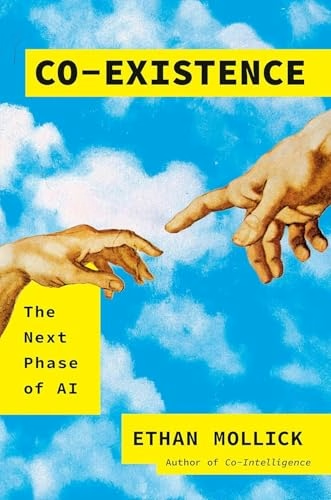
Ethan Mollick's Co-Existence: The Next Phase of AI arrives at a peculiar moment in our relationship with artificial intelligence. We're past the breathless speculation phase, yet we haven't settled into genuine understanding. Mollick, a Wharton professor and author of the widely-read One Useful Thing newsletter, positions this book as a practical guide to living alongside machines that are sometimes smarter than us—but here's where things get interesting: the book's greatest strength is also its most contentious weakness.
The Core Argument: Jagged Progress, Not Smooth Disruption
Mollick's central insight cuts through the noise that dominates AI discourse. Rather than presenting artificial intelligence as a monolithic force that will either save or destroy civilization, he introduces what he calls the "jagged frontier"—the uncomfortable reality that AI systems excel in narrow domains while failing spectacularly in others. A language model might outperform domain experts in specific technical tasks yet produce convincing nonsense moments later.
This framing represents a genuine contribution to popular AI literature. Unlike the smooth exponential curves that dominate mainstream tech commentary, Mollick acknowledges the uneven terrain we're actually navigating. AI can serve as tutor, collaborator, researcher, and strategist while simultaneously generating falsehoods and failing unpredictably. This honest assessment distinguishes Co-Existence from both utopian and dystopian narratives that have flooded the market since 2023.
Compared to similar works like "The Age of AI" by Henry Kissinger or "Artificial Intelligence Basics" by Tom Taulli, Mollick's approach feels more grounded in lived experience rather than theoretical projection. He writes from the frontline of rapidly evolving systems, not from the distance of speculation.
The Practical Framework: Centaurs, Cyborgs, and Conjurers
Mollick introduces a taxonomy for human-AI collaboration, categorizing interactions into distinct types. The framework attempts to help readers understand different modes of working with AI systems—from simple tool usage to more complex autonomous agent relationships. While conceptually tidy, this section reveals the book's first significant tension.
The categorization system provides helpful scaffolding for readers new to AI collaboration. However, for anyone already working extensively with these systems, the framework feels reductive. Real workflows rarely fit neatly into predetermined buckets. Users often shift between collaboration modes within a single project, adapting to the specific capabilities and limitations of the moment. The labels, while memorable, don't necessarily optimize how people actually integrate these tools into complex daily tasks.
Where the Book Delivers Real Value
Mollick excels at explaining how to think about AI rather than what to do with it. His guidance on distinguishing where human insight matters most—and where it doesn't—provides genuine utility. He addresses the psychological challenge of maintaining judgment and autonomy when working with systems designed to persuade and imitate. This psychological dimension often gets overlooked in purely technical treatments.
The book's discussion of how AI reshapes education, business, and everyday life demonstrates Mollick's ability to connect abstract technological concepts to concrete human consequences. His warnings about becoming overly dependent on systems designed to persuade deserve particular attention in an era of increasingly sophisticated AI interfaces. The writing maintains warmth and humor throughout, making complex ideas accessible without sacrificing nuance.
Mollick also correctly identifies that the challenge ahead isn't simply adopting new technology—it's learning how to think and work differently. This philosophical reorientation matters more than any specific prompt engineering trick or productivity hack.
The Obsolescence Problem: Where Practical Advice Breaks Down
Here's where Co-Existence stumbles significantly. Mollick acknowledges that much practical advice about interacting with AI will quickly age out. Techniques for prompt engineering, memory management, and system optimization change with each model update. Yet the book still dedicates substantial sections to these transient recommendations.
This creates a structural contradiction. Advice that Mollick himself admits will become obsolete within months shouldn't occupy prime real estate in a book designed for longevity. Most specific techniques for optimizing AI interactions can be discovered simply by opening a chat window and experimenting. Publishing static guidelines for a technology evolving at AI's pace practically guarantees immediate obsolescence—a problem Mollick identifies but doesn't adequately solve.
This weakness particularly impacts readers already comfortable with AI tools. For them, the instructional sections feel elementary, sometimes painfully so. The book would have benefited from either committing fully to evergreen principles or accepting that practical how-to content belongs in blog posts and newsletters rather than bound books.
The Durable Human Advantage Debate
Mollick argues that deep knowledge, wide knowledge, subjective taste, and agency will protect human relevance in an AI-augmented world. This thesis generates the most significant disagreement among readers. The counterargument—that AI is already overtaking domain expertise in ways that challenge even seasoned professionals—carries uncomfortable weight.
Consider the mathematician who struggles to verify AI-generated proofs, or the radiologist whose deep knowledge becomes primarily useful for checking machine outputs. Using expertise merely to validate AI work represents a fundamentally diminished role. Whether Mollick's optimism about durable human advantages will prove prescient or naive may only become clear in retrospect. For now, this tension remains genuinely unresolved.
Writing Style and Accessibility
Mollick writes with clarity and occasional warmth, making the book accessible to readers without technical backgrounds. He avoids unnecessary jargon while maintaining intellectual rigor. The prose moves efficiently, though some sections feel rushed, particularly when transitioning between conceptual frameworks and practical applications.
The book's structure works reasonably well, moving from foundational concepts to collaborative frameworks to broader implications. However, the pacing occasionally stutters when shifting from Mollick's strongest analytical work to more prescriptive guidance.
Who Should Read This Book
Perfect for: Business leaders and educators grappling with AI integration; people new to AI tools seeking philosophical grounding rather than technical tutorials; anyone wanting to understand the difference between AI hype and AI reality; parents and policymakers concerned about societal implications; professionals in transitional fields wondering how to position themselves.
Will likely disappoint: Advanced AI practitioners seeking novel technical insights; readers expecting definitive predictions about AI's future (Mollick explicitly avoids this); those wanting comprehensive how-to guides; skeptics unconvinced by arguments about durable human advantages; readers seeking either utopian or dystopian narratives.
The Verdict on Whether It's Worth Reading
Co-Existence is absolutely worth reading if you want to develop genuinely useful frameworks for thinking about AI collaboration. It's worth reading if you work in education or business and need to understand broader implications beyond your immediate domain. It's worth reading if you're tired of simplistic narratives about AI replacing or saving humanity.
It's less essential if you already spend significant time with AI systems and have developed your own working philosophies. The practical advice will feel obvious, and the conceptual frameworks may seem like unnecessary formalization of what you already know intuitively.
The book succeeds most as a philosophical and strategic guide rather than a practical manual. Judged by that standard, Mollick delivers genuine value. The weakness isn't in what he attempts but in the sections where he tries to be something he's not equipped to be—a guide to specific techniques in a rapidly shifting landscape.
Final Verdict
7.5/10 — Co-Existence offers genuinely useful frameworks for thinking about human-AI collaboration and avoids the hype that dominates popular AI discourse, but undermines its longevity with rapidly obsolescing practical advice and unresolved tensions about human competitive advantage.